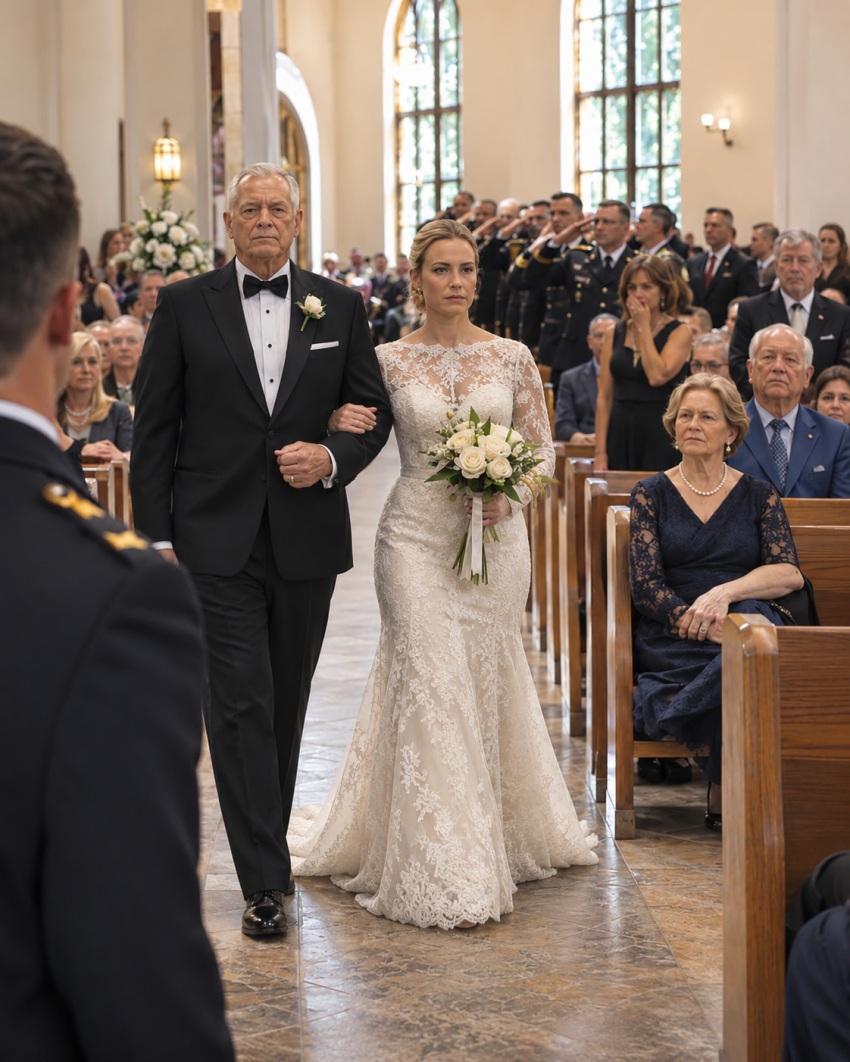
“Who gives this woman in marriage?” the chaplain asked.
The chapel held its breath. Two hundred people stood in a hush so complete that I could hear the old brass bells still humming faintly in the tower above us. Frank Hayes squared his shoulders. His hand, weathered and steady, tightened over mine.
Somewhere in the last row, a woman gasped.
“Her family does,” Frank said, in a voice that carried to the rafters. “Those who showed up.”
I should tell you who I am, because for thirty-two years my family had a version of me, and it stood in the back of photographs.
My name is Major Diane Miller. I’m thirty-two. I’m a signals intelligence officer, which means I spend my days listening to things people believe are private and deciding what they mean. It’s a useful job for a daughter like me. I learned to listen in a house where the important things were never said aloud.
My father, Colonel Richard Miller, retired, is sixty-four, a tall, silver-haired, ramrod man with a voice like a drill instructor’s and an unerring instinct for which child to look at. My mother, Donna, is sixty-one, a former school board member, brisk, polished, a woman who believes appearance is a moral category. My sister Vanessa is thirty, a public-relations consultant, blond, quick, magnetic, a person around whom rooms rearrange themselves.
I was the other one.
I told you, in that call on Tuesday, that I didn’t cry. That’s true. But I’d like you to know what I did instead.
I sat at my desk on base in Fort Belvoir, Virginia, with cold blue light washing across the monitors, and Captain Janette Collins beside me, and I listened to a recording.
It had started spreading that morning. An audio clip, seventy-one seconds long, posted anonymously on three local blogs and forwarded through the gossip channels that every military community has. A woman’s voice, low, smooth, edited. Her own father won’t walk her down the aisle. There’s a reason. Poor morals. They say the family disowned her.
The voice belonged to Khloe Sterling, Vanessa’s best friend, a publicist who once described herself on a podcast as “a reputation architect.” I’d met her four times. She’d complimented my haircut, and then asked whether it was regulation.
Janette had taken the headphones off. “It’s spliced,” she said. “Look at the waveform. Cuts at eleven, twenty-six, forty. Somebody took a longer conversation and kept the parts they liked.”
“I know.”
“We can prove it.”
“I know that too.”
Then my phone buzzed.
Dad.
For one foolish second, I thought he was calling to ask if I needed anything before Saturday.
I’ll tell you what he said, because I want you to have the record.
“I won’t be walking you down the aisle.”
I looked at the waveform. A neat green mountain range on a black screen.
“Why?”
A pause. I heard a rustle, a murmur, a woman’s voice, low and urgent, very close to the phone. Vanessa.
Dad cleared his throat. “Your sister feels overshadowed. She believes the ceremony has become too focused on your military career. We need to respect her feelings.”
“Her feelings.”
“Don’t use that tone, Diane.”
My mother’s voice came from further off, brisk and tight. “Just walk yourself. Don’t be selfish and ruin your sister’s feelings again.”
Again.
Three days before my wedding. Marcus’s mother had already flown in from Georgia. The caterers had been paid. The chapel had been reserved for eleven months. And my parents had weighed their daughter against their other daughter’s mood, and the scale had come down where it always had.
“Understood,” I said.
I ended the call.
Janette turned slowly in her chair. She’s forty-four, a compact, dark-haired woman with a scar through one eyebrow and a face that rarely moves. She looked at me for a long moment.
“Was that your father?”
“Yes.”
“He backed out?”
“He made his choice.”
It was nothing new. That’s the thing I need you to understand. It was only the newest.
When I was eighteen, I built an obstacle course in my parents’ backyard in Fairfax.
I did it with lumber I dragged out of a construction dumpster, a coil of rope, two railroad ties, and a borrowed post-hole digger. It took six weekends. I’d decided that I would earn a commission, and that I’d do it on my own, and that the Army wouldn’t be handed to me by a father’s name.
Every morning before school, at five-fifteen, I ran it. In rain. In sleet. In January, when the mud froze into ridges and my gloves stuck to the rope. I scaled a seven-foot wall until my palms bled.
Nobody came out to watch.
Ten miles away, Vanessa stood in a high school auditorium, under a spotlight, holding a trophy for public speaking. My parents sat in the front row and applauded. My mother had bought a silk dress for that six-minute speech. She cried. My father filmed it.
I’d like to say I didn’t mind. I’ve said it so many times it’s worn smooth.
My mother never once walked the forty steps from our kitchen to the backyard fence.
The day I was commissioned, a storm covered the parade ground.
It was May, a hard, cold, slanting rain that turned the grass to soup. Other families arrived with umbrellas, cameras, flowers, and balloons shaped like stars. After the ceremony, parents ran across the field toward their new second lieutenants, laughing, hugging them until dress caps fell into the puddles.
The parking space reserved for the Miller family stayed empty.
My uncle Robert watched from behind the bleachers, a stocky, quiet man in a rain-soaked windbreaker. He knew I’d just broken the installation’s eleven-year physical fitness record. He’d watched me do the final run. He didn’t say a word. I’d have liked him to.
My parents arrived forty minutes after the ceremony ended.
I stood in the rain, in my soaked uniform, with a single gold bar on each shoulder and mud to my shins. My father looked at the bars. He gave a short nod.
“Good job,” he said.
My mother looked at my boots.
“Honestly, Diane,” she said. “The mud. Why can’t you be more like Vanessa?”
Vanessa, I’d note, hadn’t come at all. She’d had a hair appointment.
Years later, my mother organized a dinner, supposedly to celebrate my promotion to major.
It was at a restaurant in Georgetown, a long, candlelit, white-tablecloth place with a private room upstairs. I arrived in a plain black dress, from the dry cleaner’s, with my dress uniform in a garment bag in the car in case someone wanted a photograph.
Above the doorway of the private room hung a gold banner.
Congratulations, Vanessa and Preston.
I stood and read it twice.
My promotion dinner had become my sister’s engagement party.
I’d like to describe the room. Thirty guests in cocktail clothes, a long table piled with flowers, a three-tier cake. Vanessa, in a pale pink sheath, holding up her left hand to a ring of admirers, a vast, square, glittering diamond. Her fiancé, Preston, a tall, smooth, pleasant man in a gray suit, with the practiced smile of someone who sells things. Khloe Sterling, in white, who looked me up and down, and murmured to a friend, “Is that a funeral dress?”
I sat at the far end, by the service door, with a glass of water.
Four-star General Arthur Vance, an old friend of my father’s, who’d come in his civilian clothes, rose halfway through dinner and tapped a glass. He’s a big man, white-haired, with a face like a granite quarry.
“To those who serve,” he said, “with courage and honor.”
Every officer in the room knew whom he meant. I felt it. A small ripple of attention, a turning of heads.
My mother waved a hand, laughing. “Oh, Arthur. Diane just runs little errands around the base. Nothing worth mentioning.”
Silence fell, for the briefest moment.
General Vance looked at her. Then he looked at me. He didn’t say anything. He simply lowered his glass, very slowly, and I saw something in his face that I’d seen once before, in a field hospital, in another country.
She doesn’t know, he was thinking. She doesn’t know what she’s got.
I should explain what my mother didn’t.
In 2019, in Kandahar Province, an insurgent mortar team hit our forward position during a night convoy. I was a first lieutenant. A shell struck the lead vehicle, and the world went white. When it came back, three of my teammates were down, and I was bleeding from a shrapnel wound in my left forearm.
I don’t remember deciding. I remember moving. I remember the weight of a man’s body across my shoulders, a young sergeant named Dominic Reyes, who’d been telling me about his daughter’s first tooth an hour earlier. I remember the sound of fire in the dark, and my own voice shouting coordinates, and a corporal named Gus Brandt, with a broken leg, saying, over and over, Ma’am, leave me, ma’am.
I didn’t.
I carried them out. All three. It took eleven minutes, and a hundred and forty meters, and a good deal of my own blood.
They gave me a medal for it. A Silver Star, in a small blue velvet box. I carry it, in my pocket, on most days. I’d never once, in my family’s presence, opened it.
My mother never asked what was inside.
I met Marcus Hayes at a forward operating base, in a place I can’t name, at two in the morning, in a plywood trauma bay with a flickering lamp.
He was a combat surgeon. A big, quiet, dark-haired man in scrubs, with his sleeves rolled to the elbows and a coffee stain on his chest. I’d come in with a teammate who’d taken a round to the thigh. Marcus looked at the wound. He looked at me.
“Sit down, Major,” he said. “You’re bleeding on my floor.”
“It’s not mine.”
“Some of it is.”
I looked down. He was right. My own arm was seeping, a slow, dark line, through a torn sleeve.
He stitched it without being asked. Eleven stitches. His hands, I noticed, didn’t tremble once, even when the generator coughed and the lamp went out and a distant explosion rattled the plywood. He worked by the light of a flashlight I held between my teeth.
“You’re good at this,” I said, around the beam.
“I’m good at staying calm.”
“Is that a skill?”
“It’s the only one that matters.”
He didn’t pretend to care. He didn’t make empty promises. He simply stayed. He sat with me for forty minutes, in the dark, drinking terrible coffee, and told me about his father, a retired master sergeant who built furniture in a garage in North Carolina.
I think I fell in love with him somewhere around the second cup.
Marcus took me to meet Frank in March.
We drove down from Fort Bragg in a rented sedan, through long, pine-lined roads, under a sky the color of dishwater. The house sat at the end of a gravel drive, in a clearing of loblolly pines, a small, low, white clapboard thing with a tin roof and a sagging porch. A chimney leaned slightly east. A beagle lay on the steps and didn’t get up.
Master Sergeant Frank Hayes, retired, came out of the garage wiping his hands on a rag.
He was seventy-one. A short, solid, stooped, weathered man with white hair cut to a quarter inch, and a face like old leather. His eyes were a pale, rinsed blue. He wore a flannel shirt and canvas trousers. He looked at me for a long moment, without a word.
“Ma’am,” he said.
“Sergeant.”
“Frank’ll do.”
“Diane.”
He shook my hand. His grip was dry, and hard, and brief.
“You hungry?”
I was. I’d been hungry for something, I think, for thirty years.
The garage had been converted into a woodworking shop.
It smelled of sawdust, machine oil, and fresh-cut oak. Long benches ran down both walls, strewn with chisels, planes, clamps. A table saw squatted in the middle, under a hanging lamp. Shavings lay in drifts on the concrete.
And on the walls, in plain black frames, hung photographs.
I stopped in front of them.
They were snapshots, mostly. Faded, creased, curling at the corners. Young men in fatigues, squinting into hard white suns. A line of them on a sandbagged wall, arms around each other’s shoulders. A man with a bandaged head, grinning. A wide, flat landscape of red dust.
“Those are mine,” said Frank, behind me. “The ones who came home.”
“And the others?”
He didn’t answer for a moment.
“The ones who didn’t,” he said, “are in the second row.”
I looked. Beneath the first line of frames hung a second. Smaller. Fewer. Each held a name, written in pencil on a strip of masking tape. Pruitt. Okafor. Delgado. Brandt. Eleven of them.
“You keep them here.”
“Somebody ought to.”
Frank didn’t display his commendations. I learned that on my second visit. He kept them in a shoebox on a closet shelf, with a rubber band around it, under a pile of old tax returns. When Marcus once, shyly, asked to see them, Frank said, “They’re just ribbons, son.”
Marcus said, “Dad. You’ve got a Distinguished Service Cross.”
“It’s a piece of metal.”
“It’s for carrying nine men out of a river.”
“Seven,” said Frank. “Two of them walked.”
I watched him build a cabinet.
I was there for most of June, on leave, in a spare room with a creaking iron bed. In the mornings, I’d drink coffee on the porch with the beagle. In the afternoons, I’d sit on a stool in the shop, with a mug of cider, and watch.
He built it from white oak. A solid, plain, square thing, with a glass front, and a drawer below, and joints cut by hand. He’d lay a board on the bench, and mark it with a pencil, and run a plane along it with a long, patient, whispering stroke. The curls of wood fell like ribbons. The smell was sweet, almost like bread.
“What’s it for?” I asked, one afternoon.
“Haven’t decided.”
I knew he was lying. I didn’t say so.
When it was finished, a week before I left, he stood it against the wall, and wiped it down with a rag, and stepped back. He didn’t say anything. He picked up a small chisel, and bent, and, in the lower left corner of the frame, carved two letters.
I stood very still.
DM.
My initials.
“A case,” he said, gruffly. “For your medals.”
I couldn’t speak.
“I figure,” said Frank, “if your own people can’t look at ’em, a man ought to build you somewhere to put them.”
I put my hand against the cabinet. The oak was cool, and smooth, and faintly warm, as if he’d held it.
I thought of a velvet box, in my pocket. Of a mother who’d never asked.
He spent weeks on this, I thought. And never told me.
It was in that garage that he noticed my arm.
I’d rolled my sleeves, in the heat. A long, pale, puckered scar ran from my wrist to my elbow, with eleven small dots on either side, like stitches in a piece of cloth.
Frank looked at it. He put down his plane.
“Where’d you get that?”
“Kandahar.”
“Mortar?”
“Yes.”
“You get anybody out?”
I hesitated. I’d never said it aloud. In the whole of my adult life, I’d never once told a person who hadn’t been there.
“Three,” I said.
He nodded slowly.
“You protected others,” said Frank. His voice was low and rough. “That means you fulfilled your duty as a soldier.”
I’d like to tell you what happened.
Something inside me, something old and clenched and braced, a muscle I’d held rigid since I was a girl, simply gave way. I felt it go. A quiet, enormous release, like a long-held breath.
It was the first time a father figure had looked at me with unconditional respect.
I turned and walked out of the shop, into the pines, and stood with my back against a tree, and wept. Not loudly. Not for long. But for a good while, in the hot, resinous, humming air, with a beagle leaning against my knee.
When I came back in, Frank was planing a board. He didn’t look up.
“Coffee’s on,” he said.
Marcus proposed in August, in the garage.
He did it badly. He’d planned a dinner, and a ring in a champagne flute, and lost his nerve, and instead asked me, over a sawdust-covered workbench, with a cup of burnt coffee in his hand.
“Diane. I don’t have a speech.”
“Good.”
“I just. I’d like to be the person who stays.”
I looked at him. At the tired eyes, the stubble, the long surgeon’s fingers.
“You already are,” I said.
Frank, at the lathe, with his back to us, very carefully did not turn around. But I saw his shoulders move. When I said yes, he switched on the lathe, and let it run for a long time.
Which brings us back to Tuesday, and a phone call, and a desk.
After my father hung up, I sat for a minute with my hand on the receiver. Janette didn’t speak. She watched me, with her scarred eyebrow lifted. In the silence, a printer hummed. Somewhere down the corridor, a door closed.
“Major,” she said, finally. “What do you need?”
“A car.”
“For?”
“North Carolina.”
She stood. She picked up her cover. “I’ll drive.”
I’d like to tell you what that meant. I’d known Janette for six years. She was the kind of officer who never offered anything she wasn’t prepared to deliver. In all that time, she’d never once said I’m sorry. She’d just said, I’ll drive.
We drove four hours, in silence, down I-95, through a gray, flat, sodden afternoon. At dusk we turned onto a gravel road between pines. The garage light was on.
The table saw was humming when I opened the door.
Frank switched it off.
He pushed his goggles up onto his forehead. A fine layer of oak dust covered his forearms and clung to his white eyebrows. He looked at me, and at Janette, in the doorway, in her flight jacket, and he wiped his hands on a rag, and waited.
I gave him the facts. I didn’t soften them. I stood in the middle of the shop, among the shavings, with my cover in my hand, and I told him.
My father had withdrawn. My mother had supported him. Vanessa had demanded it, because she felt overshadowed. A woman named Khloe Sterling was circulating an edited recording, suggesting I’d been disowned for poor morals. The wedding was Saturday. Two hundred guests. A chapel full of generals.
“I need someone beside me,” I said. “On Saturday.”
My voice didn’t shake. I’d decided it wouldn’t.
Frank set down the rag.
He looked at me for a long, quiet moment. His pale eyes were steady. Behind him, the photographs hung in their rows, the living and the dead.
“Whenever you need me, daughter,” said Frank Hayes.
Four words.
More than my own father had said to me in thirty-two years.
I nodded once. I turned, and walked out into the dark yard, before my voice could break, and stood under the pines, and breathed.
I should tell you about the letter.
On Friday night, I was in my apartment, in a half-packed kitchen, with a cup of tea going cold, when someone knocked.
It was a small, thin, white-haired woman in a navy coat. She stood on my landing with a purse clutched against her chest. I’d never seen her before.
“Major Miller?”
“Yes.”
“My name is Ruth Kellerman.” Her voice was thin and papery and perfectly clear. “I was your grandmother’s neighbor. For forty years.”
I stared.
My grandmother, Eleanor Miller, my father’s mother, had died six years ago, in a nursing home in Roanoke. A tall, stern, gentle woman, with a cane and a laugh like dry leaves. She’d been the only person in the family, apart from Uncle Robert, who’d ever come to a school event of mine.
“She asked me,” said Mrs. Kellerman, “to give you this. After she was gone. But when the time was right.”
She opened her purse. She took out a plain white envelope. It was soft with age, and yellowed at the corners, and sealed with a single strip of tape. On the front, in a shaky, upright, familiar hand, a single word. Diane.
“I thought,” said Mrs. Kellerman, “that it might be now.”
I took it.
I opened it in my bedroom, alone, on the edge of the bed.
One sheet. Lined paper. Three paragraphs, in blue ballpoint. Her handwriting had been bad, at the end. The letters wavered. But I knew it. I’d have known it blind.
Diane,
I’ve watched you for thirty years, and I’ve never said what I should. I’m saying it now, while I still can hold a pen.
Your father is a good man who was raised to believe love was a thing you earned by being easy. He couldn’t love you, because you were never easy. You were something harder and better. You were true.
I have loved you since you were four and hid under the porch with a stray cat and refused to come out for supper. You told me, “He’s scared, Gran. I’m not leaving him.” I thought: that’s my girl.
I had to stop. I pressed the back of my hand against my mouth.
Don’t wait, the last paragraph read, for a coward to knight you. Crown yourself.
Your Gran.
I read it three times.
I folded it carefully, along the old creases. I put it in the small black clutch beside my military ID and a photograph of a small blue velvet box.
Saturday dawned bright and clear.
I’d like to tell you I slept. I didn’t. I lay in my apartment, in the dark, listening to the radiator tick, and thinking about a girl in a backyard with a rope. At five, I rose. I showered. I put on my dress uniform, the one I’d laid out the night before: the dark blue coat, the white shirt, the ribbons in their neat, ordered rows.
I pinned on the Silver Star last.
It’s a small thing, a gold-and-silver star, on a red, white, and blue ribbon. It weighs almost nothing. I held it in my palm for a long time, in the thin gray light of a Virginia dawn.
Nobody’s ever asked what’s in the box, I thought.
I pinned it over my heart.
More than two hundred guests filled the base chapel.
It’s a handsome building, white-steepled, with arched windows and long oak pews. The bell, a bronze thing cast in 1943, hung in a small tower above the entrance. Flowers lined the aisle, white lilies and blue delphiniums, which Marcus’s mother had insisted on. A flag stood at the altar. Autumn sun streamed through the clear glass and lay in long gold bars on the floor.
I knew them all, from the vestibule, through a crack in the door.
Generals. Colonels. Majors. Captains. Combat veterans in dress blues, wives in good wool suits, children in clip-on ties. General Vance, silver-haired and imposing, in the third row, with his hands folded over his cap. Janette, at the aisle, in her service uniform, with her scar and her sharp eyes. Dominic Reyes, the sergeant I’d carried out of the dark, now a captain, with a toddler on his knee.
And in the last row, to my astonishment, the Millers.
I hadn’t expected them. My father had said, quite plainly, they wouldn’t attend. But they sat, in a stiff, neat line, at the back of the chapel, near the exit. Richard, in a charcoal suit, with his jaw set. Donna, in navy, with a small, tight, social smile. Vanessa, in a pale silk dress that cost more than my first car, scanning the room with quick, bright, hungry eyes, as if searching for cameras.
Beside them sat Khloe Sterling, with her phone. And Uncle Robert, alone, at the end, in a rumpled tweed jacket, with his hat in his lap.
They hadn’t come to support me. They’d come because the whole base was asking why Colonel Miller had refused to walk his daughter down the aisle.
Appearances, I thought. Of course.
I’d like to describe the vestibule.
It was a narrow room, with a stone floor and a rack of hymnals, and a tall double door of dark oak. A single lamp burned on a table. Beyond the door, I could hear the murmur of the crowd, and the organ, soft, humming a low note.
Frank stood beside me.
He’d come that morning from North Carolina, in the rented sedan, with a garment bag over his shoulder. He’d changed in the vestry. And I’d come out into the hall and found him, and stopped.
I’d never seen him in uniform.
It was an old one, a dress blue coat with brass buttons, pressed to a razor edge, and hanging a little loose on his frame. A row of ribbons ran across his chest, four deep. A Distinguished Service Cross. A Silver Star, with two oak-leaf clusters. A Bronze Star with a V. A Purple Heart. A Combat Infantryman Badge. The ribbons were faded, a little frayed. He’d pinned each one himself, with a steady, spotted hand.
His white hair was cropped. His shoes shone like black glass. He stood very straight, with his hands at his sides, and his weathered face perfectly calm.
“Sergeant,” I said.
“Frank.”
“You look.”
“Old.”
“Magnificent.”
He laughed, a short, dry, startled bark.
“Don’t start,” said Frank.
The organ shifted. A long, low, rolling chord. The doors, I knew, would open on the second bar.
I took a breath.
I thought of a girl in a backyard. A girl in the rain. A voice on a phone. Just walk yourself.
“Are you ready?” said Frank.
“I’ve been ready.”
“For what?”
“For somebody to ask.”
He looked at me, with his pale, rinsed, steady eyes.
“I’m asking,” he said.
He held out his arm.
I took it.
The doors swung open.
I’d like to describe what I saw, because I’ve never forgotten it.
Sunlight flooded the aisle. A long, gold, blazing wash of it, pouring through the arched windows, striking the white lilies and the polished oak and the old stone floor. The organ rose, full-throated, glorious. Two hundred faces turned.
I stepped forward.
I wore my dress uniform. Every decoration was carefully arranged across my chest, in neat rows, and over my heart, a small, bright, silver star. My cover was tucked under my left arm. My hair was pinned. My back was straight.
At my side walked a short, stooped, white-haired man in a faded dress blue coat.
His hand rested firmly over mine. His steps matched my cadence, perfectly, without a hitch.
Left.
Right.
Left.
I’d like to tell you what happened in the last row.
My father’s face changed.
I saw it from forty feet away. He’d been sitting, ramrod straight, with his jaw clenched and his eyes on the doors. When they opened, he looked, as one does, for his daughter, expecting, I think, a lone figure. A woman walking alone.
He saw Frank.
I watched the color leave his face. It went in a slow tide, from the forehead down. His lips parted. His eyes, a hard, clear, military gray, went to the ribbons. Then to the face.
He knew who it was.
I don’t know how. I’d never told him. But my father had been an officer for thirty-one years. He knew a Distinguished Service Cross. He knew what it meant to carry nine men out of a river.
“Frank Hayes,” he whispered.
Beside him, Vanessa’s smile vanished. Khloe lowered her phone.
It was General Vance who rose first.
He stood from the third pew, with a sudden, deliberate, thunderous scrape of his boots. He stood at attention. His heels struck the stone floor with a crack like a rifle shot.
The chapel went silent.
Another general stood. Then two colonels, with a scrape and a rustle. Then, in a rolling wave, a whole row of officers. Then the row behind. They rose with a low, collective thunder, the whisper of wool, the creak of leather, the click of shoes, until the entire left side of the chapel was on its feet.
I understood, slowly, what I was watching.
They knew him.
Several had served beside him. Others had read his name in the dusty histories of the regiment. Others knew only the story, the one that had traveled through the ranks for decades, the story of a master sergeant who’d waded into a flooded river in the dark, under fire, and carried nine of his men to the far bank, one at a time, and then, bleeding, carried the tenth.
“Who is that?” a small voice asked, near the aisle. A child’s.
“Hush,” said his mother. “That’s Master Sergeant Hayes.”
As Frank approached, the officers nearest the aisle drew themselves up. A colonel, a lean, gray, hawk-nosed man, raised his hand in a slow, solemn salute. Then a major. Then a captain, and another.
Others simply stood, in respect. The civilians, the wives, the old men with canes, in turn, rose, with a growing roar of movement.
Within seconds, nearly two hundred people were on their feet.
Not because protocol required it.
Because they knew exactly who was walking beside me.
I walked.
I’d like to tell you what it felt like. It’s difficult. I’d walked, in my life, across parade grounds and through deserts and down the long, dim corridors of three continents. I’d never walked a path like that.
The aisle was forty steps. I’d counted, in rehearsal. I counted again. Beside me, Frank’s hand lay light and warm on my arm, and I could feel, through his sleeve, a faint tremor. He wasn’t nervous. He was moved.
Fourteen.
Fifteen.
I looked left. General Vance, with his hand at his brow, tears running openly down his granite cheeks. I looked right. Janette, at attention, her scarred eyebrow lifted, her mouth set in a hard line. Dominic Reyes, with his toddler on his shoulder, saluting with the other hand.
Twenty-two.
Twenty-three.
At the altar, Marcus waited.
He stood in his dress uniform, in the gold light, with his hands clasped behind his back. His dark hair was neatly combed. His face, which I’d seen calm in a trauma bay at two in the morning, was wet.
He didn’t wipe it. He simply watched me come.
I’d like to tell you about the last row.
My father had risen. I saw it, as I passed. He’d remained seated for one stunned moment, a gray, rigid figure with his hand gripping the pew in front. Then, slowly, as if lifted by a rope, he stood.
His face was gray. His jaw hung slightly open. He looked, I thought, ten years older, and a very long way from home.
Beside him, my mother stared. Her mouth had formed a small, tight circle. The speech she’d prepared, I understood, about family unity, had evaporated.
Vanessa had gone white.
Not pale. White. She stood with her hand at her throat, and her designer dress hanging off her shoulder, and her eyes enormous, searching the chapel for a camera that wasn’t there. Khloe Sterling, at her elbow, was staring at a phone that had gone blank.
And at the end, in his rumpled tweed, Uncle Robert had stood, too. A stocky, silent man, with his hat held to his chest. He met my eyes, over forty feet of polished oak.
He nodded.
I nodded back.
Twenty-nine.
Thirty.
We reached the altar.
The organ faded. A long, shimmering silence filled the chapel. Dust turned in the light. Somewhere in the bell tower, a pigeon cooed.
The chaplain stepped forward. He was a tall, thin, stooped man named Reverend Okafor, in a white surplice, with a gentle, lined face and a voice like warm gravel. He opened his book. He looked at us.
“Dearly beloved,” he said. “We are gathered here.”
I didn’t hear the rest.
I heard my own pulse. I heard the faint whisper of Frank’s breath. I stood in the gold light, in my uniform, with a silver star over my heart, and I thought of a velvet box that no one had asked about.
At the proper moment, the chaplain lifted his eyes.
“Who gives this woman in marriage?”
I felt Frank’s hand tighten over mine.
He stepped forward, a half pace. He drew himself up, a short, solid, old man in a faded coat, with his chin lifted and his shoulders square. His voice, when it came, was low and rough and perfectly steady. It carried to the rafters.
“Her family does.”
He paused.
“Those who showed up.”
I heard the gasp.
It came from the last row. A single, sharp, shocked intake of breath. It was my mother’s. She’d put a hand over her mouth.
I’ll tell you what happened next, because it’s the part I’ll keep.
Nobody moved.
For a long moment, the entire chapel held still. Then, from the third pew, General Vance, who hadn’t sat, who’d stood at attention through the whole of it, took one step into the aisle.
He turned. He faced the last row.
I’d like to describe his face. It was a great, white-haired, granite thing, creased by sun and war. His eyes, a pale, hard blue, held my father’s.
“Richard,” he said.
His voice wasn’t loud. It didn’t have to be.
“I told you in Georgetown. Your daughter is the finest officer I’ve served with in thirty years.”
My father said nothing.
“I told you she’d earned a Silver Star. I told you she carried three men out of a mortar line with a hole in her arm. I told you, at that dinner, in front of your wife.”
“Arthur.”
“And you let Donna wave it off.”
My father’s mouth worked.
“I’d have given a good deal,” said General Vance, “to have a daughter who’d walk a path like that. And you stayed home because your other girl felt overshadowed.”
A deep, cold silence.
“I’m sorry,” said the general, “that you’ll never understand what you missed.”
I should tell you I didn’t enjoy it.
I’d like to say I did. I’d imagined it, on the long nights in the field, lying awake with a flashlight and a book. A great, clean, burning vindication. My father, laid low. My mother, silenced.
What I felt, instead, standing at the altar in my dress uniform, was a vast, quiet, aching sorrow.
I looked down the long aisle, at a gray-faced man in a charcoal suit, standing alone in the last row, with two hundred officers watching. He was sixty-four. His hands, hanging at his sides, were shaking. I saw it clearly, from the front of the chapel. They shook like leaves.
He’s frightened, I thought. He’s been frightened my whole life.
Of what?
I knew the answer. I’d always known it.
Of a daughter who didn’t need him.
“Please,” said Reverend Okafor, gently. “Let us continue.”
We did.
I won’t give you every word. We said our vows. Marcus’s voice cracked on always. Mine didn’t. I’d promised myself it wouldn’t. He slid a plain gold band onto my finger, with a hand that trembled, and I slid one onto his, and the chaplain pronounced us husband and wife, and the whole chapel, nearly two hundred people, erupted.
I’d never heard anything like it. A great, rolling, joyous roar, with whistles and stamping, and somebody shouting Hooah! from the back. Marcus kissed me. He tasted of salt. We pressed our foreheads together, and he whispered, in a voice choked with laughter and tears:
“You did it.”
“We did.”
“You crowned yourself.”
I pulled back. “How did you know?”
“Frank told me,” said Marcus. “Last night.”
I looked across at the old man, standing with his cap in his hand, a small, solid figure at the foot of the altar. He wasn’t looking at us. He was looking at the floor. His shoulders, I saw, were shaking.
I went to him.
I took both his hands. They were dry and hard and warm, with a faint sweet smell of oak.
“Frank.”
“Don’t,” he said. His voice cracked. “I’m fine.”
“Thank you.”
“For what?”
“For asking.”
He lifted his eyes. They were swimming.
“Daughter,” he said. “I’d have been honored to be asked.”
The reception was held in the officers’ club, in a long, low hall with a dance floor and a view of the river. There were round tables, and candles, and a three-tier cake with a sugar sword. A string trio played something by Vivaldi. Waiters in white jackets moved among the crowd with trays of champagne.
I’d like to tell you about my family.
They came. I want to be clear. They came, across the lawn, in the late gold light, and stood at the edge of the hall like a delegation. My father first, in his charcoal suit, with his hands clasped before him. My mother, a half step behind, with her chin up. Vanessa, pale and drawn, with her arms wrapped around herself. Khloe, discreetly, nowhere.
I saw them from across the room. I was standing by the cake, with a glass of champagne, with Marcus’s arm around my waist. Frank sat nearby in a folding chair, with a plate of ham and a cup of coffee, being gravely saluted, at intervals, by a stream of old soldiers.
My father crossed the floor.
I’d like to tell you it was graceful. It wasn’t. He walked as though he were wading, with his shoulders hunched and his eyes on the parquet. The crowd parted for him, with a faint, hushed, curious murmur. He stopped, a yard from me.
“Diane.”
“Dad.”
His face was gray. A muscle jumped in his jaw. He looked, in the soft light of the candles, remarkably like my grandmother.
“May I speak with you?”
“You may.”
“Alone.”
“No,” I said.
He flinched.
“Whatever you have to say,” I said, as gently as I could, “you can say in front of my husband.”
He swallowed.
I watched his Adam’s apple move. I watched his hands, which had been clasped, open and close. For a long moment, he said nothing at all.
“I was a coward,” said Richard Miller.
The words came out raw, in a whisper. I don’t think he’d practiced them.
“I told you Vanessa felt overshadowed. That wasn’t, that was a lie.” He pressed the heel of his hand against his eye. “It was me. I felt overshadowed.”
I held very still.
“You were, you’ve always been, I didn’t know how to.” His voice broke. “I’m a colonel. I spent thirty-one years in uniform. And I looked at my daughter, and she was a better soldier than I’d ever been. And I couldn’t.”
“Dad.”
“I couldn’t stand it.”
“I know.”
“You know?”
“I’ve known since I was eighteen.”
He stared at me.
“I built the course in the backyard,” I said, “because I wanted you to watch. I thought, if I did something hard enough, you’d come out. And you didn’t.” My voice was steady. “I stopped waiting around twenty-two.”
“I’m sorry.”
“I know you are.”
“I’m so sorry, Diane.”
He was crying. I’d never seen it. A tall, gray, stooped man, in a charcoal suit, with tears running openly down his lined cheeks. He didn’t wipe them. He stood there, in the middle of an officers’ club, shaking.
I looked at him for a long time.
I thought of my grandmother. Your father is a good man who was raised to believe love was a thing you earned by being easy.
“Dad,” I said. “I’d like to tell you something.”
“Anything.”
“I’m not going to say it’s all right.”
“I know.”
“It isn’t.”
“I know.”
“But I’m going to say something else.” I took a breath. “I wasn’t walked down that aisle by a coward. I was walked by a man who builds cabinets. And I’m not ashamed of either of you.”
He flinched. He nodded, very slowly.
“I’d like to know him,” he said, hoarsely. “Frank. If he’d, if it’s possible.”
“Ask him.”
“I don’t know how.”
“Neither did I,” I said. “I just started.”
I’ll tell you what happened with Vanessa.
She’d come last. She stood at the edge of the dance floor, in her pale silk, alone, with her arms wrapped around her ribs. She looked about nineteen. She’d been crying, I could see, for a good while, and had tried to hide it, and hadn’t managed. Her mascara had run in two gray lines.
“Diane,” she said.
“Vanessa.”
“I don’t, I don’t know how to.”
“Then don’t.”
“I do. I have to.” She laughed, a thin, wet, cracked sound. “I’ve never once in my life said it.”
I waited.
“I’m sorry,” said Vanessa. “I’m so sorry. I’m, I’ve been jealous of you since I was nine.”
I stared.
“Of me?”
“You were real.” She pressed her fingers to her mouth. “You did things. You, you climbed a wall. You jumped out of a plane. You came home with a, with a scar. And I stood on a stage and said somebody else’s words.”
“You were good at it.”
“I was adequate. At a thing nobody cared about.” Her voice cracked. “And they clapped. And I knew. I knew they weren’t clapping for me. They were clapping because it was easy.”
I put down my glass.
“Vanessa,” I said. “Look at me.”
She did.
“I wanted to be you,” I said.
She blinked.
“I wanted, God. I wanted someone to buy me a silk dress.” I laughed, shakily. “I wanted to stand in front of a room and have my mother cry.”
Her face crumpled.
“I used to watch you,” I said. “From the doorway. Practicing your speech in the mirror. I thought, ‘She’s so, she’s so easy. They love her without trying.’”
“It wasn’t easy.”
“No?”
“It was terrifying.” She was sobbing now. “Every time. I was so afraid I’d, that I’d stop being what they wanted.”
“And I was afraid,” I said, “that I’d never be.”
We stood there, two grown women in good dresses, in the middle of a dance floor, weeping.
She put her arms around me.
It was awkward, and stiff, and it smelled of expensive perfume, and I held her, a thin, trembling, blond girl, against my uniform, and felt, for the first time since I was eight, my sister’s heart beating against my own.
I’d like to tell you my mother said something.
She didn’t. Not then. She stood at the edge of the hall, in her navy dress, with her hands twisted in front of her. She’d been watching. I’d seen her, over Vanessa’s shoulder. She’d come a few steps forward, and stopped, and started again.
At last she came, and stood in front of me, and for a long time she simply looked.
“Diane,” she said.
“Mom.”
Her voice was thin. “The medal.”
I touched it. The small silver star, over my heart.
“What is it?”
I’d waited thirty years for that question.
I took it off. I unpinned it, with a steady hand, and laid it in her palm. It was small and cold and light. She held it as if it might burn.
“It’s a Silver Star,” I said. “For Kandahar.”
“What happened in Kandahar?”
I looked at her.
“Do you want to know?”
“Yes.” Her voice cracked. “God. Yes. I should have asked.”
I told her.
It took eleven minutes. I told her about a mortar, a night convoy, a wounded sergeant, three men in the dark. I told it plainly, without ornament, standing in the middle of an officers’ club, with a hundred conversations flowing around us. She listened. She didn’t interrupt. By the end, she was crying so hard she couldn’t speak.
“I’m so sorry,” she whispered. “I’m so sorry. I’m so sorry I never asked.”
“I know.”
“I said, I said errands.”
“I know what you said.”
“I’m the worst mother in the world.”
“You’re not.” I took the medal gently from her hand. I closed her fingers over my own. “You’re a mother who didn’t know how to look.”
She nodded, with her whole face.
“Will you teach me?” she said.
“To look?”
“To ask.”
I thought about it. I gave the question the respect it deserved.
“Start Sunday,” I said.
I’ve been married two years.
Marcus and I live in a small brick house in Fayetteville, ten minutes from Frank. It has a porch, and a sagging gutter, and a garage that smells, now, like oak. Frank spends most weekends there, in a paint-stained apron, building things. He’s made us a table. A bed frame. A cradle, for a baby due in April.
The cabinet stands in our living room, against the east wall. White oak, glass-fronted, with two initials in the corner. Inside, on a bed of blue velvet, a silver star shines. Beside it, a Bronze Star. A Combat Action Badge. A commendation, framed. And, at the bottom, behind a pane of glass, a small white envelope, soft with age.
Diane.
I don’t read it often. I don’t need to.
My father drives down on the first Sunday of each month. He’s learned the route. He arrives at noon, in a gray Buick, with a bag of oranges, because he’d heard Frank liked them. He’s taken to standing in the doorway of the garage, awkwardly, with his hands in his pockets, watching an old man plane a board.
It took him four visits to speak.
“Master Sergeant,” he said, finally.
“Frank.”
“Richard.”
“Colonel.”
“Retired.”
“Likewise.”
Frank didn’t look up. A long curl of oak fell, whispering, from the plane. “You want to hold the other end of this?”
My father hesitated.
I was standing at the kitchen window, with a dish towel, and I saw him cross the concrete. A tall, stooped, silver-haired man, in a pressed blue shirt. He knelt, in his good trousers, in the sawdust, and took the end of a board in both hands.
“Steady,” said Frank.
“I’m trying.”
“Don’t try. Just hold.”
They worked for an hour. Neither said a word.
At the end, my father stood. He brushed off his knees. He looked at the plank, a long, smooth, golden length of oak, and then at Frank.
“It’s beautiful,” said Richard Miller, hoarsely.
“It’s a board.”
“It’s, it’s very well made.”
“It’ll do.”
I put my hand over my mouth.
My mother calls on Sundays.
Not to chat. To ask. She’s taken it as a discipline, like a woman learning a language. How was your week? she says. What did you do? And then, because she’s honest, I don’t know what to say next.
“Ask me what it was like,” I told her, last week.
“What what was like?”
“Anything.”
A long pause. I could hear her breathing. I could hear, faintly, a clock, and the soft clink of a teacup.
“Diane,” she said. “What was it like, the obstacle course?”
I sat down on the porch step.
“Cold,” I said. “And lonely. And I loved it.”
“Why?”
“Because nobody told me I’d fail.”
I heard her draw a long, shaky breath.
“I’d like to see it,” she said. “If it’s still there.”
“It’s gone, Mom.”
“Oh.”
“But I could build you another.”
She laughed, a startled, damp, bright sound.
“I’d like that,” said my mother.
Vanessa visited in October.
She came alone, in a plain gray coat, with a paper bag. She stood on our porch, with her blond hair pulled into a ponytail, and no makeup, and a face that looked, to my astonishment, entirely at peace.
“I brought you something,” she said.
It was a small, flat package, in brown paper, tied with string. I opened it on the kitchen table.
A photograph. In a plain wooden frame.
It was black and white, creased, with a faded corner. A girl of eight, in a tattered T-shirt, standing at the edge of a muddy field, with a coil of rope over her shoulder and a grin on her face. Behind her, a crooked wall of scrap lumber. A rusted bicycle. A sky like a sheet of iron.
“I found it in Mom’s attic,” said Vanessa. “In a shoebox. She’d taken it. She’d, she must have, from the kitchen window.”
I stared.
“She kept it?”
“For twenty-four years.”
I turned it over. On the back, in my mother’s neat, upright hand, a date. And beneath it, three words.
My brave girl.
I put my hand flat on the table.
“I don’t think she knew how to say it,” said Vanessa, softly.
“No.”
“I think she was afraid.”
“Of what?”
“That you’d stop.”
I looked at the picture. At a muddy girl with a rope.
“I didn’t,” I said.
“No,” said my sister. “You never did.”
I think about the chapel, some mornings.
I sit on the porch, with a cup of coffee, at dawn. The pines are wet. A mist lies in the low places. Frank’s truck is in the drive, and the garage light is on, and I can hear, faintly, the whisper of a plane.
I think about an aisle, forty steps long. A hand on my arm. A voice, low and rough. Her family does. Those who showed up.
I used to think a family was a thing you were born into. A fixed point. A parade ground you were told to stand on.
I don’t think so now.
I think a family is a thing you walk toward. One step at a time, in cadence, with whoever’s willing to match your stride. Left. Right. Left.
Don’t wait for a coward to knight you, my grandmother wrote. Crown yourself.
I did.
But I’d add, now, in a smaller hand, beneath her line, what I’ve learned since. That the crown is only the beginning. That the best part comes after, when a man in an old blue coat takes your arm, and a hundred strangers stand, and somewhere in the back, a long, locked door begins, very slowly, to open.
I finish my coffee. I go out.
The garage smells of sawdust and cold.
“Morning, daughter,” says Frank.
“Morning.”
“Hold the other end?”
I take it.
“Steady,” he says.
I don’t try.
I just hold.