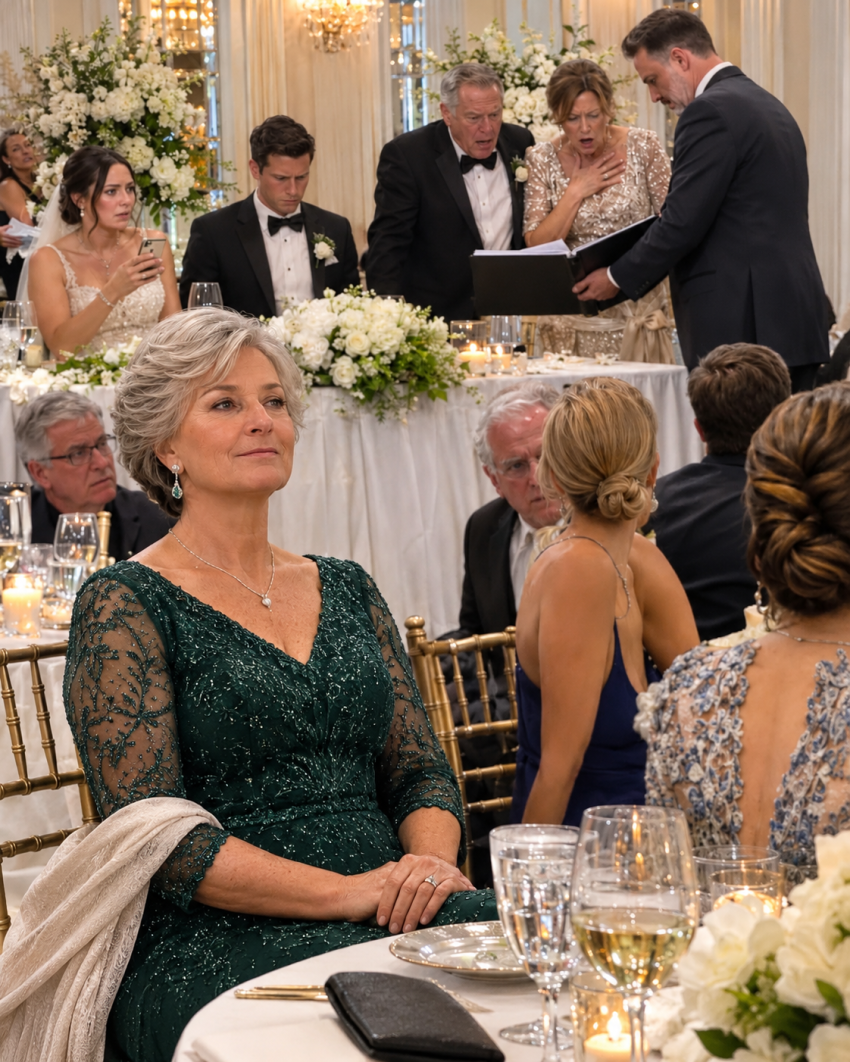
Dennis Pruitt looked down at the first page. His grin was still on his face, the way a porch light stays on after everyone has gone to bed.
The page was a payment ledger on the Harrison Estate’s letterhead. At the top, in bold: ACCOUNT HOLDER: MARGARET A. HOLLIS. Below it, a column of dates and a column of figures. Deposit, $8,000. Venue balance, $16,000. Catering, $18,500. Bar, $6,200. A running total, in red, at the bottom.
$61,014.60. PAID IN FULL.
“Sir,” said Marcus, gently, “would you like to read the name on the account?”
Dennis read it. Then he read it again. The glass in his hand tipped, and a thread of champagne ran down his sleeve.
At the back of the ballroom, the string quartet that I had paid for stopped in the middle of a bar.
I should tell you who I am, because for two years my son’s future in-laws had a version of me, and it was convenient.
My name is Margaret Hollis. I’m sixty-six. I was a dental hygienist in Dayton, Ohio, for thirty-one years, which taught me two things: people will tell you the truth with their mouths open, and nobody has ever once thanked me for a cleaning. My husband, Ray, was a mail carrier with a bad knee and a worse sense of humor, who died six years ago in February, of a heart attack, on the front walk, with a bundle of catalogs in his arm. I found him when the coffee went cold.
Ray left me the house, a pension, and a life insurance policy for $140,000 that I put in a CD at the credit union and swore I would never touch. He also left me Tyler.
Tyler is thirty-one, a high school band director, a gentle, tall, rumpled man with Ray’s jaw and a talent for apologizing in advance. I raised him mostly alone, after the insurance went to the funeral. I paid for his trumpet, his music degree, and his first apartment. I never kept score.
I’d like to say that was virtue. It was habit.
Brooke came into his life three years ago, at a charity auction. She is twenty-nine, a marketing coordinator, lovely and quick, with a smile that photographs well from every angle. Her parents, Dennis and Lorraine Pruitt, live in a big beige house on a lake outside Cincinnati. They have a pontoon boat named Second Wind. Dennis sells commercial real estate. Lorraine chairs a hospital auxiliary and has strong opinions about napkins.
They’ve never been unkind to me. They’ve simply talked over me, slowly, the way you talk to a person you assume is hard of hearing. At the engagement party, Lorraine introduced me to a friend as “Tyler’s mother, she cleans teeth.” I said, “I did, for thirty-one years.” Lorraine said, “Isn’t that nice.”
And they talk about money in a way that suggests they have a good deal less of it than the boat implies. A mention of “the lake house” that never quite said whose name was on the deed. A remark about “market timing.” A laugh a half-second too bright.
I noticed. I’d spent three decades watching people’s faces while I was a few inches from their molars. A mouth can’t lie the way a face can.
Six months before the wedding, Tyler came to my kitchen on a Sunday evening.
He sat at the table I’d bought in 1989, and turned a mug in his hands, and didn’t drink.
“Mom. I need to talk to you about something. And I hate it.”
“Then say it quickly.”
He laughed, shakily. “Brooke’s parents. They’re, I mean, they’re really tapped out. The venue wants a deposit by Friday, eight thousand, and they can’t cover it. They’ve been trying to refinance. It’s not working.”
“How tapped out?”
“All of it, Mom. Not just the deposit. The whole wedding. They can’t do any of it.”
I looked at my son’s face. It was gray with shame.
“Do they know you’re asking?”
“No.”
“Does Brooke?”
“She’s, she’s mortified. She wanted to elope.” He pressed the heels of his hands against his eyes. “I don’t want to take your money.”
“It’s not taking.”
“It’s Dad’s insurance.”
“It is,” I said. “And Dad would’ve said, ‘Ray Junior, you get that boy a wedding.’”
He laughed. It cracked in the middle.
I got up and went to the drawer where I keep my important papers. I took out a pen.
“How much?”
“I don’t even know.”
“Then find out. And bring me every number.”
It came to $61,014.60.
I know the figure because I wrote every check myself, at the kitchen table, with a cup of tea. The Harrison Estate, a nineteenth-century mansion outside Dayton with a ballroom, a rose garden, and a reputation: $24,000, in three installments. A caterer, Delphine’s of Oakwood: $18,500. A band: $5,800. Flowers: $3,400. A photographer: $2,900. Brooke’s dress, a lace thing from a boutique in Columbus: $3,100. The open bar and a string quartet for cocktails: $3,314.60.
I kept every receipt in a blue folder in my kitchen drawer. I’d labeled it, in marker, TYLER. I’m an organized woman. I’ve never trusted a memory to do a ledger’s job.
I made one request.
I said it at that same table, on a Sunday in May. “Tyler. I’d like to ask a favor.”
“Anything.”
“I don’t need a thank-you. I never have. But I’d like you to promise me something.”
“What?”
“Don’t let anyone pretend. I don’t need credit. I just don’t want it said that it was somebody else.”
He took my hand.
“I promise,” he said.
I believed him. I’d like that on the record. He meant it, and he’s a man who keeps promises. It’s only that some promises are made in a kitchen, and have to be kept in a ballroom.
The wedding was on a Saturday in September.
I’ll give you only what matters. The Harrison Estate in the afternoon light, golden, with the long lawn rolling down to a stand of maples. A white tent on the terrace, strung with lights. The ballroom, inside, with its tall windows and its three crystal chandeliers, and two hundred chairs in rows. A garden arch wound with white roses. A string quartet, in black, playing something by Pachelbel.
I wore a navy dress and Ray’s mother’s pearls. I’d had my hair done. I stood at the back of the ceremony, in the cool of the colonnade, and watched my son wait at the altar, in a gray suit, with his hands clasped and his face very pale.
When Brooke came down the aisle, on her father’s arm, in the lace dress I’d paid for, Tyler’s face did something I’d never seen. It opened completely, like a window.
I put my hand over my mouth.
They said their vows. Tyler’s voice cracked on always. Brooke’s didn’t. A priest with a face like a happy walnut blessed them, and two hundred people rose, and clapped.
It was real. I’ll say that. Whatever else is true, it was real.
The reception began at five.
I’d seen the seating chart, a calligraphy-lettered poster on an easel in the foyer, a few days earlier. I’d found my name, in loopy gold ink, on a line at the bottom.
Table 9. M. Hollis.
The head table was a long, white, flower-covered thing at the end of the ballroom, with a swag of ivy and eight gold chairs. Tyler and Brooke in the center. Dennis and Lorraine at their right. Brooke’s two sisters, a grandmother, a groomsman. A family table, to the left, with the Pruitt cousins.
Table 9 stood in the far back corner, near the kitchen doors, under a dim sconce. I sat down among Brooke’s coworkers, a pleasant, sleek, thirtyish crowd, who said, “Oh, you’re the groom’s mother! How lovely,” and went on talking about a conference in Denver.
I didn’t mind. I told myself I didn’t.
I’d chosen, over thirty-one years, to be the person who doesn’t need the seat. I’d sat in the back of every school play. I’d stood at the rear of every graduation. It’s an easy thing, to be furniture. It’s a habit like any other.
I ate a piece of salmon. I drank a glass of wine. I watched my son dance with his bride, a first dance to a song by a band I’d never heard, and I thought: There. That’s what it was for.
At 7:20, the toasts began.
I’d like to describe Kyle, because I can’t forget him.
Kyle Brandt was Tyler’s college roommate, a big, tanned, curly-haired, broad-shouldered man, with a laugh you could hear in the next county and a gift for walking into a room like he’d been invited. He’d been a trombonist in the university band. He now sold insurance. He’d been a groomsman at three weddings that year, and had, I gathered, developed a style.
He took the microphone at the head table, in a gray suit and a red tie, with a champagne flute in his other hand. His cheeks were pink. He’d had, I’d guess, four drinks.
“Okay, okay, okay!” he said. “Everybody settle down! I’ve got a few things to say!”
Laughter. A scatter of applause.
“Before I get into the embarrassing stories,” said Kyle, “and, Tyler, buddy, there are so many.” A roar. “I’d like to say one serious thing.”
The room quieted. A glass chimed.
“Dennis. Lorraine.”
He turned. He raised his flute toward the head table, toward a heavyset, silver-haired man in a navy suit, and a slim, tanned, silver-blond woman in a pale blue silk.
“Look at this place,” said Kyle. “Look at this room. The flowers, the lights, the, I mean, is that a string quartet? You two did this. You gave these kids a day they’ll never forget.”
I set down my fork.
“So I’d like everybody to raise a glass,” said Kyle, with an enormous, beaming, drunken sweep of his arm, “to the bride’s parents, for generously paying for this beautiful day!”
I’d like to tell you what happened.
Two hundred people stood. I watched them do it, row by row, in a great rustle of silk and linen. Two hundred glasses lifted into the air, gold and glinting in the light of three chandeliers.
“To Dennis and Lorraine!”
“Hear, hear!”
“To the Pruitts!”
The applause was tremendous. It rolled through the ballroom like surf. Somebody whistled. A table of cousins began to stamp.
Dennis, at the head table, grinned, and nodded, and held up a hand, like a man who’d closed a very large deal. A modest, pleased, avuncular wave.
Lorraine rose.
She stood from her gold chair in her blue silk, with one hand pressed to her heart, and her silver hair gleaming, and her eyes, I’m certain, glistening. She turned to the room.
And she took a bow.
An actual bow. A little, graceful, dipping curtsy, with her head tilted, like a woman accepting a standing ovation at the end of a long run. The applause doubled.
I sat very still.
I looked, as one does, for my son.
Tyler was looking at his plate. He sat at the center of the head table, in his gray suit, with his hands in his lap, and his face a color I’ve only seen on a patient in a chair. His jaw was set. His eyes were on a fork.
Brooke was looking at her phone.
Nobody at that head table looked at table 9.
I want to tell you what I felt, because it’s not what you’d think.
It wasn’t rage. I’d braced for rage, and I’d had two years to prepare. What came instead was a vast, cool, silent clarity, like the moment in an exam room when the film comes up on the screen and you see, laid out in gray and white, exactly what’s been wrong.
They’re not stealing it, I thought. They’ve simply forgotten.
They’ve decided I was a fixture.
I thought of Ray, at the kitchen table, with his bad knee propped on a chair. Peg, you can’t keep giving it away and expect somebody to count.
You were right, I thought. As usual. And I did it anyway.
I set down my glass.
I waited for the applause to finish. I’m a patient woman. Thirty-one years of saying open wider taught me that. You can hold a hand over a thing for a very long time without saying a word, and the person underneath will eventually, always, tell you the truth.
When the clapping had faded, and the room had settled, and Kyle had begun a long, rambling anecdote about a goat and a trombone, I raised one hand, very slightly.
Marcus saw me at once.
He was standing by the kitchen doors, in a black suit and a plain gray tie, with a clipboard under his arm. He’s fifty, a tall, narrow, careful man with silver at the temples and the permanent, faintly pained expression of someone who’s spent twenty years soothing the wealthy. I’d met him eleven times. I’d written him eleven checks. He’d learned, I think, to look for me, among the crowd.
He crossed the ballroom, in a gliding, unobtrusive stride, and stopped beside my chair.
“Mrs. Hollis.” His voice was low. “Is everything all right?”
“Marcus, I’d like to ask a favor.”
“Of course.”
“Would you bring the invoice folder to the head table?”
He hesitated.
I watched it cross his face. A flicker of alarm. A glance at the head table, at Lorraine, who was just then settling back into her chair with a flushed, pleased smile. A calculation.
“The full one?” he said, softly. “With the payment records?”
“The full one.”
“Mrs. Hollis, I’d, I’d be happy to. But, may I ask, are you certain?”
I looked at him.
I thought of a kitchen. A blue folder. A pen. I thought of a promise made, in all innocence, by a boy who couldn’t bear to disappoint anyone.
“Marcus,” I said. “If anyone asks you who paid, I’d like you to answer them honestly.”
He looked at me for a very long moment. His eyes, behind his rimless glasses, were a pale, tired, kind gray.
Then he looked past me, at Lorraine.
“Yes, ma’am,” he said, quietly. “It would be my pleasure.”
He walked to the back office.
I watched him go. A tall, dark, narrow figure, through a swinging door, down a corridor, out of sight. I could hear, from the far end of the room, the clink of cutlery and the rise and fall of a hundred conversations.
Brooke’s coworker, a tall, sleek woman named Imani, leaned toward me.
“Mrs. Hollis? Are you okay?”
“I’m fine.”
“You look, I don’t know. Calm.”
“I’m a dental hygienist.”
She laughed, uncertainly.
At 7:46, the doors swung open.
Marcus came out. He was carrying, in both arms, held against his chest like a newborn, a thick, black, three-ring binder. It was nearly four inches thick, with a worn spine and a gold stamp on the cover. HARRISON ESTATE. EVENT RECORDS.
He walked straight up the center of the ballroom.
I’d like to describe it. Two hundred people had gone back to their dinners. The band had begun, softly, a jazz standard. The chandeliers threw long prisms across the parquet. And down the middle aisle, between the round tables, walked a tall man in a black suit, with a binder against his chest, with a pace that was neither fast nor slow.
Heads turned. A fork paused. A woman in green silk, at table 4, murmured to her husband.
He passed table 12. Table 7. The long cousins’ table, where Brooke’s aunts sat in a bright, chattering row. He didn’t look at any of them.
He stopped at the head table.
“Excuse me,” said Marcus.
Nobody heard. The band had risen into a chorus. A busboy clattered a tray.
He said it again, louder.
“Excuse me, sir.”
Dennis Pruitt turned. He’d been laughing, with his head back, at something his brother-in-law had said. His face was flushed with wine and good humor. He looked at Marcus, and at the binder, and a small, pleasant, puzzled smile appeared.
“Yes?”
“I’m Marcus Ellery. The venue manager.” A careful pause. “I’d like to put this here.”
He set the binder on the white tablecloth, directly in front of Dennis, between a bread basket and a bud vase.
“What’s this?” said Dennis.
“The event file, sir.”
“I didn’t, I think there’s been a mistake. I haven’t asked for.” He chuckled. “Look, if there’s a, if it’s the final balance, I’m sure my, I’m sure it’s all taken care of.”
“Yes, sir,” said Marcus. “It is.”
He opened the binder to the first page.
I had a clear view.
I’d turned my chair, a little, to see. From table 9, forty feet away, I watched a thin, silver, glossy page lie open under three chandeliers. I watched a heavyset man in a navy suit lean forward and squint.
I watched the grin begin to go.
It went slowly. Like a porch light on a dimmer. It stayed, for a moment, on his mouth, a stiff, polite habit, while the rest of his face began to change. His brows drew together. His eyes went down the page, line by line.
Lorraine had leaned in, too. Her silver-blond head touched his shoulder. I saw her lips move.
“Sir,” said Marcus, in a voice pitched to carry, though not, quite, to shout, “I believe there’s been a misunderstanding about tonight.”
The head table fell silent.
“Would you like to read the name on the account?”
Dennis read it.
I could see his mouth. Account holder. He read the next line, and the next, and I saw his color change from pink to gray.
A thin ripple moved through the tables closest to the head. A woman, at table 2, set down her fork. A man in a seersucker jacket half rose.
Tyler had looked up.
I saw it. His gaze left his plate. It went to the binder, and then to Marcus, and then, in a wide, slow, dawning, stricken arc, across the ballroom, to the corner by the kitchen doors.
To table 9.
To me.
Our eyes met.
I didn’t smile. I didn’t frown. I looked at my son, who was thirty-one years old, in a gray suit, at the center of a head table that I’d paid for, and I tried to put into my face everything I’d ever wanted to say to him, and hadn’t.
It’s all right, I thought. I love you. I made you a promise, and you made me one, and it’s all right.
But look.
He stood.
He rose from his chair so fast that the gold seat tipped back and struck the floor with a clatter. A hush spread outward, like a ring on a pond. The band faltered. A cymbal tinkled, and stopped.
“Marcus,” said Tyler, hoarsely. “Don’t.”
“Mr. Hollis.”
“Please. It’s, I’ll handle it.”
“With respect, sir,” said Marcus, very gently, “your mother asked.”
“Mom?”
It carried. It rang out across the whole ballroom, thin and cracked and astonished. Two hundred heads turned.
I stood up.
I’d like to describe how it felt. I’d spent my whole life in the back of rooms. My knees, which have never been good, trembled a little. My navy dress was a half-size too tight. But I rose, slowly, from my folding chair at table 9, with a napkin in my hand, and I looked down the long, bright, gleaming length of the room.
I’d always thought it would be a scene.
It wasn’t. It was very quiet.
“Hello, sweetheart,” I said.
My voice came out low and level. It was the voice I use in the chair, when a patient is afraid. I’d forgotten I had it.
“Mom.” He was crying. I could see the tracks of it, shining. “I’m so sorry.”
“For what?”
“I should’ve said something. I should’ve stood up.”
“You promised not to let anyone pretend.”
“I know.”
“You didn’t.”
“I know.”
“You’re thirty-one.”
“I know.” His voice broke. “I know, Mom.”
I looked at him across forty feet of polished floor.
“I’m not angry,” I said.
It was true. I’d like you to know that. It was, I think, the truest thing I said all night.
Dennis had risen, too.
He stood at the head table, with both hands flat on the cloth, in his navy suit. The binder lay open before him. His face was the color of putty. A small, wet shine had appeared on his upper lip.
“Mrs. Hollis,” he said.
His voice was thick.
“I, we didn’t, there’s been, I’d like to say.”
“Dennis.”
“We never meant.”
“I know you didn’t.”
I walked.
I’d like to tell you what it’s like, to walk down the center of a ballroom with two hundred people watching. I’d done it once before, at Ray’s funeral, in a black dress, with a casket at the end. It’s very long. The floor is very bright. You can hear your own shoes.
I stopped at the head table.
I was close enough, now, to see Lorraine’s face.
She’d sat down. She sat, very straight, in her blue silk, with her hands folded in her lap, and her eyes on the tablecloth. Her lips were pressed into a thin line. A high spot of color burned on each cheekbone. She looked, I thought, extraordinarily young, and extraordinarily old, and very much like a woman who’s just remembered she left the stove on.
“Lorraine,” I said.
She didn’t look up.
“I’d like to say something.”
“Please.” It was barely a whisper. “Not here.”
“I think here.”
She closed her eyes.
I took a breath.
I’d rehearsed. For two years, in my head, in the car, in the bath. A long, elegant, devastating speech, with subordinate clauses. Dennis, Lorraine, I’d like to thank you for your generosity, which I’d like to note was my own.
When I opened my mouth, none of it came.
“I paid for this,” I said.
It was a small, plain sentence.
“All of it. The room, and the flowers, and the food. The band. The bar. The, the quartet.” My voice shook. I steadied it. “Sixty-one thousand, fourteen dollars and sixty cents. I’ve every receipt.”
A murmur ran through the ballroom, a low, collective, rising hum, like wind in a field.
“I’m not telling you to shame you,” I said. “I’d like to be very clear. I’m not.”
“Margaret,” said Dennis. He sounded strangled. “We’re so, I don’t know what to say.”
“Say nothing.”
“We’re deeply.”
“Dennis.” I put up a hand. “I understand. You’re embarrassed. You were, you’ve been, it’s been a hard year.”
His face crumpled.
“I’d just like,” I said, “to be in the toast.”
I’d said it very quietly.
It went through that room like a bell.
I hadn’t known it was what I wanted. I stood, in my navy dress, in the long gold light, among a hundred stunned faces, and I heard it come out of my own mouth, and I understood that it was true. It had been true for two years, and for thirty-one, and for sixty-six.
I’d just like to be in the toast.
Nobody moved. A waiter, at the edge of the dance floor, stood with a tray of champagne flutes and didn’t breathe. At table 4, a woman in green silk had put her hand over her mouth.
Kyle, the best man, swayed.
He’d been standing at the microphone, in his gray suit and red tie, with an empty glass in his hand. He looked, now, extremely sober. His round, tanned, curly-haired face had gone slack, and then, slowly, crimson, and then white.
“Oh my God,” he said.
Everyone heard. He’d forgotten the microphone.
“Oh my God. Mrs. Hollis. I’m so, I didn’t, I thought, they told me, Brooke said her parents, I’m so, oh, God.”
He put the microphone down on the table, as if it were hot.
“I’m so sorry,” said Kyle. “I’m so sorry. I’m an idiot.”
“You were told.”
“I was, I mean, yes, but I should have. I should’ve asked.”
“You’re thirty-two.”
“I know.”
“It’s a hard age to ask.”
He gave a short, wild, astonished laugh. He put both hands over his face.
The room had begun, I think, to breathe again.
A woman at table 7 was crying quietly. A man near the back had taken off his glasses, and was polishing them, over and over, with a cocktail napkin. The quartet, in their black coats, in the corner, sat with their bows lowered, looking at one another, and I could see, from forty feet away, that the cellist, an old, gaunt, white-haired man, was fighting a smile.
Brooke stood up.
I’d forgotten about her. I’d looked at everyone else. She rose, from her place at the center of the head table, in her lace dress, with a phone in her hand and her face a mask. She was twenty-nine, a slim, lovely, dark-haired girl, with her mother’s cheekbones and a stricken, startled, beautiful face.
“Margaret,” she said.
“Brooke.”
“I didn’t, I swear, I didn’t know they’d, I thought, my mother said.”
“What did she say?”
“That you wanted it low-key.” Her voice cracked. “That you didn’t want a, a fuss. She said it’d embarrass you.”
I looked at Lorraine.
Lorraine had opened her eyes. She was staring at her daughter, with a face I can only call naked. The look of a woman who’s been caught in the middle of a long, careful, tender, very human lie, and who has, quite suddenly, run out of words.
“Mom,” said Brooke. She turned. “Is that true?”
Lorraine said nothing.
“Mom.”
“I thought,” said Lorraine, in a very small voice, “that it would be easier.”
It was Dennis who broke.
He’d been standing there, in his navy suit, with his hands on the table and the binder before him, and I saw a thing happen to his face that I’ve watched, over thirty-one years, in perhaps four thousand patients. A slow, crumpling, sagging collapse, like a man who has been braced against a heavy door, and has stopped bracing.
“It’s my fault,” he said.
He said it to the table. Then he looked up, at the room.
“It’s my fault. All of it. Not Lorraine’s.” His voice was gravelly, and wet. “I lost the, I lost the lake house. In June. We, I lost it.”
A gasp. A soft, shocked, rippling sound.
“We’ve been, I’ve been, God. Since 2022. I made some, I invested badly. In a, a development. In Florida.” He wiped his face with the back of his hand. “It was a Ponzi scheme. I didn’t know. I didn’t, I’m a commercial real estate agent. I should have.”
“Dennis,” said Lorraine.
“No.” He turned to her, and his eyes were streaming. “No, Lor. I’d like to say it.”
“Not here.”
“Why not here?” His voice rose. “We’re, we’re standing in a ballroom paid for by a woman at table nine who we never even bothered to put at the family table. I think here’s exactly the place.”
The room was silent.
“The boat’s gone,” said Dennis. “The lake house is gone. We’re renting a, a two-bedroom, in Mason. I never told the girls. I, I couldn’t. I couldn’t stand it.”
Brooke made a sound like a wounded animal.
“Daddy.”
“I’m so sorry, Brookie.”
“Why didn’t you, why didn’t you tell me?”
“Because I wanted,” said Dennis, brokenly, “to give you one thing. One day. To not be ashamed.”
I’d like to tell you what I felt.
It wasn’t triumph. I’d braced for that, in the long silence. It wasn’t pity, either, exactly. It was a vast, tired, tender sorrow, like standing at the end of a very long shift, and looking at the chair, and thinking: There’s always one more.
I thought of Ray. You can’t keep giving it away.
I thought: No. But I can say it.
“Dennis,” I said.
He looked up.
“Come here.”
He stared.
“Please.”
He came around the table. A heavy, stooped, silver-haired man, in a wrinkled navy suit, with a wet face and a stricken, shaking mouth. He stopped in front of me. He was a head taller. He looked like a boy waiting to be scolded.
I took his hand.
It was large, and cold, and damp. It trembled in mine like a bird.
“I’m sorry about the lake house,” I said.
His face crumpled.
“I mean it. I’m very sorry. I lost a house once, too. Not like that. But I know what it is to sit in a kitchen and hear a number.”
“Margaret.”
“I’d have helped.”
“You’d have?”
“If you’d asked.”
He began to weep. He did it silently, in great, shuddering heaves, with his hand in mine and his head bowed. In the front row of the cousins’ table, an old woman in a lavender suit pressed a handkerchief to her face.
“I’m so ashamed,” said Dennis.
“I know.”
“I should have asked you. I should have, I should have just said, ‘Peg, we’re sunk.’”
“You should have.”
“I couldn’t.”
“I know.” I squeezed his hand. “Neither could I.”
Lorraine rose, slowly.
She’d been sitting, very still, with her hands folded. Now she stood. She smoothed her blue silk, a small, mechanical, habitual gesture, and turned to face me.
She’d been crying. I hadn’t seen it. Her mascara had run, in two fine gray lines, and she hadn’t wiped it. She stood, tall and thin and silver, with her chin up and her lips trembling.
“Margaret,” she said.
“Lorraine.”
“I took a bow.”
“You did.”
“I took a bow.” She laughed, a high, strained, cracked sound. “In front of two hundred people. For a thing I didn’t, for money I didn’t.” She pressed her fingers to her mouth. “God.”
“It was a gracious bow.”
“Don’t.”
“It was.”
“It’s the worst thing I’ve ever done.”
I looked at her. I thought about it. I gave the question the respect it deserved.
“It isn’t,” I said.
She stared.
“I’ve seen worse,” I said. “I’ve seen a man pull his own tooth, in a trailer, and call it a day. I’ve seen a mother lie about her son’s cavities for six years. I’ve seen a great many people do a great many foolish things to avoid saying a plain sentence.”
“What sentence?”
“‘I can’t afford this.’”
She flinched, as if I’d slapped her.
“It’s four words,” I said. “It’s the hardest four words in the language.”
She sat down.
She did it all at once, like a puppet with its strings cut. She dropped into her gold chair, and put her face in her hands, and her shoulders shook.
“I’ve been so afraid,” she said, behind her fingers.
“I know.”
“Of being, of being the one who.”
“Who what?”
“Who didn’t have it.” Her voice was thin and muffled. “My father was a plumber. In Dayton. I grew up in a duplex on Troy Street. I married up, I thought. I married a man with a, with a beige house. And I’ve been, my whole life, I’ve been, I’ve been so careful.”
“I understand.”
“You don’t.”
“I’m a dental hygienist,” I said. “I grew up on Keowee Street.”
Lorraine lowered her hands.
She looked at me, with her wet, ravaged, astonished face.
“You did?”
“Four blocks from Troy.”
She made a small sound, half laugh, half sob.
“Oh, God,” she said. “I called you ‘the girl who cleans teeth.’”
“It’s what I am.”
“It’s not all you are.”
“No,” I said. “But it’s a good start.”
I’ll tell you what happened next, because it’s the part I’ve never forgotten.
Tyler walked across the ballroom.
He did it slowly, in his gray suit, with his hands at his sides. The crowd parted. Two hundred people, who’d been frozen in their chairs, drew back like water. He crossed the long, bright, glossy floor, past the cousins’ table, past table 4, past table 7, and came to a halt in front of me.
He stood for a moment, tall and rumpled, with a wet face.
Then he knelt.
I’d never seen him do it. He went down on one knee, on the parquet, in front of two hundred guests, in his wedding suit, and took both my hands.
“Mom,” he said.
“Get up, Tyler. You’ll ruin your pants.”
“I don’t care.”
“They’re rented.”
He laughed, wetly. He pressed my knuckles to his forehead.
“I’m so sorry,” he said. “I promised.”
“You did.”
“I should have stood up. The second Kyle said it. I should have, I should have said, ‘No. That’s my mother’s.’”
“It’s all right.”
“It isn’t. It isn’t all right.” His voice broke. “I’ve been a coward. I’ve been, for two years, I’ve been so afraid of making a scene that I made the biggest one of all.”
I looked down at the top of his head. Ray’s hair, thick and a little wiry, going gray at the temples.
“You were afraid of embarrassing them,” I said.
“I was afraid of embarrassing me.”
“That’s honest.”
“It’s pathetic.”
“It’s human,” I said.
He rose.
He did it with a hand on my arm, and then, to my surprise, he turned. He faced the room. Two hundred people, in silk and linen and sequins, with their glasses forgotten and their faces turned toward him.
He took a long, shaking breath.
“Everyone,” he said.
His voice cracked. He tried again.
“Everyone, I need to say something.”
The ballroom fell silent. The quartet, in their corner, lowered their instruments. A server in the doorway set down his tray.
“Kyle said a toast,” said Tyler. “He meant well. It was, it was a lovely toast. But it was wrong.”
A small, collective gasp.
“My mother paid for this wedding,” said my son. “My mother, Margaret Hollis, who is standing here. She paid for every dollar. She did it from my father’s life insurance. She did it so that I could marry the woman I love, in a room I couldn’t afford.” He swallowed. “She asked me for one thing. She asked me not to let anyone pretend.”
He turned to me.
“And I let them. For two hours. I let Dennis and Lorraine take a bow for something they didn’t do, because it was easier.”
He wiped his face.
“I’m sorry, Mom.”
“I know.”
“I’d like to say it right.”
“Go ahead.”
He turned back to the crowd. He raised, in a hand that shook, an empty flute.
“Somebody give me a glass,” he said.
A waiter appeared.
It was Marcus himself. I hadn’t noticed him come back. He stood at Tyler’s elbow, in his black suit, with a silver tray, and on it, a single flute of champagne. He held it out with a small, grave, perfect bow.
Tyler took it.
He turned to the room. He lifted it, high, so that the light of the chandelier ran down the stem.
“To my mother,” he said.
His voice was steady, now. It rang.
“To Margaret Hollis. To the woman who taught me to play the trumpet, and to do my taxes, and to be kind to people at the back of the room.” A ripple of laughter, damp and surprised. “To the woman who sat at table nine. Who is, I’d like to note, the only person here who has never once asked for a thing.”
He raised the glass.
“To Mom.”
I’d like to tell you what it sounded like.
Two hundred people rose. I heard it, the whole great rustle of it, chairs scraping, silk whispering, glasses lifting. A roar went up, a deep, warm, rolling wave of sound, from every corner of the ballroom.
“To Margaret!”
“To Mom!”
“Hear, hear!”
I stood, in my navy dress, in the middle of a ballroom, with my hands over my mouth, and the tears running down my wrists.
I looked at the faces. Brooke’s coworkers, at table 9, on their feet, applauding. The old woman in lavender, with her handkerchief. The cellist, who had laid down his cello, and was clapping with a hand held high over his head. A man I didn’t know, at the back, who had simply taken off his hat.
Kyle was crying. He stood, with his empty glass, clapping, with his round face wet and crumpled. He mouthed, across the room, I’m sorry. I shook my head. It’s all right.
At the head table, Lorraine had stood. She stood, in her blue silk, with her hands pressed together, and her face streaming, and she clapped. Not delicately. With her whole body. A woman of fifty-eight, clapping for a stranger in a navy dress.
Dennis, beside me, held my hand, and wept.
And Brooke came around the table.
She came quickly, in her lace dress, with the train bunched in one fist. She came across the floor, among the clapping, and flung her arms around my neck.
She was tall, and warm, and trembling. She smelled of roses and champagne.
“I’m so sorry,” she said, into my shoulder. “I’m so sorry, Margaret. I’m so sorry.”
“It’s all right.”
“It’s not. It’s, I should have, I looked at my phone. I looked at my phone.”
“You were frightened.”
“I was a coward.”
“You were twenty-nine.”
“That’s not an excuse.”
“No,” I said. “It’s a reason.”
She pulled back. Her face was wet, and flushed, and lovely, and young. She was crying so hard she’d begun to hiccup.
“Can I call you Mom?”
I couldn’t speak.
“I know I haven’t,” she said. “I know I’ve called you Mrs. Hollis, and, and, I’d like. If it’s all right.”
“Brooke.”
“It’s okay if it’s not.”
I took her face in my hands. I looked at the dark, wet, startled eyes, the pointed chin, the smudge of mascara.
“I’d like that,” I said.
I’d like to tell you what happened afterward, and I’ll be brief, because it was ordinary, and I’ve learned to treasure the ordinary.
We danced. Not at once. For a while, we simply stood, the five of us, in a loose, awkward, weeping circle, in the middle of a ballroom, until the quartet, bless them, began to play something soft and slow. Tyler held out his hand. I took it. We danced, my son and I, in the middle of that great bright room, to a song I didn’t know, while two hundred people watched, and wiped their eyes.
“You’re a good dancer,” he said.
“I was a hygienist. We have to keep our balance.”
He laughed. His shoulder shook against mine.
At 9:30, when the cake was cut, a white, tiered, sugar-flowered monstrosity that I’d also paid for, Brooke handed me the knife.
“You first,” she said.
“It’s your cake.”
“It’s yours.”
I cut a piece. I put it on a plate. I handed it, with a napkin, to Dennis, who took it in both shaking hands, like a man receiving the sacrament.
“Thank you,” he said.
“You’re welcome.”
“I’ll pay you back.”
“No.”
“Margaret.”
“I’d like you to do something else.”
He looked up.
“Come to dinner,” I said. “Next month. At my house. Bring Lorraine.”
“We, I don’t know if we can.”
“It’s not a question of can,” I said. “It’s a question of will.”
He stared at me.
Then, slowly, he nodded.
They came on a Sunday in October.
I’d made a roast chicken. Nothing grand. A pan of potatoes, a green bean casserole, a pie from a recipe on a card in Ray’s mother’s hand. I’d set the table with the blue willow plates. I’d opened the window.
They arrived at five, in a battered gray Camry I’d never seen. Dennis wore a clean flannel shirt and no tie. Lorraine, in a plain navy sweater, with her silver hair pinned back, carried a bakery box, tied with string.
“I didn’t make it,” she said, on the porch. “I tried. It was a disaster.”
“Come in.”
We ate at my kitchen table. Not the dining room. The little oak one, with the ring from Ray’s coffee cup. Dennis sat in Ray’s chair, which I hadn’t planned, and which, I realized, as he lowered himself into it, I wouldn’t have minded.
For a while, we spoke of nothing. The weather. The roast. A neighbor’s dog.
Then Dennis put down his fork.
“Margaret.”
“Yes?”
“I’d like to tell you what we’ve been doing.”
I waited.
“I took a job. At a hardware store. In Mason.” He gave a small, dry, rueful smile. “I stock shelves. It’s, I’m rather good at it.”
“I’m sure.”
“Lorraine’s, she’s working at a florist’s.”
“I’m terrible,” said Lorraine. “I cut my thumb on the first day.”
I laughed.
“We’re renting a two-bedroom,” said Dennis. “It’s small. It’s, you’d like it. There’s a tree.”
“I’m glad.”
“I’ve been going to a, there’s a group. On Thursdays. For people who’ve, who’ve lost money. And can’t say it.”
He looked at his hands.
“I’m learning to say it,” he said.
I put down my fork.
“Say it,” I said.
He swallowed.
“I can’t afford this,” said Dennis Pruitt. “Any of it. I never could.”
I reached across the table. I took his hand.
“Thank you,” I said.
I think about table 9, sometimes.
It’s a plain round table, with a white cloth, in the back of a ballroom, under a dim sconce. I think about all the tables like it. In every school gym, in every church basement, in every banquet hall in America, there’s a table 9. A place set at the edge of the room for the person who paid, and the person who cooked, and the person who drove, and the person who didn’t mind.
I don’t think it’s a punishment. I think it’s a habit.
And I think the thing I learned, at sixty-six, in a navy dress, with a napkin in my hand, is that a habit can be broken with a single, ordinary, quiet sentence. Not a shout. Not a lawsuit. Not a folder, though it helps.
I’d just like to be in the toast.
Tyler and Brooke have a house now. A small blue one, in Oakwood, with a porch and a maple. I’m there every Sunday. Brooke has taken to calling me Mom Peg, which makes me wince and secretly delights me. They have a baby coming in April.
Last month, Tyler gave me a gift.
It was a flat, wrapped rectangle, in tissue, tied with a ribbon. I opened it at the kitchen table, with Brooke watching, and her hand on her round belly.
It was a frame.
Inside, behind glass, in black and white, was a photograph. A ballroom. A tall, shining, empty room, with a long white table at the far end, and a smaller one in the corner. Somebody, a guest, I gathered, had taken it that night, in the last light.
At the head table, on a gold card, in loopy calligraphy, a name. Dennis & Lorraine Pruitt.
And in the corner, under a dim sconce, a second card, on a plain white cloth.
Table 9.
Beneath it, in Tyler’s neat, blocky hand, in black ink, a single line.
Reserved. For the one who pays attention.
I held it a long time.
“Mom,” said Tyler, softly. “You’re crying.”
“I’m not.”
“You are.”
“It’s a hygienist’s tear,” I said. “We don’t count them.”
He laughed.
I hung it in my hall, beside a photograph of Ray, with his mailbag over his shoulder, squinting into the sun.
Some evenings, I stand in front of the two of them, with a cup of tea.
Well, Ray, I think. You’d have loved it.
Somebody counted.