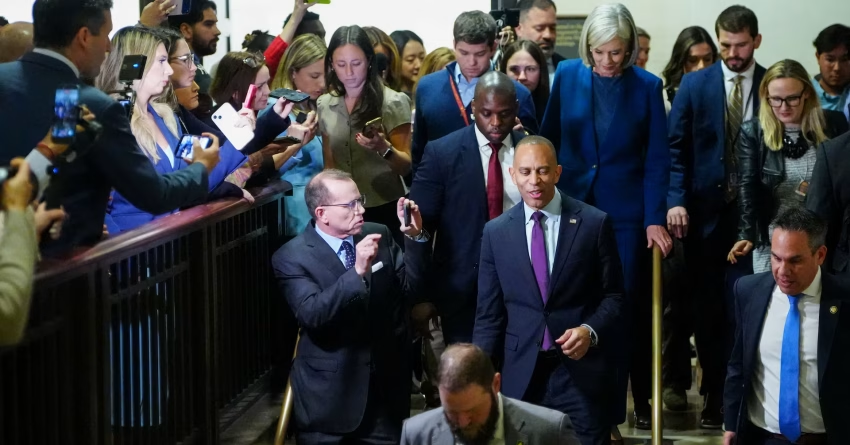
WASHINGTON — Democrats preparing to assume control of the U.S. Congress on January 3 are developing an ambitious legislative agenda for their first 100 days and beyond, following sweeping victories in the November 3 elections.
The proposed agenda will test the growing influence of progressive lawmakers, the ability of Democratic leaders to unite their party and the willingness of congressional Republicans to cooperate with the new majorities.
Democrats are expected to announce their legislative priorities in early December, after resolving an internal contest over Senate leadership.
Their return to congressional power represents a significant reversal from the previous two years, when President Donald Trump’s Republican Party controlled both the Senate and the House of Representatives.
During that period, Republicans used their narrow majorities to enact substantial tax reductions that disproportionately benefited wealthier Americans. They also allowed Trump considerable latitude in exercising authority over tariffs and federal spending, powers traditionally subject to congressional oversight.
The incoming Democratic majorities are considerably larger.
Democrats will hold 56 seats in the Senate compared with 44 for Republicans, leaving them four votes short of the 60 generally required to advance legislation through the chamber.
In the House, Democrats are positioned to control 257 seats against 172 held by Republicans, an 85-seat advantage that could expand once several outstanding races are decided.
Georgia Democratic Sen. Raphael Warnock described the election results as evidence of a significant shift in the country’s political landscape.
“This is a realignment,” Warnock told reporters in a post-election interview.
Despite their commanding congressional majorities, Democrats will still face substantial obstacles in advancing legislation opposed by the White House.
Republican Sen. John Boozman of Arkansas cautioned that Trump continues to wield considerable influence within his party, even after Republicans suffered widespread electoral defeats.
Boozman described the president as “a powerful force” and said, “I don’t see any of his vetoes getting overridden” during Trump’s remaining two years in office.
## **Democrats Prepare an Aggressive Legislative Agenda**
Democratic lawmakers and congressional aides say party leaders have spent months developing a coordinated strategy between the House and Senate to reverse major policies enacted during Trump’s presidency.
Their initial legislative efforts are expected to concentrate on issues that dominated voters’ concerns during the midterm elections, particularly the rising cost of living.
Party leaders believe measures addressing household expenses could attract support from both moderate and progressive Democrats while potentially creating opportunities for cooperation with Republicans.
Among the early priorities is legislation restricting Trump’s ability to conduct military operations against Iran without congressional authorization.
Democrats also hope that limiting the conflict could help ease pressure on gasoline prices, which have contributed to concerns about affordability.
Another major objective involves reversing Republican reductions to Medicaid and the Supplemental Nutrition Assistance Program, commonly known as SNAP or food stamps.
Restoring those benefits would be intended to help lower-income households manage healthcare expenses and grocery costs.
Progressive Democrats are also pressing for an increase in the federal minimum wage, which has remained at $7.25 an hour since 2009.
Some lawmakers and activists have proposed raising the minimum wage to between $20 and $25 an hour, although such increases could face resistance from moderates and Republicans.
Government ethics reform is another anticipated priority.
In response to public frustration over ethical controversies in Washington, Democrats are expected to introduce legislation early in the new Congress that would prohibit members of Congress from engaging in insider trading involving stocks.
The proposals could present Republicans with difficult political choices.
Supporting Democratic legislation could put Republican lawmakers at odds with Trump if he opposes the measures, while refusing to cooperate on popular economic issues could create problems with voters.
Boozman acknowledged that rising healthcare expenses are an issue Congress must confront.
“I think there’s a real understanding in Congress that things like healthcare, the really exorbitant premiums, you know, that people are having to pay” require attention, he said.
Boozman previously supported approximately $1 trillion in reductions affecting Medicare, Medicaid and Affordable Care Act programs that were enacted last year.
The Arkansas senator is among the Republicans facing reelection in 2028 who could potentially consider working with Democrats on certain legislative priorities.
However, he indicated that he would consult Trump before deciding how to approach such cooperation.
## **Progressives Push for Broader Economic and Political Changes**
Beyond the initial affordability agenda, progressive Democrats are advocating a more extensive set of reforms that they hope to advance over the next two years.
Their proposals include ending U.S. assistance to Israel and establishing a moratorium on construction of new artificial intelligence data centers.
Progressive lawmakers are also calling for major changes to campaign finance laws, higher taxes on wealthy Americans, comprehensive immigration reform and stronger federal action to address climate change.
The incoming congressional class is notably younger than the lawmakers currently serving.
Government figures indicate that newly elected House members are approximately eight years younger on average than the existing membership, while incoming senators are about 14 years younger.
Some of those younger lawmakers argue that Democrats should use their new majorities to confront the concentration of economic power across major industries.
William Lawrence, a 36-year-old Democratic representative-elect who captured a Republican-held House seat in Michigan, said Congress should address the influence of dominant corporations.
“We’d have to actually confront monopoly power, whether it’s in tech or whether it’s in the utility or other major industries,” Lawrence said.
He argued that strengthening democratic accountability should extend beyond elections and political institutions into the broader economy.
“There’s a lot of talk about protecting democracy. We need more democracy in the economy,” Lawrence added.
The progressive agenda also includes expanding healthcare coverage, strengthening environmental enforcement and pursuing sweeping changes to the immigration system.
However, the breadth of those proposals could complicate efforts to establish a unified Democratic legislative strategy, particularly because moderate lawmakers continue to outnumber progressives in Congress.
## **Immigration Reform Could Require Bipartisan Support**
Comprehensive immigration legislation is among the major issues Democrats hope to revisit when the new Congress convenes.
Retiring Democratic Sen. Dick Durbin of Illinois said he has discussed the need for immigration reform with colleagues, emphasizing that existing laws have failed to address several longstanding challenges.
Potential legislation could include updating employment visa rules, establishing a pathway to citizenship for undocumented immigrants and adopting durable border security measures.
Durbin also wants lawmakers to consider approaches that avoid some of the Trump administration’s more aggressive deportation practices.
He acknowledged that passing comprehensive immigration legislation would require Democratic leaders to attract Republican support in the Senate.
“With the numbers that we have, we have to try to press forward, try to make a bipartisan 60 votes in the Senate” on comprehensive immigration legislation, Durbin said during an interview in a congressional hallway.
Republicans have long argued that major immigration reforms should be postponed until the federal government establishes effective control over the southern border.
Trump maintains that his administration has already achieved that objective.
Congress has previously come close to approving a broad immigration overhaul.
In 2013, the Senate passed a bipartisan immigration reform bill by a 68-32 vote, but the legislation failed to advance in the Republican-controlled House.
The history of that effort illustrates the political difficulties involved in securing agreement on border enforcement, employment-based immigration and legal status for undocumented migrants.
## **Medicare for All Returns to the Democratic Debate**
Healthcare reform is another area where Democrats face differences between their moderate and progressive factions.
For years, many moderate Democratic lawmakers have avoided endorsing Medicare for All, a proposal that would establish a universal healthcare system.
Progressives, however, have continued advocating the policy, and recent months have brought signs of increasing interest among some politicians and voters.
Independent Sen. Bernie Sanders, a longtime supporter of universal healthcare, has proposed gradually expanding coverage over four years.
Under his plan, the Medicare eligibility age would initially be lowered to 55.
The proposal would also expand Medicare benefits to include dental, vision and hearing services while guaranteeing healthcare coverage for all children.
The broader objective would be to establish universal healthcare coverage through a phased transition.
Although progressive lawmakers view the proposal as a major opportunity to expand access to medical services, its advancement would depend on securing support from a Democratic caucus that includes substantial numbers of moderates.
The Senate’s 60-vote threshold for most legislation would present an additional obstacle unless lawmakers could reach a bipartisan agreement or pursue an alternative legislative procedure.
## **Environmental Protections Expected to Receive Renewed Attention**
Democrats are also preparing to strengthen congressional oversight of federal environmental policies and spending.
Maine Democratic Rep. Chellie Pingree, who was first elected to Congress in 2008, expects to become chair of a House subcommittee responsible for overseeing federal environmental expenditures in January.
Pingree indicated that environmental protection and the consequences of regulatory rollbacks would be central to her subcommittee’s work in 2027.
“I think people are deeply worried about the rollback of clean air, clean water standards, climate change issues, also just the toxins in our environment,” Pingree said.
Her comments suggest that Democratic lawmakers intend to examine the Trump administration’s environmental policies while considering measures addressing pollution, climate risks and public health concerns.
The party’s wider environmental agenda could include stronger enforcement of existing regulations and efforts to restore protections weakened during Republican control of Washington.
As Democrats prepare to assume their new congressional majorities, their challenge will be turning an extensive collection of campaign promises into legislation capable of passing both chambers and overcoming potential presidential opposition.
The first 100 days will provide an early indication of how Democratic leaders balance progressive ambitions with moderate priorities, whether Republicans are prepared to cooperate on selected issues and how effectively Congress can exercise its authority during the final two years of Trump’s presidency.