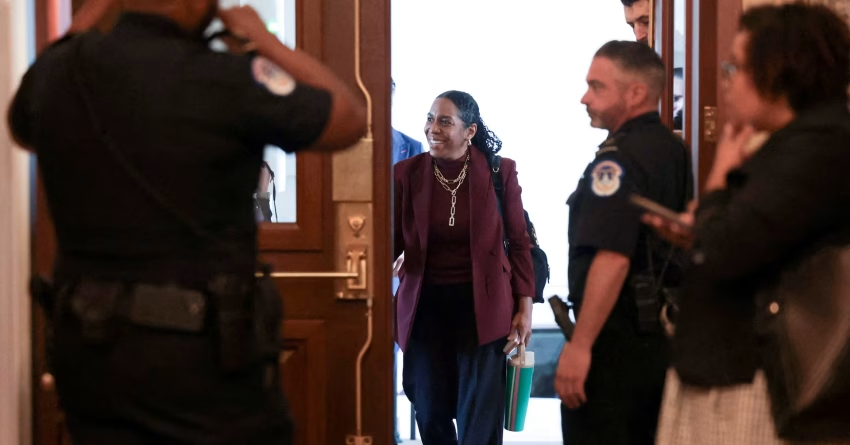
WASHINGTON — The largest group of newly elected Black Democratic lawmakers in more than three decades is preparing to enter the U.S. Congress in January, following November’s midterm elections that produced significant victories despite Republican efforts to redraw congressional districts.
An analysis of congressional election results and historical records shows that 13 new Black Democratic lawmakers will take office when the 120th Congress convenes, marking the largest incoming class since 1993.
The election results represent a notable development in Black political representation, but they also raise questions about whether the growing presence of Black lawmakers will translate into greater influence over federal legislation and congressional leadership.
Four members of the incoming group are 34 or younger, reflecting a broader generational shift within the Democratic Party.
More than half of the Black lawmakers serving in the House were first elected in 2020 or later, meaning they began their congressional service in 2021 or afterward.
Political analysts say the arrival of younger Black representatives could influence Democratic priorities on voting rights, healthcare affordability, economic inequality and other issues affecting communities across the country.
However, their ability to shape legislation will depend on whether they secure influential committee assignments, build alliances and achieve policy victories amid renewed challenges to longstanding civil rights protections.
## **Black Representation Expands in the Senate as House Numbers Shift**
Black candidates secured 58 seats in the 435-member House of Representatives for the incoming Congress, compared with 61 Black lawmakers serving in the current House.
That number could change because two additional Black candidates in Louisiana are competing in runoff elections scheduled for December 12.
Meanwhile, four Black Republican lawmakers will leave Congress, making Republican Sen. Tim Scott of South Carolina the only Black Republican serving in either chamber.
Black representation in the Senate will reach a record seven members following the election of Illinois Democrat Juliana Stratton and Mississippi Democrat Scott Colom.
Colom’s victory is particularly significant because he will become Mississippi’s first Black U.S. senator in more than 140 years.
The changes reflect a generational transition similar to developments during the early 1990s, when expanded Black political representation helped establish a group of lawmakers who eventually gained substantial seniority and influence in Congress.
Dedrick Asante-Muhammad, president of the Joint Center for Political and Economic Studies, said the historical experience demonstrates how increases in representation can produce lasting political consequences.
“This points to how important it was for a significant increase in Black representatives and how it pays off 20 to 30 years later,” Asante-Muhammad said.
## **Historical Gains Show Importance of Committee Representation**
Congressional historical records show that 16 first-time Black lawmakers entered Congress when the legislative session began in 1993.
By the end of that Congress, the number had increased to 17, establishing a record for the largest group of new Black members during a single congressional term.
Five of the six longest-serving Black House members currently in office began their congressional careers in either 1991 or 1993.
Their careers illustrate how longevity in Congress can help lawmakers obtain influential committee positions and shape major policy decisions over time.
Andra Gillespie, an Emory University professor who studies African American political leadership, said broader representation can create opportunities for Black lawmakers to participate in a wider range of congressional committees.
“When you have proportional representation in Congress, it does allow for diverse representation across committees. Part of the reason why the Congressional Black Caucus formed is so that they could convince leadership to put Blacks on key committees,” Gillespie said.
The Congressional Black Caucus, whose current membership consists entirely of Democrats, has historically sought to strengthen the political influence of Black lawmakers and advance legislation addressing the concerns of their constituents.
Its chair, New York Democratic Rep. Yvette Clarke, said members are hearing growing demands from voters for more decisive action on economic and social challenges.
“We’re all being contacted by our constituents who are impressing upon us the need to be very bold in our approach … to address what are crises in communities across the country,” Clarke said.
She identified the affordability crisis as the leading concern among caucus members, reflecting widespread anxiety over household expenses and economic pressures.
## **Republican Redistricting Efforts Fail to Flip Key Democratic Seats**
The election results also followed an intensified national battle over congressional district boundaries.
Republican-controlled state legislatures redrew several districts held by Black Democrats in efforts to improve Republican electoral prospects.
Four districts represented by Black Democratic lawmakers were among those targeted by Republican-led redistricting initiatives.
Those efforts accelerated after an April Supreme Court ruling weakened protections under the Voting Rights Act of 1965.
Of the three affected contests decided so far, Republicans failed to flip any of the seats.
In Alabama, Democratic Rep. Shomari Figures won reelection despite changes to his district’s boundaries.
North Carolina Democratic Rep. Don Davis also retained his seat following redistricting.
In Texas, Democrat Leticia Gutierrez, who does not identify as Black, won a redrawn district previously represented by Democratic Rep. Al Green.
Two additional contests in Louisiana remain unresolved, with Black Democratic women competing for the state’s remaining congressional seats.
In a majority-Black district redrawn in May, Democrat Chauna Banks will face Republican Blake Miguez in a December 12 runoff.
A neighboring Louisiana district will also be decided in a runoff between Democrat Patricia Moore and Republican Gabe Firment.
Moore finished first in a nine-candidate field with nearly 18% of the vote, while Firment placed behind her with 17.2%.
The outcomes of those races could further affect the composition of the incoming congressional delegation.
## **Warnock Urges Early Action on Democratic Priorities**
Georgia Democratic Sen. Raphael Warnock, the 11th Black senator in U.S. history, said lawmakers should begin developing their legislative priorities before the new Congress formally convenes in January.
Warnock supported Colom’s successful Mississippi campaign through political donations and campaign appearances.
His involvement reflected efforts by established Black Democratic leaders to help expand representation in states where such victories have historically been uncommon.
Warnock identified economic concerns and major federal policy disputes as priorities for the incoming Congress.
“I’m focused on ending this war, ending these tariffs, and restoring tax credits that will bring people’s healthcare costs down,” Warnock said.
Despite Democrats’ congressional gains, major legislative changes will still face procedural and political obstacles.
Most substantial legislation will require bipartisan cooperation to overcome the Senate’s 60-vote threshold for advancing bills.
Republican President Donald Trump also retains the authority to veto legislation approved by Congress, creating another potential barrier to Democratic policy initiatives.
Those constraints mean that increased representation alone will not guarantee the passage of legislation supported by Black Democratic lawmakers.
## **Younger Lawmakers Bring New Perspectives to Congress**
The incoming class includes several young Black Democrats whose election victories highlight the changing demographic composition of Congress.
Melat Kiros, 29, will become the first woman from Generation Z elected to Congress and the first Black woman to represent Colorado in the House.
Generation Z generally refers to people born between the late 1990s and early 2010s.
Kiros is among four newly elected Black House members who are 34 or younger.
The others include Darializa Avila Chevalier of New York and Adrian Boafo of Maryland, both 32, and Donavan McKinney of Michigan, 34.
Their arrival contrasts with the presence of longtime Black Democratic leaders who have accumulated decades of congressional experience.
Among the party’s senior figures are California Rep. Maxine Waters, 88, and Mississippi Rep. Bennie Thompson, 78.
The combination of younger lawmakers and established leaders could create opportunities for collaboration while also exposing disagreements over political strategy, policy priorities and the pace of legislative change.
Pennsylvania Democratic Rep. Summer Lee, who won reelection, said she believes voters are seeking a more assertive approach from their representatives.
“I’m unapologetically progressive. So many people are looking for bold leadership and I think that too often the messages that come out are that boldness is risky,” Lee said.
Her comments reflect broader demands among progressive Democrats for party leaders to pursue more ambitious legislative proposals rather than limiting their agenda to measures considered politically safer.
## **Democratic Leadership Faces Generational and Ideological Pressures**
The changing composition of Congress will also present challenges for Democratic leaders responsible for maintaining unity across the party’s moderate and progressive factions.
New York Democratic Rep. Hakeem Jeffries is considered the leading candidate to become House speaker when Democrats assume control of the chamber.
If elected, Jeffries would oversee a caucus that includes lawmakers seeking substantial changes to the party’s policies and leadership approach.
The situation could place additional pressure on established Democratic leaders, including Senate Democratic leader Chuck Schumer.
Periloux Peay, a political science professor at the University of Maryland, said growing dissatisfaction with existing leadership could complicate efforts to maintain party unity.
“Democratic leadership is in for some trouble. (Senate Democratic leader Chuck) Schumer and Jeffries are really going to have to push back against what is going to be and has already proven to be a groundswell against their leadership,” Peay said.
The debate reflects broader tensions between lawmakers who favor experienced leadership and those who believe the party needs a new direction following the midterm elections.
Those differences could become particularly important as Democrats prepare to advance legislation addressing economic inequality, healthcare costs, voting protections and other issues.
## **Congressional Black Caucus Reaches Record Membership**
The Congressional Black Caucus is expected to enter the new legislative session with a record 64 members, an increase from its current membership of 62.
The expanded caucus could provide additional opportunities to influence committee assignments, coordinate legislative priorities and advocate for policies affecting Black communities.
However, its effectiveness will also depend on cooperation among lawmakers with differing political philosophies and approaches to governing.
Clarke said one of her principal objectives as caucus chair is to maintain unity between progressive and moderate members while ensuring their concerns receive attention from Democratic leadership.
She also expressed confidence in Jeffries’ ability to respond to the priorities of the incoming congressional majority.
“I’m under the impression that he’s not tone deaf and that he will lead as the body requires,” Clarke said.
As the new Congress prepares to convene, the influx of Black Democratic lawmakers marks a significant generational and political development.
Their growing presence offers the potential for broader participation in congressional decision-making, but the ultimate measure of their influence will depend on committee leadership, legislative negotiations and their ability to turn policy priorities into enacted laws.
The coming congressional session will test whether the largest incoming class of Black Democratic lawmakers since 1993 can build lasting institutional influence while navigating internal party divisions and opposition from the Republican White House.