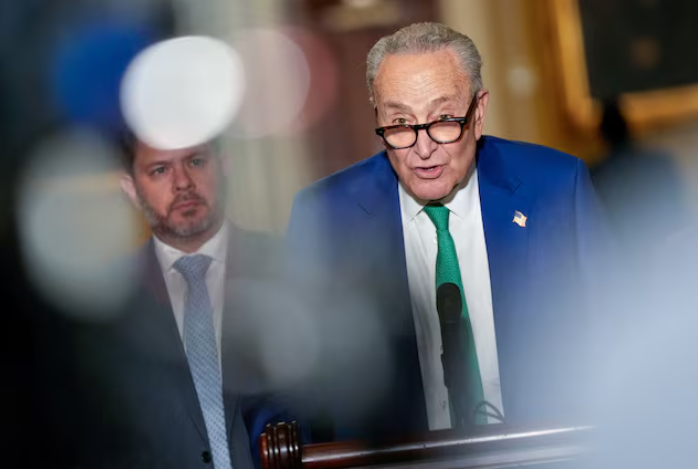
WASHINGTON — Senate Democratic leader Chuck Schumer is facing a challenge from within his party despite overseeing an election cycle that delivered Democrats a commanding 56-seat majority in the 100-member Senate.
Following the party’s sweeping victories in the November midterm elections, progressive activists and lawmakers have intensified calls for Schumer to step aside, arguing that Democrats need a new generation of leadership to reflect the changing priorities of their voters.
Schumer, who turns 76 on Monday, has spent decades in Washington and led Senate Democrats for the past 10 years. Critics contend that his longstanding connections to the Democratic establishment make him an unsuitable choice to lead a caucus increasingly influenced by younger lawmakers seeking significant changes to the party’s direction.
The Working Families Party, a progressive political organization that supports candidates aligned with its populist priorities, formally urged Schumer to consider relinquishing his leadership position.
In a Nov. 13 letter, the organization’s leaders acknowledged his contributions to the party’s electoral success while advocating for a generational transition.
“We write first to thank you,” the group stated.
“If you step aside at the height of a victory you helped secure, you would show voters that the Democratic Party heeded their call for change. The new majority can begin its work united and focused on fighting for the people who elected them,” it said.
Schumer, however, has expressed confidence that Democratic senators will retain him as their leader when they gather for a secret-ballot election on Dec. 1.
“I will be elected majority leader,” Schumer told reporters last week.
The leadership contest is the first competitive race for the top Senate Democratic position since 1994.
His challenger, Maryland Senator Chris Van Hollen, 67, has positioned himself as an alternative for lawmakers seeking changes in the party’s internal leadership and legislative strategy.
Although Van Hollen is only nine years younger than Schumer, he and his progressive supporters have emphasized his willingness to challenge established practices and expand opportunities for newer senators to influence policy decisions.
Van Hollen has argued that the 2026 election results demonstrate a demand for Democrats to move beyond traditional approaches and pursue a more ambitious legislative agenda.
Democrats captured majorities in both the Senate and House of Representatives from President Donald Trump’s Republican Party during the November elections.
The party will formally assume control of both chambers when the new Congress convenes in January.
## **Van Hollen Calls for New Leadership and a Different Approach**
Van Hollen has become increasingly visible in his campaign to replace Schumer, although the ultimate decision will be made privately by Democratic senators.
Of the 56 members of the incoming Senate Democratic caucus, at least 16 have publicly declared their support for Schumer, while six have announced that they intend to back Van Hollen.
The remaining senators have not all publicly disclosed their preferences.
Van Hollen has maintained that his candidacy is intended to bring substantive changes to how Senate Democrats operate.
“I’m in this to win it,” Van Hollen said on Thursday. “That’s my goal. I think if we want to move forward on an ambitious agenda like this, we need new leadership. We need to change the culture of the Democratic caucus. People need to have more input. Our new members need to be at the table.”
The debate over leadership comes after Democrats flipped nine Senate seats in November, including victories in several states that Trump carried by double-digit margins during the 2024 presidential election.
Several incoming Democratic senators publicly opposed Schumer’s continued leadership while campaigning for their seats.
Their positions have added momentum to calls for a different approach within the Senate Democratic caucus.
Senator-elect Troy Jackson of Maine acknowledged Schumer’s contributions while expressing support for a leadership transition.
“Do I like Chuck Schumer?” asked Senator-elect Troy Jackson of Maine. “He’s been great, but I do think it’s time for new ideas.”
Van Hollen also discussed the leadership contest during an appearance last week on CNN’s *State of the Union*.
He described a “hunger for change” among Senate Democrats and pointed to two incoming senators who won their elections despite Schumer having supported their opponents in Democratic primaries.
Van Hollen criticized Schumer’s involvement in those contests, arguing that the Democratic leader had aligned himself with influential pro-Israel and cryptocurrency interests.
The Maryland senator has presented those disputes as examples of why the party should reconsider its leadership practices and give greater influence to a wider range of Democratic voices.
## **Progressive Democrats Rally Behind Van Hollen**
Van Hollen has attracted support from progressive lawmakers who believe his political experience and willingness to challenge established positions could help reshape the Senate Democratic caucus.
Senator-elect Abdul El-Sayed of Michigan highlighted Van Hollen’s previous leadership roles within Democratic campaign organizations in both chambers of Congress.
Van Hollen has served as chair of the campaign committees responsible for helping elect Democrats to the House and Senate, giving him experience with congressional elections and party operations.
El-Sayed argued that Van Hollen combines that institutional knowledge with a willingness to take politically challenging positions.
“Those two things are what we need right now, and we need to rethink the way we legislate,” El-Sayed said.
The incoming Michigan senator cited Van Hollen’s efforts to advocate for a migrant who had been wrongfully deported, as well as his travel to draw attention to Israel’s war in Gaza.
El-Sayed described those actions as examples of the Maryland senator’s readiness to take risks in pursuit of his policy priorities.
Other Democrats have characterized the leadership contest as an opportunity for the party to examine its future direction following the midterm victories.
Virginia Senator Tim Kaine suggested that the debate could be a constructive part of the caucus’s internal decision-making process.
“And there’s nothing wrong with that,” Kaine said.
The Senate Democratic leadership position remains the only unresolved role among the four top congressional leadership posts.
House Democrats nominated Representative Hakeem Jeffries last week to serve as speaker when the new Congress takes office.
On the Republican side, Senator John Thune is set to continue leading Senate Republicans, while Representative Jim Jordan will replace current House Speaker Mike Johnson as the chamber’s top Republican.
Those leadership arrangements will take effect as Democrats prepare to exercise their newly won congressional majorities.
President Trump has also weighed in on the Democratic leadership contest, publicly criticizing Schumer ahead of the Dec. 1 vote.
In a Sunday post on Truth Social, Trump said he would find it difficult to work with the New York senator if Schumer becomes majority leader.
The president wrote that Schumer “failed badly as ‘Leader’ once before, one of the worst (in) history, and I have little doubt that he will fail again.”
Trump’s comments come as the White House prepares for the final two years of his presidency with Democrats controlling both chambers of Congress.
## **Schumer Could Face a Primary Challenge in 2028**
Beyond the immediate leadership election, Schumer faces questions about his political future as he approaches his next Senate reelection campaign in 2028.
A defeat in the Democratic leadership contest could leave him more exposed to a potential primary challenge from other members of his party.
Among the prominent Democrats mentioned as possible challengers is New York Representative Alexandria Ocasio-Cortez, whose political future has attracted considerable attention.
A memorandum prepared by Ocasio-Cortez’s campaign acknowledged several possible paths for the 2028 election cycle.
Those options included seeking the presidency, running for the Senate or pursuing another term in the House of Representatives.
No final decision about her plans was identified in the memorandum.
Schumer, meanwhile, has declined to engage in extended discussion about his political future beyond the upcoming leadership election.
Instead, he has emphasized his intention to focus on the work awaiting Democrats when they assume control of Congress in January.
“I’m focused on 2027 and delivering for the American people,” Schumer said on Wednesday.
The Dec. 1 secret-ballot election will determine whether Senate Democrats retain their longtime leader or choose Van Hollen to guide the party’s new majority.
The contest has exposed differing views within the Democratic caucus over leadership, legislative priorities and how the party should respond to voters following its midterm election victories.