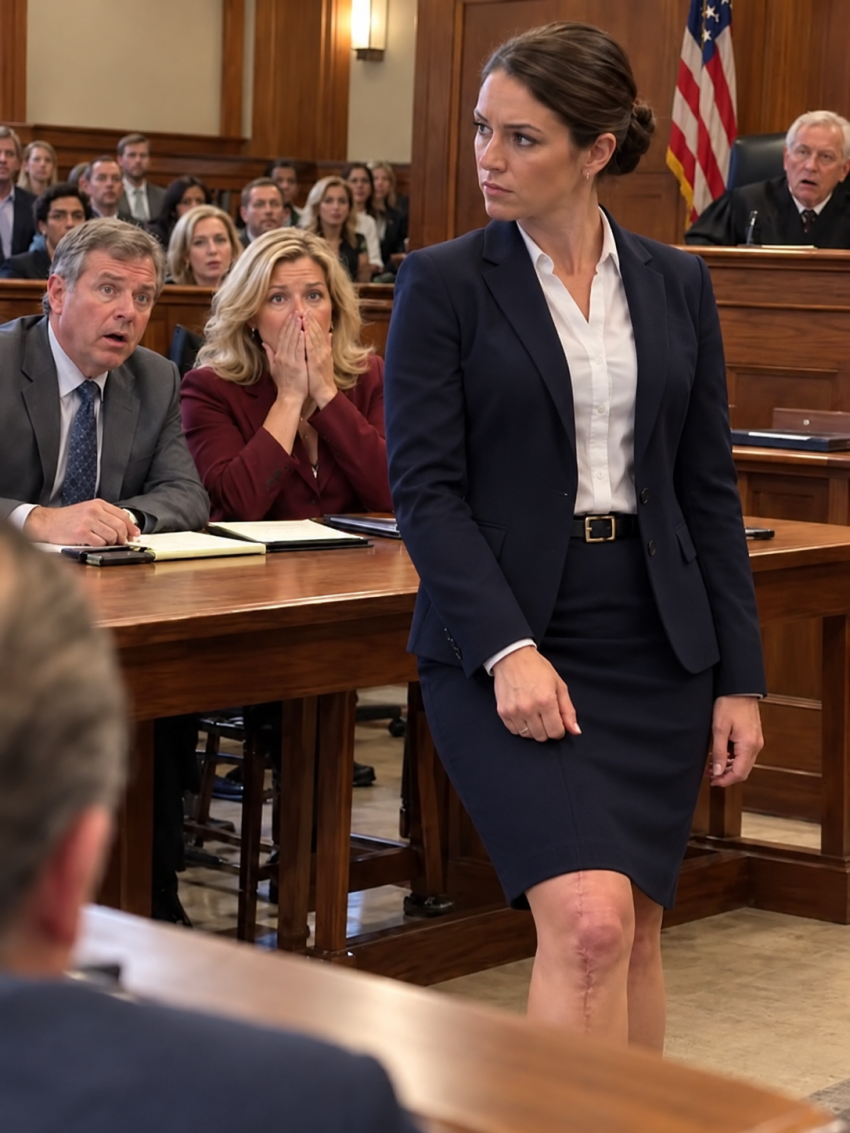
The judge lifted the aging sheet by one corner, careful not to crease it. Silence settled over the courtroom as he examined the signature near the bottom.
I stood beside the defense table in my Navy dress uniform. My parents were seated across the aisle, barely a dozen feet away. It was the closest we had been to one another in twelve years.
Before the judge spoke, I recognized the handwriting. Samuel Carter. My grandfather’s signature began with a sweeping S and ended in a stroke that rose toward the top of the page. I had seen him sign enough receipts and letters to know it anywhere.
My father recognized it as well. He shifted toward the bench, while my mother’s fingers froze against the pearls around her neck.
Judge Simmons settled his glasses and identified the paper as a notarized property agreement executed on March 16, 2012, then entered into the Portsmouth Circuit Court land records three weeks afterward.
My father stared. “That can’t be right.”
“Are you questioning the signature?” the judge asked.
“No, Your Honor. I’m questioning what the document says.”
“Then we ought to examine its language,” the judge replied.
I am Evelyn Carter, thirty-seven years old and a commander in the United States Navy. Until five weeks earlier, I had assumed the distance between my parents and me would remain a private family matter.
Then a process server approached me outside my apartment in Norfolk. He looked uncomfortable as he handed me a thick envelope and offered a brief apology. Knox, my dog, pressed against my leg while I opened it beside my truck.
The papers named Robert and Margaret Carter as plaintiffs. I was the defendant.
My own parents had taken me to court.
I reread the complaint in the parking lot and again after I got home. According to their filing, my grandfather’s farmhouse on Willow Creek Road had sat abandoned since his death in 2014. They claimed the transfer into my name was never legally finalized. They also asserted that they had maintained the property with their own money and paid its property taxes every year beginning in 2015.
On that basis, they wanted a judge to award them ownership.
I sank to the kitchen floor, leaned against the cabinets, and let out a laugh that sounded nothing like amusement. Knox rested his head on my knees. He had learned to recognize when a laugh meant something was wrong.
I knew precisely who had paid those taxes. I had. The money left my account year after year, whether I was stationed on land, aboard a ship, or recovering in a hospital.
To understand how we reached a courtroom, you have to understand the family I grew up in.
Our house stood in a tidy neighborhood outside Portsmouth, about half an hour from Grandpa’s farm. Dad worked as an engineer. Mom ran the reception office at a dental practice, but at home she seemed to manage every detail of our lives as well.
Neither parent sat me down with a written plan, yet I always understood the future they expected. I would attend a nearby college, take a dependable job, marry someone respectable, and settle close enough to come over for Sunday dinners. Children would follow. My mother was already leaving bridal magazines around the living room when I was sixteen.
Grandpa’s farmhouse offered an entirely different world. I spent most summer days and many weekends there. Samuel Carter had worked as a shipyard welder for three decades and built much of the house with his own hands. He believed in knowing how things worked before trusting them.
He showed me how to repair a sagging gate, sharpen equipment, and replace a tire in a downpour. When his socket set came back missing pieces, he acted as though he hadn’t noticed. We talked about the shipyard, the vessels passing Norfolk, and the sailors whose stories had stayed with him.
At seventeen, I announced that I had applied to the Naval Academy. Dad set his fork on the table and dismissed the idea as a passing phase.
He was wrong.
I went to Annapolis and earned my commission. My parents attended graduation, but they left the stands before we threw our hats. Later I entered explosive ordnance disposal, a field devoted to finding and neutralizing dangerous devices. To Dad, that choice seemed like a deliberate attempt to prove I could live without anyone’s help.
The argument that finally broke us happened in my parents’ kitchen, shortly before my first extended deployment. I was twenty-four. Dad stood near the sink, his arms folded tightly across his chest.
He told me that pursuing that career meant putting the Navy ahead of my family. Then he said I was no longer the daughter he had raised.
I walked out that evening.
One week later, with my seabag over my shoulder on a Norfolk pier, I received a message from Mom. She wrote that they had raised a daughter, not a soldier.
I left the message unanswered. Twelve years passed.
Grandpa remained the one relative I could speak to freely. I called from ports and bases and mailed him photographs of my ships, training milestones, and promotions. He displayed them on his refrigerator beneath little fish-shaped magnets.
In 2014 he died peacefully in his farmhouse at eighty-six. I returned for the funeral and stood in uniform at the rear of the church. My parents occupied the front pew. We did not exchange a word.
His will named me as the person who would inherit the farmhouse. I placed my copy inside my Navy footlocker, beneath the folded flag of my friend Lewis. I continued paying the taxes, but I could not bring myself to visit the property.
Instead I preserved it in memory: a porch, an oak tree, a workshop beyond the barn. I imagined those things waiting unchanged for me, even though buildings age whether anyone comes home or not. Families do too.
The morning of the first hearing, an award ceremony kept me on base until after seven. I drove directly to the courthouse, still wearing my dress blues and every ribbon and insignia required for the occasion.
I represented myself. Between Grandpa’s will, my financial records, and more than a decade of resentment, I believed I had everything necessary.
When I entered Courtroom 3B, Mom turned in her seat. Her gaze traveled over the decorations on my uniform. Color drained from her face, and her hand rose to the necklace at her throat. I could not tell whether she felt ashamed of me or simply embarrassed by how little she knew about my life.
Dad did not look back.
Judge Simmons was slender, gray-haired, and remarkably soft-spoken. He explained that he routinely reviewed county records himself when a dispute concerned land ownership. That habit had led him to the paper now resting in his hand.
He read the operative provision aloud. Samuel Edward Carter had conveyed sole beneficial ownership of the property at 1187 Willow Creek Road, including its buildings and improvements, to Evelyn Marie Carter, while reserving the right to live there throughout his lifetime.
Dad shut his eyes.
I understood what the arrangement meant. Grandpa had kept a life estate. After his death, the house belonged to me, not because of a family understanding or an informal promise, but through a recorded legal instrument.
The next provision expressly excluded Robert and Margaret Carter from any ownership interest.
Mom whispered Dad’s name. He did not respond.
The judge asked whether my father had known the deed existed. Dad admitted that Grandpa had talked about giving me the property someday. Judge Simmons reminded him that this was not a conversation about future intentions. It was an executed, recorded deed.
I remembered that particular shift in Dad’s chair. When I was young, he made the same movement whenever Grandpa challenged him at the dinner table. Silence could usually win Dad an argument, but never against his own father.
The judge asked whether I had known about the filing. I explained that I possessed the will but had not seen this particular document. He then turned to the tax history.
Every annual property-tax payment since 2014, he said, traced to an escrow account associated with my military credit union.
Dad finally faced me. “You paid them?”
“Yes. Every year.”
He began mentioning notices from the county. I explained that notices could be delivered to the farmhouse while the actual payments came electronically from my account.
Judge Simmons pointed out that the complaint explicitly stated Dad had paid those taxes since 2015. After a long pause, Dad said he had believed he was paying them.
The judge observed that believing something and actually doing it were not the same.
The room grew strangely still. I had imagined this moment as a victory, but I felt no satisfaction. Across the aisle sat two older people whose faces had changed while I was away. Dad’s hair was gray. Mom had fine lines around her eyes. For twelve years I had pictured them exactly as they were when I left, certain and immovable. Time had been working on them as surely as it had worked on me.
Then Dad described the repairs they had made after Grandpa died. They had dealt with roof leaks, damaged porch boards, broken well pumps, and failing windows. Mom had arranged lawn care; Dad had hired contractors and performed some work himself.
As he spoke, an unwelcome truth became clear. They really had cared for the building. I had sent money for taxes without ever checking a gutter or examining the roof. During deployments, the farmhouse had remained a photograph in my head, not a place needing maintenance.
Dad handed the judge receipts. They established repair expenses, not tax payments. When the judge asked why the complaint said otherwise, Mom quietly answered that they had misunderstood the records.
Dad tried to stop her, but she reached into her purse and produced a folded county statement from 2018. It showed Grandpa’s estate as the mailing contact and listed my parents’ address.
Grandpa had been dead for four years by then.
Dad said he had supplied that address to the clerk and consequently received the county notices. He had not received the electronic payment confirmations, which came to me. Judge Simmons suggested the case appeared to involve inaccurate records, mistaken assumptions, and years of incomplete communication.
I looked directly at Dad. “But you still sued me.”
“Yes,” he answered.
For once, he offered no immediate defense.
The judge directed us to assemble full documentation: my deed and tax history, their repair invoices, and an explanation from the county for the estate’s outdated contact details. He continued the hearing for fourteen days and urged us to establish the facts before returning.
No one had won or lost. We simply had another date on the calendar.
As the courtroom emptied, Mom mentioned that Grandpa had stored copies of almost everything in the workshop behind the barn. Dad said he had already checked the metal filing cabinet. She reminded him that he had searched only the upper drawer and that Grandpa had always said thieves looked in drawers first.
That sounded exactly like him. He trusted coffee cans hidden under benches more than ordinary filing systems.
The judge, on his way out, cautioned us to preserve any documents we discovered and share them with the opposing party. He remarked that relatives often remember the same person in very different ways, while records can sometimes settle what memory cannot.
I reached the elevator before Mom called my name.
“Evelyn.”
Hearing her address me directly after twelve years stopped me. Up close, I saw the silver at her temples and the shorter haircut she now wore. She seemed to search for words, but Dad interrupted by suggesting we inspect the workshop the following day.
“Today,” I said.
He mentioned the approaching rain. I reminded him that we lived in Virginia. Mom nearly smiled and asked whether I still used that expression.
The elevator doors opened. Before they closed, Mom looked again at my uniform and admitted that she had not known.
I could have asked what she meant. My rank? My injuries? The tax payments? The person I had become?
“There’s a great deal you don’t know,” I replied.
Then the doors slid shut.
After leaving the courthouse, I traded my dress uniform for jeans, boots, and a worn Navy sweatshirt. Knox climbed into the passenger seat as soon as I opened the truck. He had never met my parents; in his world, they were strangers. Dogs have a simpler understanding of absence than we do.
The drive toward Willow Creek Road took me through places I almost recognized. The old blue bait shop had been painted yellow, and a pharmacy occupied the gas station I remembered. Yet the narrow road leading to the farm seemed untouched, with drainage ditches beside the pavement and pines bending toward the overhead wires.
Grandpa’s mailbox appeared around the curve. CARTER was still visible on its weathered side. Dad’s car stood beside the barn, and Mom waited on the porch when I pulled in.
She watched Knox jump out. “That’s a big dog.”
“Being big is practically his profession.”
He approached her carefully, inspected her outstretched hand, and then leaned against her leg. She laughed, and the sound carried me briefly into our old kitchen, where I could almost see her younger face dusted with flour.
Dad emerged from beside the house holding a flashlight. He wanted to finish searching before the storm arrived. His matter-of-fact tone gave us something safe to focus on.
The workshop stood beyond the barn, assembled from reclaimed boards in the 1970s. When Dad pushed the door open, I smelled sawdust, cedar, damp lumber, and old machine oil. My throat tightened. For an instant Grandpa was there again, working at his bench and humming a tune he never quite got right.
Dad switched on the ceiling light. It flickered before glowing steadily.
“Still working,” he observed.
“Grandpa would take that as an insult. You doubted his wiring.”
Dad considered that, then nodded. “He probably would.”
The green cabinet remained against the wall. Dad searched the first drawer, which held manuals, insurance forms, and receipts. Old tax returns filled the second. The third refused to open completely, and he started pulling harder.
“Wait,” I told him.
I crouched despite the protest in my injured knee and felt along the drawer rail. Grandpa used to wedge a carpenter’s pencil there so the drawer would catch. The brittle yellow pencil was exactly where I remembered it. Once I removed it, the drawer slid free.
Dad looked astonished that I knew. I told him I had spent more hours in the workshop than he had. The remark sounded harsher than I intended, and his expression closed. Behind us, Mom quietly confirmed that it was true.
Envelopes arranged by year occupied the drawer. Behind them sat three folders labeled in Grandpa’s unmistakable block letters: ROBERT, MARGARET, and EVELYN.
I paused when I saw my name. Dad urged me to take the folder, then gently acknowledged that it belonged to me.
Inside was a collection of my life: school photographs, report cards, a newspaper clipping about a track trophy I had won at seventeen, and a picture from my Naval Academy graduation. Dad asked where Grandpa had obtained that last one.
“I mailed it to him.”
He looked down. “You sent him pictures?”
“All the time.”
Beneath them lay a handwritten letter dated February 2013. Grandpa had addressed it to me. Its opening warned me to put it back if I was snooping, but conceded that if he was gone, I had earned the right to read it. I smiled. Mom recognized his humor immediately.
Much of the letter was practical: the lawyer who prepared the deed, the location of insurance documents, and the person who serviced the well. Then I reached a line that made me stop. Grandpa believed my father and I resembled each other far more than either of us cared to admit.
Dad noticed my reaction, so I passed him the page. A faint smile appeared as he read. He said Grandpa had always considered himself funny. I told him he really had been, and Dad reluctantly agreed that he sometimes was.
The final passage explained Grandpa’s view of our quarrel. Dad regarded strength as refusing to surrender his position; I understood it as choosing my own path. Grandpa thought both ideas had merit, but neither of us knew when to turn back. He had left me the farmhouse because I understood that coming home did not require remaining there.
He also told me not to turn the building into a monument. I could repair it, sell it, live in it, or welcome others into it. Whatever I decided, pride should not make the choice for me.
Rain began striking the metal roof. Mom sat on an overturned bucket and read the letter, whispering that Grandpa had understood everything. Dad asked what she meant. “All of it,” she answered.
We examined the other folders. Dad’s contained certificates from his engineering career, pictures of him working on the roof with Grandpa, and a crayon Father’s Day card he had made at eight. He held the card for a long time, saying he had assumed his father threw it away. Mom reminded him that Grandpa almost never discarded anything.
Knox interrupted us by pushing his nose behind the workbench. I told him to leave it alone. As usual, he was obedient only when the instruction suited him. A wooden crate scraped against the floor, and Dad moved it aside to reveal an old red toolbox.
Dad insisted he had cleaned the workshop after the funeral and would have noticed it. Mom said he had merely cleaned around things. When he protested, she accused him of relocating dust rather than removing it.
I laughed. The sound startled all three of us. Mom began laughing too, and even Dad smiled. For a few seconds, it felt as though the lost years had never happened.
Under the toolbox tray we discovered a locked metal cashbox. The keys hanging on the pegboard were useless. Mom suggested searching the coffee cans on a shelf. One contained nails, another washers, and the third an assortment of keys. Eventually a small brass key opened the box.
Inside were photographs, canceled checks, bank statements, and a sealed envelope. Grandpa had written across its front: FOR ROBERT AND EVELYN TO OPEN TOGETHER.
Dad and I exchanged a look. Mom stepped away. When Dad asked whether she knew anything about it, she denied it. He pressed her, and she pointed out that after forty-three years of marriage she was capable of telling a more convincing lie.
Dad set two folding chairs beside the workbench. My knee ached, so I sat opposite him. Neither of us reached for the envelope. He offered to let me open it, but I refused; it was addressed to both of us. Finally we each gripped a corner and tore it open together.
Four pages lay inside. Dad began reading aloud. Grandpa had written that if Robert and Evelyn were willingly in the same room, a miracle had occurred—or someone had forced them together. Mom covered her mouth as Dad continued.
Grandpa knew enough about our estrangement to see that each of us held an incomplete account of it. Dad believed I had chosen the Navy instead of my family. I believed he had forced me to choose. Both accounts held some truth, Grandpa wrote, but neither contained the whole story.
Dad’s expression hardened when the letter turned to a secret about the farmhouse and money. In 2011, before my deployment, he had approached Grandpa for a loan.
I asked Dad whether he had borrowed money. He said the situation had been complicated. When I demanded the amount, he hesitated before admitting it was seventy-eight thousand dollars.
The workshop fell silent except for the rain. Dad explained that his business partnership had nearly collapsed. Without the loan, he might have lost our family home and everything else. Mom went pale; he had told her the company absorbed the losses.
I remembered how tense he had been that year, coming home late and criticizing my decisions. I had interpreted all of it as anger about my leaving. Now I wondered how much of his behavior had been driven by fear he never admitted.
I asked him to continue. Grandpa’s letter emphasized that Robert had repaid every dollar. He had not been reckless, Grandpa insisted. He had been frightened, and that was not the same thing.
Dad stopped reading. I had never known anyone to describe him as afraid.
The letter revealed something Dad himself had not known. Grandpa had obtained the money by refinancing part of the farmhouse, rather than withdrawing savings. He concealed that fact because Dad would have rejected the help. When Dad repaid him, Grandpa cleared the loan. The supporting papers were tucked beneath the letter.
Dad’s hands trembled as he examined them. “Why would he do that?”
“Because you were his son,” I answered.
I meant it without criticism. Somehow that seemed to affect him more deeply than anger would have.
Mom took the next page and read aloud. Grandpa had not transferred the house to me because he loved me more or was disappointed in Dad. He had chosen the person least likely to regard it primarily as money.
I lowered my eyes. He had seen something in me I had barely understood myself.
Then Mom reached a passage about my injury. The Navy had contacted the emergency person listed in my records after I was hurt. Dad looked up sharply. He had not known I had been injured at all. He only knew that I had stopped taking field assignments.
I thought of the explosion outside a village whose name I still could not bring myself to say. The operations, my reconstructed knee, rehabilitation, a year with a cane, and the nightmares Knox had learned to interrupt. Dad asked how badly I had been hurt. I could only repeat my disbelief that he had never known.
Grandpa knew. I had called him from a hospital in Germany and made him promise not to tell my parents. He had reluctantly kept his word. But the letter revealed that he later regretted allowing each side to believe the other had freely chosen silence.
Mom read that Dad had tried three times to reach me through Grandpa after the injury. I stared at him. Dad said he had called after Lewis contacted my parents to say I was wounded, though Lewis could not share details.
Lewis. Hearing his name stunned me. He had been my closest friend. The folded flag from his funeral still rested in my footlocker. He had never told me he called my parents.
Dad had asked Grandpa where I was, and Grandpa had said I wanted no contact. That was precisely what I had instructed him to say.
Dad thought I had made my decision. I accused him of giving up after only three calls. He reminded me that years had passed without a word from me. I reminded him that he had once said I would no longer be his daughter if I chose the Navy.
He flinched and admitted he had said things he should not have. Mom interrupted before we could fall into the familiar argument.
She said we would not settle this by assigning one person enough blame to absolve everyone else. Dad had been cruel when I left, she told him. I had closed every available door, she told me. And she had allowed both things to happen.
I wanted to defend myself. Instead I looked at Grandpa’s letter. Each of us had been telling a true but incomplete story.
The rain beat against the roof while Knox rested beneath my chair. For years I had pictured reconciliation as a dramatic apology that would repair everything at once. The reality was three people sitting among old tools and dead batteries, unable to find the next words.
It might have been the more truthful beginning.
Dad passed me the last page. Grandpa had opened a separate account after paying off the farmhouse loan. He had deposited money regularly—sometimes fifty dollars, sometimes five hundred—and later increased the amounts. Neither Dad nor I could use the account alone. His attorney, Daniel Mercer, held the instructions.
Grandpa’s final condition was simple: use it together, or do not use it at all.
There was no phone reception inside, so we went into the drizzle. At the bottom of the porch steps I found one signal bar and called Mercer & Hale in Portsmouth. The receptionist checked Grandpa’s records after I supplied his name and my birth date.
She returned with a message: Mr. Mercer would discuss the matter only when Robert Carter and Evelyn Carter were both present. Dad stood close enough to hear. She offered us an appointment at ten the following morning.
I looked back at the farmhouse: its worn porch, peeling paint, and aging oak. For the first time, it did not seem deserted. It seemed to have been waiting.
“Tomorrow,” I said.
Daniel Mercer was eighty-one, with wire-framed glasses and suspenders beneath his jacket. From the way he greeted us, I gathered he had been waiting for this appointment for twelve years.
“Well,” he said, studying Dad and me, “Samuel would be irritated that you took so long.”
Dad’s mouth twitched. “I’m sure he would.”
The lawyer briefly noticed my limp but made no comment. I appreciated that. Mom had accompanied us, though she chose to stay in the reception area. She said Samuel’s arrangement concerned his son and granddaughter, not her. Once, she would have insisted on joining every conversation. Apparently, people could learn to give one another room.
Mercer opened a substantial folder and explained that Grandpa had established a trust five months before his death.
Dad immediately wanted to know its value. Mercer acted as though he had not heard the question. Samuel, he said, had anticipated that Robert would ask about the money first.
Dad exhaled. “Naturally.”
Before disclosing the balance, Mercer pushed a handwritten note across his desk. Grandpa had written that money often distracted otherwise sensible people from the questions worth asking. He wanted us to answer one question before learning anything else: What purpose should the farmhouse serve?
Dad asked whether answering was a legal obligation. Mercer said it was not; he had simply promised Samuel he would ask. When Dad sighed again, Mercer remarked that Samuel had predicted that reaction as well. I laughed, and to my surprise, Dad joined me.
I considered the house in all the ways I had considered it over the years: a childhood refuge, an inheritance, a reminder of Grandpa, evidence that he had trusted me. It could also be an expense and a responsibility. None of those descriptions told me what it ought to become.
“It was our home,” I said.
Dad agreed, but I added that being a former home could not be its only purpose. In my mind, I saw the repaired porch, a working kitchen, people leaving boots by the door, and conversations filling the rooms. Grandpa had written that houses were meant to be lived in.
“I think it should be useful,” I said.
Dad watched me for a moment and nodded. He said that sounded exactly like his father. Mercer shut the folder with a satisfied expression. When Dad protested that he had not given his own answer, the lawyer pointed out that agreeing with me was an answer.
Only then did Mercer reveal the account balance: approximately $246,000.
I wondered whether I had misunderstood. Grandpa had saved bits of aluminum foil and complained whenever somebody left a light on in an empty room. Somehow, with regular deposits and conservative investments, he had accumulated nearly a quarter of a million dollars.
Mercer placed another document before us. Across the top it read CARTER FAMILY RESILIENCE TRUST. Underneath, Grandpa had written a message saying that if Robert and Evelyn ever arrived together, we should be told the farmhouse was merely the beginning.
The trust had two stated aims. It could finance the preservation of the farmhouse or its conversion to another practical purpose; it was not required to remain a private residence. It could also provide modest grants for education or emergencies, but those grants required the approval of both trustees.
Dad asked who those trustees were. Mercer named Robert Carter and Evelyn Carter.
We rejected the idea at precisely the same moment. Mercer said Samuel had predicted that too.
Dad argued that because the property belonged to me, I should make the decisions. Mercer replied that Samuel had distinguished between owning a place and taking responsibility for its care. I asked what would happen if one of us refused to cooperate. Neither of us, Mercer said, could access the funds.
Dad called the arrangement manipulative. Mercer thought Samuel would prefer a different word: encouraging. I laughed despite myself.
Grandpa had not required us to forgive one another, apologize, or sit through family dinners. He had simply created a situation in which neither of us could continue acting as though the other did not exist.
Dad asked whether Samuel had imagined a particular use for the farmhouse. Mercer said he had considered several, especially temporary accommodations for veterans. He had been careful to describe a guesthouse rather than a shelter: somewhere veterans could stay during treatment, training, relocation, or another difficult transition.
I felt something tighten behind my ribs. Grandpa had known about my injuries and the long return to ordinary life. He had never mentioned the plan because, Mercer explained, he did not want me to feel obliged to carry it out.
The trust also contemplated scholarships. Dad observed that Grandpa had never attended college himself. Mercer said that was exactly why education had mattered to him.
We found Mom in the lobby with a gardening magazine. Dad handed her the summary and told her we had inherited a project. She read it and lingered over the reference to veterans. Grandpa, she remembered, had once talked about helping them after I joined the military.
“I went to the Naval Academy,” I corrected. “I didn’t enlist.”
Mom flushed and acknowledged the difference. A few days earlier, I might have treated her mistake as evidence of indifference. Now I saw somebody struggling to understand a life she had kept at a distance for twelve years. I told her she did not have to know every detail. She replied that perhaps she ought to know at least a few.
Outside, beside my truck, Mom invited me to lunch. Refusing invitations had been my protection for years: no awkward meetings, no explanations, and no renewed disappointment. It had also helped turn a disagreement into twelve years of silence. I asked where she wanted to go.
She suggested a diner near the river. Dad declared its food terrible, and Mom reminded him he had eaten there every Tuesday for six years. He defended only the coffee. I agreed to go.
The diner had red booths and a waitress called Denise, who addressed everyone as honey. Dad chose meatloaf, Mom ordered chicken salad, and I asked for eggs. Mom remembered that I had always liked breakfast food at lunchtime. Her certainty surprised me.
Then she asked whether she should address me as Commander. Dad told her she could simply call me Evelyn. She informed him that the question had been directed at me. I explained that Commander was the appropriate formal title.
Mom said she had researched the ribbons on my uniform the previous night, although she could not identify all of them. I turned toward Dad. Mom revealed that he, too, had spent hours searching on the computer. He admitted that he did not understand what the decorations signified.
I said some represented assignments to places that had not been pleasant. When he began asking about a ribbon bearing a star, I interrupted him. He stopped. After a moment, I told him I was not ready to discuss that one. He accepted the boundary without arguing.
We ate quietly until Dad set down his fork and admitted he had been wrong about the Navy. His fear had been real, he said: he thought I might disappear from their lives. I reminded him that I had. He said he still wondered how much responsibility he bore. I told him he had contributed. He nodded and accepted it.
He had believed I was choosing dangerous work to demonstrate that I needed no one. There was enough truth in that accusation to make me uneasy, and I admitted that some part of me might have felt that way. Dad said that possibility was what had frightened him.
Mom explained her fear differently. Before I had the chance to plan my own future, she had already imagined it: nearby college, marriage, children, and a house close to hers. When I chose another life, she treated it as a rejection of her. Looking directly at me, she admitted that had been unfair.
I had rehearsed a composed answer to an apology like that for years. In reality, I could barely look up from my plate. I eventually agreed with her. Then I admitted something of my own: I had told Grandpa about every promotion and success, partly hoping he would repeat the news to my parents and prove them wrong.
Dad quietly said that he had heard about my achievements. He had simply never known how to respond.
The diner continued around us. Dishes rattled, customers talked, and Denise poured more coffee. Nothing dramatic happened. Yet the conversation opened a door that had remained shut for a very long time.
Inspecting the farmhouse required three days. Dad arranged an inspector, I contacted a structural engineer, and Mom organized the remaining people. The findings were manageable. The foundation was sound, but the electrical system needed modernization, the porch required rebuilding, and the roof had perhaps three useful years left.
The engineer remarked that Grandpa had built far beyond ordinary requirements. Dad said building codes had always offended him personally.
Upstairs, near the door to the room where I had slept as a child, I found pencil marks showing my height at eight, ten, and thirteen. Beside the tallest mark, Grandpa had accused me of cheating by rising onto my toes. Dad had forgotten the marks existed. So had I.
He said Grandpa had adored me. I reminded him that the workshop contained an entire folder celebrating his accomplishments too. Dad admitted that he had assumed his father spent his final years disappointed in him. I asked whether Grandpa had ever actually said that. He had not. Perhaps, I suggested, Dad had invented part of the story himself. He agreed that we had invented quite a lot.
The lawsuit, however, had not yet been dismissed. By the second week, my patience was thinning. At the farmhouse one Monday, I demanded to know why Dad had not withdrawn it. He said Mercer advised waiting until the county finished examining the land records; otherwise, an unexplained address change might never be investigated.
I pointed out the absurdity of continuing a lawsuit based on faulty records in order to investigate faulty records. Dad conceded the point, then explained that neither he nor Mom had requested the change that sent notices to their address. I asked who had done it. That, he said, was precisely the question.
Mom arrived with coffee and a paper bag. When she asked why we looked upset, I told her that her husband was being reasonable. She called that disturbing and passed me a blueberry muffin. She remembered my favorite. Such little details were becoming part of our new routine.
We worked on repairs, shared coffee, and occasionally stumbled into old arguments. Some days we moved easily around one another; on others, the silence returned. The important difference was that no one left.
Three days before the next hearing, Angela Ruiz, a county clerk, summoned us to the records office. She had located the source of the mailing-address change. No person had requested it. During a 2018 database migration, the system automatically connected older estate records with a living relative’s address taken from a probate contact.
Dad asked whether that meant nobody had lied. Ruiz confirmed it did. I said someone had nevertheless misunderstood the records. Dad identified himself as that person.
Ruiz had found another detail. Although my credit-union account had paid the property taxes continuously, the parcel also carried annual drainage district assessments of roughly two or three hundred dollars. Dad had paid those charges, believing they were the taxes.
I asked why he had never told me. He said he had no idea I was paying anything. I almost laughed at the absurdity: we had each been sending money toward the same property, both convinced the other had abandoned it.
In the parking lot, Dad said he owed me an apology. I suggested he owed several. Mom recommended making them specific.
Dad turned to me and acknowledged that he should have contacted me before filing suit, verified the bills before claiming to have paid the taxes, and called me directly twelve years earlier rather than relying on Grandpa. He had mistaken accepting my silence for respecting me. I told him they were not the same thing. He agreed and apologized.
There was no judge or audience, just my aging father standing beside his car with a folder in his hands. I had wanted those words for twelve years. They could not undo what happened, but they left me free to decide how to proceed. I accepted the apology while making clear that everything was not suddenly repaired. He understood.
Mom said her apology would take longer. She spoke of the message she had sent after I left: that they had raised a daughter rather than a soldier. She had expected an angry reply. When none came, she waited, then felt ashamed, and each passing year made the next attempt harder. She admitted she should have written again, visited, and learned about the life I chose instead of grieving the one she had imagined.
My eyes stung. I told her I did not yet know what forgiveness would look like. She said she did not know either. That uncertainty felt more truthful than any promise, so I hugged her. She froze for an instant before holding me. Her lavender hand cream smelled exactly as I remembered.
Dad pretended to study the drainage paperwork. Mom and I both caught him trying to hide his reaction.
The second hearing took twenty-two minutes. I wore a civilian navy suit rather than my uniform. When Dad noticed, I told him he knew who I was now. He said he did.
Judge Simmons reviewed the corrected records, my tax-payment history, and Dad’s receipts for repairs and drainage assessments. Dad asked to dismiss the complaint with prejudice, permanently ending the claim. I raised no objection. The judge signed the order.
I had expected relief to feel like a dramatic release. Instead, it was quiet. I no longer trusted the idea of closure. Some experiences never disappear; they become part of the framework of who we are.
Before leaving, Judge Simmons asked whether we had found the missing records. Dad said we had, although we were still working out what they meant. The judge observed that understanding was usually the more difficult task, and told us to look after the house.
“We intend to,” I said.
Six months passed before the porch was complete.
I would not call it a restoration. We finished it, and that distinction mattered.
Anything beyond repair was replaced; whatever remained sound was kept. Dad fought to preserve the original support beams. I insisted that every entrance accommodate a wheelchair. Mom wanted additional windows in the kitchen. We disagreed over each decision, and in the end, each of us gave a little.
The farmhouse took on a new name: Carter House.
We deliberately avoided anything grand like the Samuel Carter Memorial Veterans Residence. Grandpa would have despised a name that sounded as though someone were preparing to unveil a statue.
Carter House was enough. Its four bedrooms, common kitchen, reading room, and broad porch offered temporary accommodation to veterans and military families navigating rehabilitation, training, relocation, or extended medical care.
There were no displays celebrating my decorations and no portraits of me in uniform. We hung one photograph of Grandpa with a hammer in his hand. Beneath it were words from his letter: Houses are for living.
Mr. Mercer visited once the work was finished.
“Samuel would complain about that picture frame,” he remarked.
“It was twelve dollars,” Dad replied.
“Precisely.”
Our first guests arrived one at a time.
Thomas, a Navy mechanic, came while his wife underwent prolonged treatment at the medical center. He stayed nine days. After him came a Marine completing a welding qualification, followed by a Coast Guard family waiting for permanent housing.
Running the place was rarely picturesque. We dealt with dripping faucets, misplaced keys, endless forms, and one guest whose badly burned toast triggered the smoke alarm at five in the morning and woke everyone.
Grandpa would have enjoyed the disorder. The place was doing something useful.
Dad and I also directed some of the trust’s grant money toward a modest scholarship bearing Grandpa’s name. It supported training in plumbing, electrical work, carpentry, and welding.
“He’d say college costs too much,” I told Dad.
“And then pay somebody’s welding tuition anyway,” he answered.
Our relationship improved gradually. I came to appreciate the pace.
Nothing had been magically restored. Dad and I still stumbled into difficult conversations. Mom’s questions about my private life occasionally made me wish I had never shown her how to text. Sometimes, rather than explain that I needed time alone, I simply went quiet for days.
An apology does not instantly erase an old pattern. It makes the pattern easier to recognize, and sometimes recognition gives you a chance to change it.
One Sunday afternoon, Dad held a gate steady near the barn while I tightened a loose hinge.
“You’re doing it wrong,” he announced.
I stopped working.
He grinned. “I’m kidding.”
“Good. You must want to stay alive.”
“I’m learning,” he said.
After another minute, he asked whether my knee hurt all the time.
“Not every day.”
“Does it hurt today?”
“Yes.”
He acknowledged the answer with a nod and did not press for details or offer sympathy I hadn’t requested.
A little later, he slid the toolbox toward me so I would not have to lower myself onto my knee again.
I saw him do it. Neither of us commented.
That was how we began to understand each other: less through declarations than through small, thoughtful changes.
Mom, meanwhile, wanted to hear about my life.
For months, I avoided most of her questions. Then, one evening as we washed dishes at Carter House, she mentioned Lewis. She did not ask for an account of his death or the circumstances overseas. Instead, she asked what sort of person he had been.
The difference meant everything.
“He couldn’t stand tomatoes,” I said. “He called them vegetables that hadn’t been finished.”
Mom smiled. “That’s absurd.”
“So was he.” I dried another plate. “He could mimic every instructor we knew. Once, during a wet weekend in California, he persuaded six exhausted sailors that he could cook gumbo. He couldn’t. It tasted like someone had seasoned wallpaper paste.”
Mom laughed until she needed the counter to steady herself. Then she noticed my expression.
“You miss him.”
“Every single day.”
She gave a quiet nod. She did not try to console me with advice or repair something she could not repair. She simply remained beside me.
Perhaps she had changed. Perhaps that gentleness had always existed, hidden for years beneath her fear.
Nobody is only one thing.
A year after the lawsuit began, I found Dad alone on the porch. Two envelopes rested in his hands.
“Please don’t tell me Grandpa established another trust.”
Dad chuckled. “He didn’t.”
He offered me the first envelope. My name and my parents’ former address appeared in his handwriting. The date was twelve years old.
It had never been posted.
“I wrote it after Lewis phoned,” Dad explained.
I unfolded the letter.
Evelyn,
I don’t know where you are. Grandpa won’t tell me, and perhaps he has a reason. Lewis says you’re expected to recover, but I don’t know what recovery means. I’m not even certain I have the right to ask.
I was furious when you left. Sometimes I still feel that anger. I believed a father’s responsibility was to teach his child to choose wisely. No one prepares you for the day your grown child decides that wisdom looks different from what you taught.
I don’t know how to handle any of this. Neither does your mother.
We miss you.
I lowered the paper before finishing the moment in my head.
“Why didn’t you mail it?”
“I thought it made me sound weak.”
“It does,” I said.
He nodded. “That’s why it stayed here.”
“No. It makes you sound human.”
He gazed across the yard. “To me, that was worse.”
For most of his life, Dad had treated love as a series of tasks: repair the roof, cover the bills, replace a tire, arrive ahead of time. Fear was something to conceal, not confess.
“And the second envelope?” I asked.
He passed it over.
The handwriting was mine. It was addressed to my parents, dated the same year, and had also never entered the mail.
“Where did you find this?”
“In your grandfather’s folder.”
Memory returned in pieces: a hospital bed, medication clouding my thoughts, a pen moving across three pages at three in the morning. Grandpa visiting. Me placing an envelope in his hand.
A yellow note was attached, written by Grandpa.
She asked me to send it tomorrow. Tomorrow she changed her mind. Holding on to it in case she changes it again.
A short laugh escaped me, and I put my hand over my mouth.
I opened my letter. Much of it I kept to myself. It was full of loneliness, anger, and fear. But I read the final paragraph aloud.
“I want you to phone me. I refuse to be the one who calls first. I know that’s immature, and I don’t care. Be my father. Work it out.”
Dad’s voice was low. “You wanted me to call you.”
“Looks that way.”
“I did call. I went through Grandpa.”
“And Grandpa told you to leave me alone, because I’d made him promise to say that.”
We both laughed quietly. Not because the situation was amusing, but because the alternative was too painful to put into words.
Twelve lost years. Two unsent letters. Two stubborn people waiting for the other to make the first move. Between them stood Grandpa, attempting to honor promises that could never both be kept.
“We were fools,” I said.
“Without question.”
“Are you angry with Grandpa?”
Dad considered it. “No. He was doing his best.”
“So were we.”
“Not very well.”
“Not at all.”
Wind stirred the old oak. An arborist had removed its dead limbs and thought it might recover. Perhaps it would; perhaps it wouldn’t. Wanting something to last cannot make it permanent. What matters is caring for what remains.
Dad lifted the envelopes. “What do we do with these?”
“Save them.”
“For what reason?”
“Evidence.”
“Evidence of what?”
“That silence tells lies.”
His smile softened. “That’s a good line.”
“Don’t have it engraved on anything.”
“I was considering T-shirts.”
“Then I’ll sell the farmhouse.”
“You can’t. We only just renovated it.”
“It’s my property.”
“Technically,” he said.
I stared until he broke into laughter.
“I’m joking. Still learning.”
“At a painfully slow rate.”
At Christmas, Carter House filled with people again. This time they weren’t guests staying temporarily. They were family.
Mom’s sister drove from Richmond. One of Dad’s cousins arrived carrying two pies but no serving utensil. Mr. Mercer appeared with wine and announced that the trust would receive a bill for his travel expenses. Nobody took him seriously.
Knox settled beside the kitchen table, prepared for any falling ham. My second cousin’s toddler discovered his toy basket and spent nearly an hour presenting him with one toy after another. Knox received each offering with solemn importance.
The rooms were noisy, not with echoes of the past but with people actually living there. Plates clattered. Conversations overlapped. Someone adjusted the thermostat without permission. Mom scolded whoever kept opening the oven. Dad made an unconvincing effort to hide how pleased he was.
After we ate, I went outside onto the porch. The screen door squeaked, and Dad joined me.
“Taking refuge?”
“Only for a minute.”
Through the window, we watched Mom laughing with her sister.
“She loves having you around,” Dad said. “I do too.”
The admission sounded awkward, which somehow made it more valuable.
“I like coming here,” I told him.
We stood together until he asked whether I regretted leaving home.
“No. I wouldn’t choose a different career.”
“Good.”
“But I regret some of the years we didn’t speak.”
“So do I.”
After a pause, he asked whether I was happy.
It may have been the first time he’d ever asked without already having an answer in mind.
I considered it. My knee still ached. Some nights remained difficult. Lewis was gone, and those twelve years could never be returned. My relationship with my parents would always carry the mark of where it had once broken.
Yet a seam does not necessarily mean weakness. Sometimes it shows that something damaged has been carefully joined again.
“Yes,” I said. “Are you?”
He studied the dark yard.
“I’m on my way.”
I believed him.
Later, when the visitors had left, Mom handed me a little box.
Grandpa’s small brass cashbox key lay inside.
“You ought to keep it,” she said. “You always knew where he hid things.”
“And your mother has forbidden me from reorganizing the workshop,” Dad added.
“That’s right,” Mom said.
I attached the key to my ring.
Mom embraced me without waiting. Dad lingered uncertainly; neither of us had much practice.
So I stepped forward and hugged him.
At first his arms held stiffly, then he returned the embrace with surprising strength.
“Good night, Commander.”
“Evelyn is fine.”
“Good night, Evelyn.”
They headed toward the car. Halfway down the path, Mom turned.
“Sunday dinner?”
Once, an invitation from my parents would have sounded like an instruction. Now I could hear it as a genuine offer, one I was allowed to accept or decline.
“Six o’clock?”
“Five-thirty,” she countered.
“Six.”
She glanced at Dad. He lifted his shoulders. “Six.”
“Be punctual,” Mom called.
“I won’t promise anything.”
Their taillights faded along Willow Creek Road.
Knox pressed his weight against my leg. Behind me, the farmhouse made its familiar settling noises. Old timber and new wiring, fresh paint and scratched floorboards, the rebuilt porch where Grandpa’s beams supported newer wood.
At last I understood why Grandpa had never wanted the house turned into a memorial. Memorials are made to preserve what has ended. A home must be allowed to change.
Families must change too.
Through the window, I saw his photograph: the hammer, the crooked half-smile, the expression of a man who understood something we would need years to discover.
“You could’ve made this simpler,” I told him.
Naturally, the house gave no reply.
Perhaps that was right. Grandpa had left property, money, letters, and questions. He had not left a set of rules for forgiving one another. That work belonged to us.
Maybe his final gift was the freedom to choose it. He hadn’t forced us to repair what we had damaged. He had merely left enough doors unlocked that, when we were ready, we could finally find our way home.