The Point
“This one?” I asked.
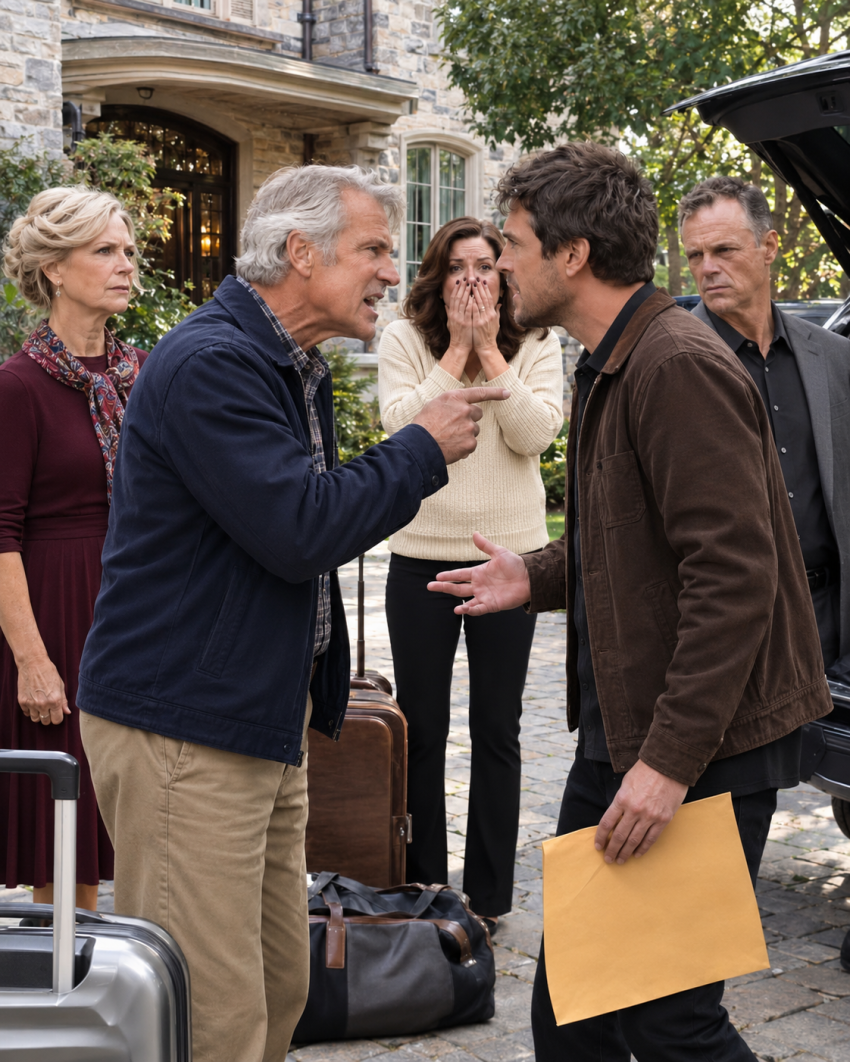
The cream envelope shone in the September sun. I held it above my head the way a teacher holds up a test, and twenty-nine people in linen and good loafers watched it as if it might open on its own. Down at the water, a gull complained about something. The tide was coming in.
Cullen’s face did a thing I had not seen since he was eight and I found a cracked window and a baseball.
“Where did you get that?” he said.
“It was in my front hall. In a drawer. Under a stack of takeout menus, actually, which I’ve been meaning to ask you about.” I turned the envelope over so everyone could see the strip of clear tape across the flap. “Somebody opened this and resealed it. Badly. I’d have used a better tape.”
Laurelai Vance stepped forward in a coral dress, one hand pressed to her pearls. “Margaret, this is hardly the place.”
“You chose the place, Laurelai. You set out the chairs.”
I should tell you how I came to be sitting on my own porch with a coffee cup on the railing and a dozen people judging my parenting.
My name is Margaret Hollis. I’m seventy-one. I was a court stenographer in Providence for thirty-eight years, which means I have typed the worst moments of other people’s lives at two hundred and forty words a minute without changing my expression. It’s good training. You learn that people say who they are very clearly if you just stop interrupting.
My husband, Nile, was a marine contractor. He built docks and seawalls up and down the Rhode Island coast, and he came home every night smelling of creosote and salt, with sawdust in the creases of his neck. He died fourteen years ago, in March, of a heart attack on a job site in Narragansett, standing on a piling he had set himself.
The beach house was his dream and, in the end, mine.
In 2003, after a hurricane took the roof off a gray-shingled cottage on a spit of land in Charlestown that everyone called the Point, Nile found it at an estate auction. The owners had walked away. The porch had collapsed. A family of raccoons had moved into the master bedroom. We bought it for $212,000, which was every dollar we had, and for six summers we rebuilt it ourselves. Nile did the structure. I did the paint and the floors and the cursing. We slept on a mattress in the living room for the first year and ate dinner on the hood of his truck.
He painted the front door blue himself, a deep, certain blue he mixed from three cans. “Same as the water at four o’clock,” he said.
That house is appraised at $1.94 million now. I don’t care about that number. It is the only place on earth where my husband’s handwriting is still on the studs. He wrote the date on every beam before it went up.
Cullen is my only child. He’s thirty-eight, a regional sales director for a medical-supply company, with Nile’s shoulders and a salesman’s trick of making you feel like the most important person in the room right up until you stop being useful. When he was small, he followed Nile everywhere with a toy hammer. At eleven he held the other end of a tape measure for an entire Saturday and never once complained.
I don’t know exactly when it changed. I think it was when he started making real money. There was a year when his phone calls became shorter and his invitations rarer, and a Christmas when he introduced me to a colleague as “my mother, she’s, retired, from the courts,” and the pause before retired had a shape.
I told myself it was ambition. Ambition, in a young man, can look a great deal like contempt.
Then he met Blythe.
She was thirty-three, a pharmaceutical marketing executive, with a wide, white, lovely smile and the kind of polish that takes years of maintenance. I liked her at first. I’ll say that. She brought lilies the first time we met. She asked about Nile and listened to the answer. She admired the house, and I watched her walk the porch with one hand on the rail, looking down the long gray planks to the water, and I thought: she loves it. Good.
I should have asked what she loved about it.
Her parents were Laurelai and Miles Vance, of a gated community in Barrington. Miles owned three car dealerships. Laurelai chaired charity luncheons and had a way of looking at your shoes before she looked at your face. They invited me to dinner once, at a restaurant where the menu had no prices, and Laurelai said, over the crab, “Cullen tells us you have a little place at the shore. How sweet.”
Little. A house I had rebuilt with a crowbar.
On a Sunday morning in early September, my phone rang while I was standing in my kitchen with a cup of coffee. The number was Cullen’s. The background was an airport, loud and echoing, with a boarding announcement rolling over it.
“Mom. Big news.”
“Good morning, sweetheart.”
“Blythe and I got married yesterday.”
I put down the cup.
I want to describe the next few seconds exactly, because I’ve gone over them. I wasn’t angry. I was quiet, in the way a courtroom goes quiet in the half second after a verdict, before anyone reacts. I heard the refrigerator hum. I heard the clock. I heard my own breathing.
“Yesterday.”
“At the Vance place, in Barrington. It was small. Forty-six people.”
“Forty-six.”
“Close friends, mostly. It was kind of, I don’t know, it was for people with status, Mom. You’d have hated it, honestly. All that standing around. Cocktail hour.”
People with status.
I had typed those words before. In depositions. They always arrive in the same tone, light and helpful, the tone of someone explaining why a door was locked.
“I see.”
“We’re flying to Hawaii now. Twelve days. And Mom, when we land on the twenty-sixth, we’re going straight to the Point.”
I waited.
“I mean, Blythe’s parents are giving us a welcome-home party there. It’s all planned. We gave up the apartment in Providence.” He laughed, easy and quick. “It’s just, it’s always been understood, right? The house was going to be ours eventually. Dad always said.”
I looked out the kitchen window at the maple.
Nile had said no such thing. Nile had said, and I have it in writing, in a note I’ll tell you about, something very different.
“Congratulations, sweetheart,” I said. “Have a safe flight.”
I hung up. I picked up my car keys.
It’s forty minutes from my house in Warwick to the Point, down Route 1, past the salt ponds and the stands of scrub oak, with the radio off. I drove it with both hands on the wheel.
The blue door looked the same. The porch swing moved a little in the wind. I let myself in with my key, and the smell hit me first, a smell I did not know. Vanilla, expensive, a candle on the kitchen counter in a glass jar with a gold lid.
Four suitcases stood in the front hall. Leather, matching, the color of cream. Six moving boxes were stacked against the wall, labeled in Blythe’s looping hand: KITCHEN, BOOKS, B’s SHOES, B’s SHOES 2.
They had moved in. Before the wedding. Before the honeymoon. They had come, I understood, the weekend before, while I was at my sister’s in Newport, using the spare key I’d given Cullen “for emergencies.”
I walked down the hall to the master bedroom.
A white bathrobe, thick, hotel-quality, hung on the back of the door.
My own robe, the faded green terrycloth one Nile bought me in 1996, had been moved to the hallway closet and wadded onto a shelf, beneath a stack of beach towels.
I stood there with it in my hands.
Then I went into the living room and looked at the mantel.
For fourteen years, a photograph had stood there in a plain wooden frame. Nile, on the dock at the Point, in a stained cap, squinting into the sun with a hammer in one hand and a grin like an open window. I had dusted that frame every Sunday.
The mantel was bare.
I looked in the kitchen. The bookshelf. The hall table. Then I opened the drawer under the telephone and found it, face down, buried beneath a pile of takeout menus. Pizza. Thai. A place called Bao Down.
I picked it up. The glass was smudged. I wiped it on my sleeve. Nile looked back at me, delighted, with sawdust in his eyebrows.
I held that photograph for a very long time.
Then I took out my phone and called a locksmith.
His name was Teodoro, and he arrived in forty minutes in a van that said KEY & CORE on the side, a stocky, patient man in his fifties with a gray mustache. He looked at the front door, at the blue paint, at my face.
“Changing everything?”
“Every exterior lock.”
“Any reason?”
“I’d like to be able to tell you I own the house, and I’d like the house to agree.”
He gave me a small, sympathetic smile. “Family?”
“My son.”
“Ah.” He set down his bag. “I do about three of these a month. It’s usually someone’s son.”
It took him two hours. Front door, back door, the porch slider, the basement hatch, the boathouse. He fitted new deadbolts, brass, and handed me three keys on a ring. I paid him $640 in cash and added a tip. He wouldn’t take it at first.
“Take it,” I said. “You’ve been kinder than anyone I’m related to.”
He laughed, and took it.
When he’d gone, I carried every suitcase and every box out onto the covered porch. It took nine trips. I stacked them against the south wall, under the roof, so the weather couldn’t reach them. I am not a vindictive woman. I covered the leather ones with a tarp.
Then I took a photograph.
The porch, the boxes, the blue door with its new brass. I sent it to Cullen with one line.
Congratulations again. I’ve changed the locks at the Point. Your things are safe.
The phone began to buzz within ninety seconds, though they were somewhere over the Pacific. Messages queue, and they landed in Honolulu all at once.
MOM. WHAT DID YOU DO.
We told everyone we’re living there. EVERYONE.
This is insane. Call me.
Then a long one from Blythe, which began, Margaret, I’m sure this is a misunderstanding, and ended, we’ve already given up the apartment, please, we have nowhere to go. It was pleasant and it was careful. It did not contain the words I’m sorry.
I replied to neither. I sent a single text to both.
Enjoy your honeymoon. We’ll talk on the 26th.
I spent a quiet week.
I’ll tell you what I did, because it matters. I read my own mail. I cleaned the refrigerator. I called my sister, Dorothea, in Newport, and told her, and she said, “Margaret Anne, you changed the locks?” in a voice like a woman discovering her sister could, in fact, drive.
And on the Wednesday, I sat down at my laptop and looked at the wedding.
The photographs were all over the internet. Blythe’s cousin had posted two hundred, in a public album titled B & C ❤️ Barrington. I went through every one.
My son, in a navy suit, looking happy. I’ll say that. He looked happy, and it hurt more than I’d expected. Blythe in ivory silk, radiant. Flowers, arches, candles. A string quartet. Long tables under a white tent. Forty-six people, and I studied every face, as I’d studied faces in a hundred courtrooms, looking for the one who knew.
And the cake.
I enlarged the picture three times. A three-tier cake, white fondant, with sugar roses. And on top, where a bride and groom would stand, a tiny sculpted house.
Gray shingles. A wraparound porch. A little door in deep, certain blue.
My house.
Someone had made, in sugar, a replica of the Point, down to the paint. Someone had worked on the door for hours. And they had put it on top of a cake and cut it in front of forty-six people, and my son had smiled for the photograph.
I sat quite still.
Below the picture, a comment from a woman named Pru Aldridge. So sorry your mom couldn’t make it, Cullen. Hope she’s feeling better!!
Feeling better.
I hadn’t been sick. I hadn’t been told. Apparently the guests had been informed, kindly, that Cullen’s mother was unwell. I had been given an illness so that nobody would ask why I wasn’t there.
My house had made it onto the cake.
I hadn’t made it onto the list.
Laurelai Vance called on Thursday afternoon.
I was at the sink with a dishcloth. The number came up unfamiliar, with a Barrington area code, and I answered because I’m a woman who answers.
“Margaret. Laurelai Vance.” She said it as if announcing a ship. “I think we should speak frankly.”
“Please.”
“I understand there’s been some confusion about the beach house.”
“Has there?”
“The house has been promised to the children.” Her voice was smooth, warm, and utterly sure. “Cullen explained it to us in June. It was always understood. We’ve made arrangements. We’ve told our friends. Blythe’s given notice on her apartment. I’d hate to see anyone embarrassed.”
“Anyone.”
“Margaret.” She dropped her voice, intimate, a woman speaking across a pillow. “Blythe is very sensitive. She’s been through a great deal. I’d ask you not to embarrass her daughter. I’m sure you understand what’s at stake.”
“I’m afraid I don’t.”
“The children’s happiness,” Laurelai said, with the faint, patient emphasis of a person explaining something to a very small child.
I looked at the dishcloth.
“Laurelai,” I said, “was I ill?”
A pause.
“I beg your pardon?”
“At the wedding. I’m told I was too unwell to attend. I’m curious. Whose idea was that?”
“I’m sure I don’t know what you mean.”
“I’m sure you don’t,” I said. “Thank you for calling.”
I hung up and stood in my kitchen, with the afternoon light on the oilcloth, and discovered that my hands were perfectly steady.
Miles called on Saturday.
I almost didn’t recognize the voice. In four years of acquaintance, Miles Vance had said perhaps forty words to me, mostly about the weather, in the cheerful baritone of a man who sells cars. This voice was lower, careful, with a hesitation in it.
“Margaret. Miles Vance. I hope I’m not disturbing you.”
“Not at all.”
“I wanted to, well. This is awkward.” He cleared his throat. “Is there some kind of problem with the paperwork?”
I stood still.
“What paperwork?”
“For the house. The transfer.” He sounded genuinely puzzled. “Cullen told me in June that it was done. Signed. He said you’d, I think the phrase was, ‘taken care of it,’ and that the deed was in your front hall. Ready to go. I’ve been telling people. Laurelai’s been telling people.” A pause. “I just, Margaret, I’d like to know, is it done?”
“Miles.”
“Yes?”
“I haven’t signed a transfer.”
A long, dead silence. I heard him breathe.
“I see,” he said quietly.
“I’d like to understand what Cullen told you. In June. Exactly.”
“He said, and I’m quoting, ‘Mom signed everything. The Point’s ours. We just need a party.’” Miles’s voice was low and slightly unsteady. “I took him at his word. I’m, I want you to know, I’m not a man who’d have wanted to, to take a woman’s house out from under her. I thought it was a family arrangement.”
“I believe you.”
“Margaret, I’m so sorry.”
“Thank you for telling me.”
“If there’s anything,” he began, and stopped. “I’ll, I’ll call you back.”
He hung up.
I stood with the receiver against my ear, listening to the tone. Then I set it down and went to find the envelope.
I should tell you about the envelope.
In April, six months before any of this, I had gone to see my attorney, Harold Okafor, whose office occupied a narrow brick building on Wickenden Street in Providence, above a shop that sold secondhand cameras. He’d handled Nile’s estate. He was sixty-eight, soft-spoken, with a bow tie and the unhurried manner of a man who has watched many families open many envelopes.
“Margaret,” he said, when I’d settled in the leather chair. “You look like a woman with a plan.”
“I’d like to give something to Cullen. On his wedding day.”
“Whenever that is.”
“Whenever that is.” I took a folded paper from my purse and laid it on his desk. “I want you to draw up something, and I’d like to tell you why.”
It was a note.
I’d found it in January, in the toolbox Nile kept in the basement of the Point, under a tray of wood chisels. I had gone down for a screwdriver. I had lifted the tray. And beneath it, folded in four and sealed in a plastic bag against the damp, was a single sheet of lined paper, in Nile’s square, slanting capitals.
I’d read it standing in the basement for an hour.
Margaret. If you’re reading this, I’m either dead or I’ve forgotten where I put it. Same thing probably. I wanted to say something about the Point, and I don’t know how else to say it.
It’s not worth what it’ll be worth. I know that. It’ll be a million, two million, the way the shore goes. People will want it. That’s what money does to a house. It makes it a number.
Don’t let Cullen have it because he’s ours. Let him have it when he’s built something of his own. When he’s driven a nail and hit his thumb. When he’s stood on a dock at four in the morning and understood what it’s for.
If he does, give it to him. All of it. With my love, and with the door painted blue.
If he doesn’t, don’t. Keep it. Or give it to someone who will. It was never a prize. It’s a trust.
I love him. I want him to deserve it. That’s the only way anyone can.
N.
I’d put it on Harold’s desk. He read it twice, took off his glasses, and rubbed the bridge of his nose.
“He was a good man,” he said.
“He was a very stubborn one.”
“Same thing.” He smiled faintly. “What would you like me to draft?”
“Two documents. A revocable trust, with the Point as its only asset. I’d be trustee. And a deed, held back, signed by me but not recorded, that would transfer the house to Cullen on a condition.”
“What condition?”
“That he come to me, in person, and ask. Not for the house. For the work. I’d like him to spend a summer on it. A real one. Scraping, painting, replacing the rotted boards on the dock. Nile’s list. I’d like him to learn what the house is.” I looked at my hands. “And at the end of the summer, if he’s done it, the deed is his. All of it, no strings.”
“And if he hasn’t?”
“Then it stays in the trust. And it passes to a foundation. A marine trades scholarship, for kids who want to build seawalls and docks.”
Harold wrote it down. He looked up.
“You’d consider that?”
“Nile would.”
“And you?”
I thought about it.
“I’d consider it a very expensive lesson,” I said, “that I hadn’t had to learn at a funeral.”
He drew it up in May. I signed in his office, with a notary named Priya Venkat who stamped it in lilac ink. There were three documents: the trust, the conditional deed, and a letter to Cullen in my own hand, which I’d written and rewritten eleven times.
I put them all in a long cream envelope. I wrote CULLEN on the front.
And I made a mistake.
I put it in a drawer in the front hall of the Point, the one under the telephone, because I thought, I’ll give it to him at the wedding. I’d imagined the day. A toast, perhaps. A small, private moment, my son in a good suit, and me, pressing an envelope into his hand with something I thought of as love.
I did not imagine the wedding would happen without me.
The night after Miles called, I drove to the Point and opened the drawer.
The envelope was there. I almost wept with relief. But when I lifted it, my fingers found a ridge across the flap, and I held it up to the light.
Clear packing tape. A neat strip. It had been opened and resealed, by someone who hadn’t wanted to be caught, and had done it just badly enough to be caught.
I carried it to the kitchen table. I sat down. I slit the tape with a butter knife.
All three documents were inside. The trust. The deed. My letter, folded in thirds.
But on the first page of the deed, in the margin, in blue ballpoint, someone had written a note.
“Needs signature. Mom’s at Dorothea’s 6/14. Do it then?”
The handwriting was Cullen’s.
I put my hand over my mouth.
I’d been at Dorothea’s on the fourteenth of June. I’d been in Newport for the weekend. Someone had stood in my front hall, read the document, and planned. Not to steal the deed, which wasn’t signed over, but to complete it. To find a way to make my signature appear. And somewhere in between, I think, a smaller, wiser voice had asked: what if she notices?
He hadn’t gone through with it. The deed was still unsigned by anyone but me, and still conditional, still unrecorded. But he’d stood where I was standing. And he’d told his future father-in-law in June, with absolute assurance, that it was done.
I sat at that kitchen table for a long while.
I thought of a boy of eleven holding the end of a tape measure.
Then I called Harold.
“Margaret,” he said, when I’d finished. “I want to be very careful here.”
“I know.”
“What Cullen did, opening a sealed envelope addressed to him, and annotating a draft, is not, strictly speaking, a crime. It’s a trespass of privacy, but it’s his own name on the front.” I heard him turn a page. “What he told Mr. Vance, that the transfer was complete, is more troubling. It’s a misrepresentation to a third party. But he’d have to have acted on it.”
“They’ve planned a party.”
“I’m aware. I’ve had a call from a neighbor.” A pause. “Margaret. Are you intending to go?”
“I’m intending to sit on my own porch.”
“I’d advise,” he said carefully, “that if you do, you have the documents with you. All three. And that you read the last page, aloud, and offer a copy to anyone who asks.”
“What’s on the last page?”
“A statement of conditions. Signed by you. And a codicil, a short one, in which you refer to Nile’s note.” He hesitated. “I’m not suggesting theater, Margaret. But sometimes the clearest thing is the true thing, said once, where everyone can hear.”
I looked at the window. A single gull sat on the porch rail.
“I’ve spent thirty-eight years typing what people say aloud,” I said. “I think I’d like, just once, to say something myself.”
The invitation came from my neighbor, Mrs. Ostrowski, a tiny, fierce widow of eighty-four who lived two doors down the Point and kept binoculars on her windowsill. She knocked on my door on the twentieth, in her gardening hat, with a cream-colored card.
“This was in my box,” she announced. “Thought you’d like to see.”
You are cordially invited to a Welcome-Home Celebration for Mr. and Mrs. Cullen Hollis. Saturday, September 26th, 2 o’clock. At the Point, Charlestown. Hosted by Laurelai and Miles Vance. Champagne and light refreshments. Regrets only.
I read it twice.
At the Point. My porch. My blue door.
“Thirty-four people,” Mrs. Ostrowski said. “I counted the RSVPs on the neighborhood board. They’re all coming to watch you hand over the keys.”
“Is that what they’ve been told?”
“That’s the rumor.” She sniffed. “I don’t care for it, Margaret. I knew your Nile. He’d never have stood for this.”
“No, he wouldn’t.”
“What are you going to do?”
I considered the question. I looked at the card, at the engraved script, the little silver border.
“I’m going to let them have their party,” I said.
She stared at me.
“I’m not going to cancel. I’m not going to make a scene. I’m going to sit on my own porch and drink a cup of coffee.” I smiled. “And then I’m going to read them something.”
Mrs. Ostrowski’s face broke into a slow, delighted grin.
“I’ll bring the folding chair,” she said.
On Saturday, the twenty-sixth of September, I arrived at the Point at noon.
It was a clear, bright, perfect day, the sky scrubbed blue, the water flat and silver and a little restless. I parked in the gravel and carried two things up the walk: a thermos of coffee, and my purse, with the cream envelope in it.
The suitcases were still on the porch, under their tarp. I’d put them there, in plain view, just as I’d left them. I unfolded a canvas chair beside them, next to the blue door, and sat down.
At one o’clock, the first car arrived.
Laurelai had hired a caterer. Two young men in white shirts carried trays up the path. A florist’s van delivered six arrangements of white hydrangeas. A string trio, two violins and a cello, set up under the oak. Folding chairs, white, with cushions, were arranged on the lawn in four neat rows, all facing my front door.
I watched it all with a cup of coffee in my hand.
At two, the guests began to arrive. Thirty-four, Mrs. Ostrowski had said. I counted twenty-nine in the first wave, in linen and silk and good loafers, carrying gifts wrapped in gold. They greeted one another with the soft air-kisses of people who see each other at benefits. Several glanced at me, and looked away. A woman in a wide hat whispered something to her husband. A man in a blazer, seeing the suitcases beside my chair, raised an eyebrow.
Laurelai swept up the path in a coral dress with Miles at her elbow. She stopped when she saw me.
“Margaret.”
“Laurelai.”
“I’m so glad you could be here.” Her smile was tight and radiant. “Is the door, are you going to open it?”
“I thought I’d wait for the guests of honor.”
“Of course.” She patted my arm. “They’ll be here any moment.”
Miles didn’t meet my eyes. He stood a step behind his wife with his hands in his pockets, a heavy, well-dressed man looking at the planks. I thought he looked ill.
At 2:20, a black car pulled into the drive.
It was a hired car, a sleek town car, with tinted windows. It came up the gravel slowly and stopped beside the oak. The driver got out, opened the rear door, and stood waiting.
Blythe emerged first, in a pale yellow sundress, with a lei of orchids still around her neck. She was tanned, radiant, glowing like a woman out of a travel advertisement. She lifted a hand to the crowd, and a ripple of applause went through the lawn.
Then Cullen.
He climbed out slowly, with one hand on the door, and stood a moment in the sun. He wore a linen shirt, rumpled from the flight, and his hair was longer, bleached a little at the ends. He was smiling. It was a rehearsed smile, bright and open, the smile of a man walking into a room he’s already decided to own.
It lasted about four seconds.
Then his eyes went past the crowd, past the chairs, past the flowers, and found the porch. The tarp. The suitcases. And me, in a canvas chair, with a coffee cup.
The smile didn’t fade. It tightened, the way a rope does when a weight is added.
He came up the walk. The crowd parted. I watched him come, my son, thirty-eight years old, with his father’s shoulders and his father’s walk, and for one moment, one small and terrible moment, I saw the boy with the tape measure.
“Mom,” he said, low. “Open the door. Now.”
“Hello, sweetheart. How was Hawaii?”
“I said, open the door.”
“I heard you.”
“Mom.” His voice cracked on it. He looked over his shoulder at the crowd, thirty-odd people, all watching, and lowered his voice. “Please. Everyone’s here. Don’t do this.”
“Do what?”
“This.” He gestured at the porch, the suitcases, the chair. “Embarrass us.”
Laurelai stepped forward in a rustle of coral.
“Margaret,” she said, projecting, in the voice she used for charity luncheons. “The children are home. Everyone’s waiting. If you’d be so kind as to give them their keys.”
A murmur of agreement from the lawn. Someone clapped, uncertainly.
I set down my coffee.
I looked directly at my son.
“Who told you this house was yours?”
The lawn went quiet.
I hadn’t raised my voice. I’d spoken at conversational volume, as I would across a kitchen table. But the quartet had stopped, and the wind had dropped, and the sentence carried out over the grass like a thrown stone.
Cullen’s face flushed. A dark, dull red crept up from his collar.
“What?”
“I asked who told you. I’d like to know. It’s a simple question.”
“It’s, Mom, it’s always been, you know that!” His voice rose, cracked, rose again, a man whose composure was slipping its mooring. “This house was always going to be mine! Dad said! You’ve said it yourself, a thousand times! It’s, it’s ours!”
“Is it?”
“Yes!”
“Cullen,” Blythe said sharply, behind him. “Lower your voice.”
“I’m not going to lower my voice! She’s, she changed the locks, Blythe! She put our things on the porch!” He was nearly shouting now, his face blotched, the veins standing at his temples. “She’s been, she’s sitting there like a, like a judge, in front of all these people, and she knows it’s mine! She knows! I saw it!”
I said nothing. I waited.
“I saw the deed, Mom!” he cried. “In your front hall! In the drawer! It’s done! It’s signed! I saw it!”
The silence that followed was absolute.
A hundred conversations stopped at once. Twenty-nine heads turned. I heard, very distinctly, the creak of the porch swing and the slap of a wave against the pilings, and, somewhere behind me, Mrs. Ostrowski, in a lawn chair at the property line, draw a long, slow, satisfied breath.
I slowly placed my coffee on the railing.
Twenty-nine people stood on my lawn, staring.
I reached into my purse.
“This one?” I said.
I drew out the long cream envelope and held it up, in the bright light, where everyone could see.
The tape across the flap caught the sun.
“The same envelope,” I said, “that was in the drawer under the telephone in my front hall. The one marked with your name, Cullen. The one someone opened, in June, and resealed with packing tape.”
His face went white.
It happened all at once, as if a plug had been pulled. The red drained out of it, in a long gray wave. His mouth opened slightly. His eyes, I saw, had fixed on the envelope with the expression of a man watching a car roll toward him down a hill.
“You said you saw it,” I said.
“I…”
“In the front hall. In a drawer. You said, and I’d like these good people to hear it, that you saw the deed, and that it was done.”
“Mom, I didn’t, I mean…”
“I’m going to read you something,” I said. “And then I’m going to give a copy to anyone who’d like one.”
I took out the documents. The trust. The deed. My letter. I laid them on my knee, in the sun. I turned, slowly, to the last page of the deed, and I held it up so the crowd could see the signature at the bottom.
Margaret A. Hollis. And beside it, in a smaller hand, Notarized, Priya Venkat, Providence County, May 14th.
Behind Cullen, Blythe had put her hand over her mouth.
“This is a deed,” I said, in the clear, level voice I’d used for thirty-eight years to read testimony into a record. “It’s signed by me, and notarized, and it has never been recorded. It’s a conditional deed, and I’d like to read you the condition.”
I cleared my throat.
“‘This conveyance shall take effect only upon the grantee’s completion, in person and in good faith, of a full summer’s labor upon the premises, to be certified by the Grantor, in accordance with the written wishes of Nile R. Hollis, deceased. In the event of non-completion, title shall remain in the Hollis Point Trust, and pass, upon the Grantor’s death, to the Nile Hollis Marine Trades Scholarship.’”
I looked up.
“I wrote that in April,” I said. “Before the wedding. Before you’d told me you were getting married. I’d planned to give it to you that day. I’d planned to say, Here. This is yours. Your father wanted you to have it. All you have to do is come and earn it.”
Cullen made a sound.
“I never got to say it,” I said. “Because I wasn’t there. I was, I’m told, too unwell.”
The lawn was silent. Thirty-odd people stood as if carved. The string trio had put down their bows. Down at the water, a boat horn sounded, long and low.
Miles Vance stepped forward.
He did it slowly, a heavy, gray man in a blazer, with his hand pressed to his tie as though it were suddenly too tight. He looked at the envelope. He looked at the deed. He looked at his own wife.
“Laurelai,” he said quietly.
“Miles, don’t.”
“You told me it was done.”
“Cullen told me.”
“Cullen told me it was signed. And I told you, and you told everyone.” His voice was shaking. “We made a cake, Laurelai. We put a, a replica of her house on a cake.”
A faint, horrified gasp rose from the lawn.
“I’m sorry,” Miles said, turning to me, and his eyes were wet. “Margaret. I’m so sorry. I’d like to, to say it in front of everyone. I took a man’s word, and I never called you. I never asked. I should have called you in June.” His jaw worked. “It was your husband’s house.”
I looked at him for a long moment.
“Thank you, Miles,” I said. “That’s the first honest sentence anyone’s said on this lawn.”
He bowed his head.
Laurelai had gone the color of bone. She stood with her coral dress hanging off her shoulders and her hand frozen halfway to her pearls, looking at the paper like a woman at a diagnosis.
“This is absurd,” she said weakly. “It’s, it’s a private matter. It’s, there’s been a misunderstanding. A family misunderstanding.”
“There has,” I said. “Hardly a private one. You hired a quartet.”
A laugh, startled, somewhere in the crowd. Quickly stifled.
Cullen had sat down.
I hadn’t seen him do it. He was simply on the porch step, a few feet from my chair, with his elbows on his knees and his face in his hands. His shoulders were shaking. His linen shirt, rumpled and sun-bleached, had come untucked at one side.
I let him.
I sat with the papers in my lap and the sun on my shoulders, and I did what I’d learned to do in a thousand courtrooms. I waited. A person in the middle of the truth should not be hurried.
The gulls cried. The tide came in.
Finally, he lifted his head. His face was blotched and swollen. He wiped his nose with the back of his hand, like a child.
“I didn’t forge anything,” he said. His voice was a rasp. “I want you to know that. I wrote that note, I wrote, do it then, and I stood there, and I couldn’t. I couldn’t do it.”
“I know.”
“You know?”
“I read the margin. The deed was unsigned by anyone but me. I saw where you stopped.”
He stared at me.
“I’d like to tell you something,” he said. “And I’d like to say it here. In front of, in front of everyone. Because I think I owe it.”
“Go ahead.”
He stood. He faced the lawn, the chairs, the white hydrangeas, the faces. His hands, I saw, were shaking.
“I told everyone you were sick,” he said. “I told them you couldn’t come. I told Blythe’s mother, and her father, and Pru, and everyone. I said you had a, a heart thing.” His voice cracked. “You didn’t. You were fine. I just, I couldn’t have you there.”
A murmur.
“I was ashamed,” he said. “I’m so, God. I was ashamed of you. Because you were a, you were a stenographer. You’d never been on a boat. You wore a green robe from 1996. And I was marrying into a family that, that summered, and I thought, if she’s there, they’ll see where I come from.”
I closed my eyes.
“And I couldn’t, I couldn’t bear it. So I told them you were sick. And then I told myself the house would, would make up for it. That if I had the Point, I’d have a place in the world. That nobody would ask where I came from if I came from there.”
He stopped. He put the back of his wrist against his mouth.
“But it’s not my house,” he said. “It never was. It’s Dad’s. And I’ve been, I’ve been standing on it like I earned it.”
The lawn was silent.
I opened my eyes.
My son stood in front of me, thirty-eight years old, with his father’s shoulders and his father’s blunt, honest face. He was weeping, openly, without shame. I thought of Nile on the dock at four in the morning, with a hammer. I thought of what he’d written.
When he’s driven a nail and hit his thumb.
“Cullen,” I said.
“Yes.”
“Come here.”
He crossed the porch. I stood, with the papers in my hand, and I put my free arm around him. He was taller than me by a foot. He bent, and put his face in my shoulder, and I felt him shake.
“I’m sorry, Mom,” he said, muffled. “I’m so sorry.”
“I know.”
“I don’t, I don’t know why I did it.”
“I do,” I said. “You wanted to belong somewhere. You just picked the wrong room.”
He cried harder.
I held him, on my own porch, in front of thirty-four people and a string trio, as I’d held him at eleven after he’d fallen off the dock. I stroked the back of his head. And I thought, with a clarity that surprised me, Nile, I did it. I didn’t give it to him. I made him come to me.
When he finally straightened, he wiped his face on his sleeve.
“What do I do?” he asked.
I looked at the envelope.
“There’s a list,” I said. “Your father’s. It’s in the basement. Rotted boards on the dock, the south stairs, the trim around the porch. The boathouse door. It’s a summer’s work.”
“I’ll do it.”
“It’s not a punishment.”
“I know.”
“It’s a way to know the house.”
“I know.” He swallowed. “Mom. Will you, will you teach me? Where the beams are, and what Dad wrote on them?”
My throat closed.
“Yes,” I said. “I’ll show you.”
They left, one by one, a little after three.
It was done with great gentleness. A few guests approached me quietly, in twos, and murmured something and pressed my hand. The woman in the wide hat squeezed my fingers and whispered, “I’m so sorry, dear.” A man in a blazer, who I later learned was a retired judge, said, “Mrs. Hollis, I’ve sat on the bench for thirty years, and I’ve never seen a document read more clearly.” The caterers, tactful, began to pack the trays. The trio played something soft and unobtrusive, as if to cover a departure.
Laurelai left without a word. She walked down the path in her coral dress with her chin high and her shoulders rigid, a woman who had been caught in the middle of an elaborate lie and had decided, at all costs, to look as though she had been planning to leave. Miles followed a few paces behind. At the car, he turned, and lifted one heavy hand in a half wave.
I lifted mine.
Blythe was the last.
She stood at the foot of the porch steps in her yellow sundress, with the orchid lei hanging crushed around her neck. She’d taken off her sandals. She held them in one hand, a young, tanned woman with tears running down her face.
“Margaret,” she said.
“Blythe.”
“I need to say something. And I’d like you to hear it as, as me. Not as, as my mother’s daughter.”
“All right.”
“I didn’t know.” Her voice shook. “I swear. Not about the, the deed, or the envelope, or the, the sick. I thought you’d, I thought you agreed. Cullen told me you’d said it was fine. That you’d said of course, of course, take it. I thought you wanted us there.”
“I believe you.”
“I put a house on a cake.” She laughed, wetly, horribly. “I, I ordered it. From a bakery in Providence. I sent them photographs of the door. I thought it was romantic.”
“It was a very good cake.”
She gave a strangled, tearful gasp that was nearly a laugh.
“I’m so sorry,” she said. “I’d like, I’d like to meet you. Properly. If you’d let me. Not for a house. I just, I realized, standing there, that I don’t know you. I’ve been married to your son for three weeks and I don’t know a single thing about his mother.”
I looked at her.
I thought about Laurelai’s coral dress, and the way a daughter learns a mother’s habits without meaning to. I thought of Nile’s note. It’s a trust.
“Come back next Saturday,” I said. “Wear old clothes.”
She blinked.
“There’s a lot of scraping to do.”
I won’t tell you everything about that summer. Some of it belongs to my son.
He took leave from work, six weeks, unpaid, which he’d negotiated with a boss who thought he’d lost his mind. He and Blythe moved into the guest room at my house in Warwick, and drove down to the Point every morning at six. I met them there with a thermos. I handed Cullen Nile’s list, a yellowed sheet of graph paper in the old square capitals: South stairs, 3 treads rotted. Dock, replace stringers 4 thru 9. Porch trim, scrape and prime. Boathouse door, rehang.
He read it standing on the porch, in his father’s old cap, which I’d found in the closet and handed over without a word.
“Where do I start?”
“Where your father did. With the dock.”
It was hard. I want you to know that. He’d never done real work. By the second day, his hands were blistered, and by the fourth, they’d cracked and bled, and he stood on the end of the dock at noon, in the glare, with a cheap hammer and a bandaged thumb, swearing steadily in a flat, defeated monotone.
“I hit my thumb,” he announced.
“I noticed.”
“It really hurts.”
“It’s meant to.”
He looked at me. And I saw something move across his face, an old, slow, startled thing, as of a man receiving a message from a great distance.
“That’s what Dad meant,” he said. “In the note. About hitting my thumb.”
“Yes.”
“I thought it was a figure of speech.”
“Your father didn’t have many of those.”
He laughed, and winced, and sucked his thumb. And for the first time since the wedding, I heard him laugh like himself.
Blythe, to my surprise, was magnificent.
She arrived on the first Saturday in an old pair of jeans and a paint-spattered shirt, with her hair in a ponytail and a bandanna tied over it. She said, “Put me to work.” I handed her a scraper and a bucket of primer and pointed at the porch rail.
She worked for nine hours without a break. She had, I discovered, a gift for it, a methodical, patient, perfectionist’s focus. When she’d finished the north side, she stood back and wiped her forehead with her wrist, and said, in a small, wondering voice, “I didn’t know I could do this.”
“Most people don’t.”
“Do you think Nile would have liked me?”
I considered.
“I think,” I said, “he’d have made you hold the other end of the tape measure.”
She beamed.
We got to know one another, that summer, over thermoses and sandwiches on the dock. She told me about growing up in Barrington, about a childhood of private lessons and perfect recitals and a mother who corrected her posture at the table. She told me she’d never once, in thirty-three years, been allowed to get dirty.
“I think I married your son,” she said, scraping a stubborn patch of old paint, “because he laughed when he spilled a drink. Nobody in my family ever laughs when they spill.”
“He gets it from his father.”
“Nile spilled things?”
“Constantly.”
She grinned at the rail.
The Vances came on the last day of August.
I hadn’t expected them. They arrived unannounced, in the late afternoon, in a gray sedan that wasn’t a dealership car. I was on the porch with a pitcher of lemonade. Cullen and Blythe were on the dock, rehanging the boathouse door, with a spirit level and a great deal of argument.
Miles got out first. He wore khakis and a plain polo shirt, and he looked years younger. He’d lost weight. He came up the path alone, and stopped at the foot of the steps.
“Margaret.”
“Miles.”
“I was hoping to speak with you. If you’ve got a minute.”
“I’ve got a pitcher of lemonade.”
He smiled. It was a shy, crooked smile, I noticed, and it suited him.
We sat on the porch swing, side by side, with a glass each. The water glittered. Down on the dock, Cullen’s voice rose in protest, and Blythe’s rose in answer.
“I wanted to apologize,” Miles said. “Properly. Not in front of a crowd.”
“You did.”
“I did it badly.” He turned his glass in his hand. “I’ve been thinking about it all summer. I spent thirty years in a business where a man’s word is the whole thing. And I took Cullen’s, and I never checked.” He looked out at the water. “I don’t think I’ve ever been so ashamed.”
“You weren’t the one who lied.”
“No. But I was the one who stopped asking.” He swallowed. “I’ve been that man for a long time, Margaret. The one who lets his wife run the table, because it’s easier.”
I said nothing. I let the silence sit.
“I’m leaving the business,” he said abruptly. “Selling the dealerships. I’ve got a buyer. A young man from Worcester.” He gave a short, astonished laugh. “I think I’m going to take up woodworking. I was going to ask, if you’d, if it wasn’t an imposition, whether I might come down some weekends. And help. With the list.”
I looked at him.
A heavy, gentle, gray-haired man in a polo shirt, holding a glass of lemonade. A man who’d sold cars for thirty years and had never once, I thought, been asked to hold the other end of anything.
“Bring a hammer,” I said.
He grinned like a boy.
“And Laurelai?” I asked.
His face sobered.
“She’s, she’s working on it. She sees a woman in Providence. A therapist. She’s, it’s not easy. But she, she asked me to tell you something.”
“Yes?”
“She said,” Miles said slowly, “to tell you that the cake was made by a very good baker. And that she’s sorry she didn’t ask what the house meant.”
I thought about that.
“Tell her,” I said, “that’s a start.”
On the second Saturday in September, a year to the week after the call from the airport, I stood on the dock at four o’clock in the afternoon with a bottle of cheap champagne and four plastic cups.
The work was done.
Every item on Nile’s list had been crossed off in my own hand. The south stairs, rebuilt. The stringers, replaced. The porch trim, scraped and primed and painted, white as bone. The boathouse door, rehung, with a new brass latch. On the front of the house, the blue door had been repainted, by my son, in a deep, certain, three-can blue, mixed from a formula I’d found on the lid of a rusted paint tin.
Cullen stood beside me in his father’s cap.
His hands were scarred. He had a new, permanent crescent of callus along each palm. He’d lost ten pounds and gained, somewhere along the way, a stillness that hadn’t been there before. He looked, I thought, a great deal like Nile at thirty-eight.
“Mom,” he said. “It’s four o’clock.”
“I know.”
“The water’s the color of the door.”
I looked down. He was right. In the low, slanting light, the bay had gone a deep, level, glowing blue. The same blue. Exactly.
“Same as the water at four,” I said. My voice cracked.
“That’s what Dad said.”
“That’s what he said.”
I took the envelope from my coat pocket. It was the same long cream one, resealed, with fresh tape, and I’d written a new line on the front, beneath his name.
Done.
I put it in his hands.
“Open it,” I said.
He slit it with his thumbnail. He drew out the deed. It was the same document, the same notary stamp, and on the last page, beneath the condition, a new line, in my own handwriting, dated that morning.
Condition fulfilled. Title to the Point conveyed to Cullen N. Hollis, with his father’s love. — M.A.H.
He read it twice. His hands were shaking.
“Mom,” he said. “I don’t…”
“It’s yours.”
“I don’t know if I deserve…”
“That’s why you do.”
He stared at me. He opened his mouth. And then, my tall, scarred, blunt-faced son, who had once been too ashamed of me to put me on a guest list, folded over at the waist like a man struck, and put his arms around me, and held on.
“I love you,” he said. “I love you. I’m sorry. I love you.”
“I know, baby.”
“I’m going to take care of it.”
“I know you are.”
“I’m going to, to keep it.”
“I know.”
We stood there, on the end of a dock, in the gold light, with the tide running in beneath our feet. Behind us, on the porch, Blythe and Miles and Laurelai, who had come, tentatively, in a plain linen blouse, stood watching in silence. Mrs. Ostrowski, at the property line, held up her binoculars and wiped them furtively on her sleeve.
And the blue door stood open, in the long light, with the smell of fresh paint drifting out over the water.
That night, after everyone had gone, I walked through the house alone.
I went from room to room, as I’d done a thousand times. The kitchen with its wide, scarred table. The living room with its stone hearth. The bedroom at the end of the hall, where a faded green robe now hung on the back of the door, exactly where it belonged.
On the mantel, in the center, stood a photograph in a plain wooden frame.
Nile, on the dock, in a stained cap, squinting into the sun, with a hammer in his hand and a grin like an open window.
Cullen had put it back himself. On the first day of the summer. Without a word. I’d found it there when I arrived, polished, with the glass wiped clean.
I stood in front of it for a long time.
“Well, Nile,” I said, aloud. “We did it.”
The house ticked around me, the old settling sounds I’d known for twenty years. The wind moved in the eaves. Somewhere under the porch, the tide slapped softly at a piling that my husband had set with his own hands.
I put out my hand and touched the frame.
On the beam above the mantel, in the lamplight, I could just make out the faded pencil capitals, written a decade and a half before the first anyone asked what the house was worth.
MAY 9, 2004. N.H. — FOR M. — FOR C. — FOR WHOEVER COMES.
I’d read it ten thousand times.
I read it again. And then I turned off the light, and went out onto the porch, and sat in the swing, and watched the last of the blue go out of the water.
It wasn’t a number. It never had been.
It was a door that opened from the inside.
And, at last, everyone I loved was standing on the right side of it.