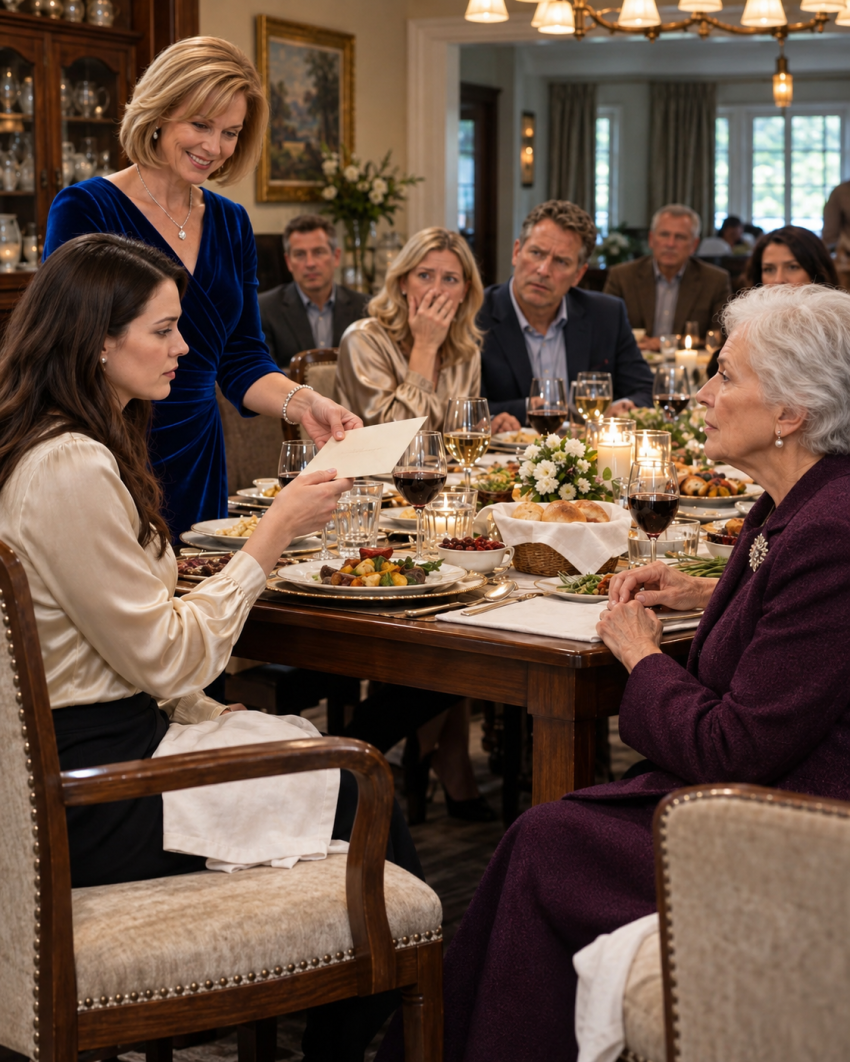
Mom’s mouth opened, and for once nothing came out.
Twenty-two relatives sat frozen around the long table, the candles throwing gold on the good china, the ham going cold, and Grandma Ruth held my mother’s eyes the way you hold a door shut against wind.
“Mother,” Mom said, finally, with a thin laugh. “Don’t be silly. Lydia does filing.”
“I asked you a question, Paula.” Grandma’s voice was soft and perfectly clear. “What does she do?”
At the far end, Grant had stopped breathing.
My name is Lydia Kerr. I am forty-four years old, and for four days I had been awake in a windowless room in Toledo, running six hospitals on paper.
I should tell you what that means, because my mother never asked. Northwood Health is a network of six hospitals and thirty-one clinics in northwest Ohio, about nine thousand employees, 1.4 million patient visits a year. At 3:12 on the morning of December 21, a ransomware attack locked every clinical system we owned. Medication records, lab results, imaging, orders, all of it. A message on every screen demanded $4.2 million in cryptocurrency.
I was the chief operating officer. I had held that title for fourteen months.
Our chief nursing officer, Marisol Okonkwo, a brisk woman of fifty-eight who once talked a man off a parking-garage ledge, called me before the sun was up. She didn’t say hello. “Everything’s locked.”
By 4:30, I was in the command room with the incident team, a gray windowless box with a whiteboard and bad coffee. I gave six hospitals the same instruction: open the downtime boxes. We go to paper.
Every unit has one, a plastic bin of blank medication sheets, order forms, and charts, rehearsed twice a year in drills nobody loves. I had insisted on those drills for eleven years, over complaints about cost. That morning, nurses pulled the boxes down and began writing by hand.
Nobody guessed. If someone didn’t know a dose, they asked. A patient is a patient whether or not the screens are lit.
I want to tell you how I got to that table, because the toast didn’t start in the dining room.
I was nineteen, in my second year of nursing school at Ohio State, with a 3.8 and a scholarship, when my father, Richard Dunn, a high school band director, was diagnosed with pancreatic cancer. My mother called my dorm at eleven at night.
“I need you home.”
“Mom, I have finals.”
“Kelsey’s sixteen. She can’t lose this year. You’re the sensible one, Lydia.”
I withdrew in January. I’d like to say I fought it. I packed a duffel bag.
I took a night job in the medical records basement at the hospital where Dad was treated, because it paid $9.10 an hour and let me sit with him in the afternoons. My first badge read LYDIA DUNN, FILE CLERK. I pulled charts from steel shelves and carried them up in a cart with a bad wheel.
Mom’s Christmas letter that year said: Lydia is doing a little filing at the hospital to help out.
Dad died in October, when I was twenty. After the funeral, standing in the kitchen with a casserole dish in my hands, I asked whether I might go back to school in the spring.
Mom looked at me with red, tired eyes. “Let’s not make this about you right now.”
So I didn’t. I took night classes at a community college, one at a time, while working days. It took eleven years to finish my bachelor’s degree. My mother missed the ceremony. She had a hair appointment.
I rose slowly. I want you to know that, because people assume a great title means a great leap. It was a ladder with missing rungs.
Supervisor of medical records, at twenty-nine. “So you’re in charge of the folders now,” said Mom. Manager of health information, at thirty-three. Director, at thirty-six, with forty people under me and a master’s degree in health administration I’d earned at night over five years.
At Thanksgiving that year I told the family, over pie, “I’m the director of health information now.”
Mom smiled sweetly. “Director of filing. Well, look at you.”
Everyone laughed. Kelsey laughed hardest. She’s two years younger than I am, blond and warm and quick, and I don’t think she ever meant harm. She’d simply never been asked to look.
That night I drove to my grandmother’s.
Ruth Kerr is eighty-nine, my father’s mother, a retired school librarian with a cap of white hair, a cane she refuses to lean on, and eyes like the blue part of a gas flame. She lives in a small brick house in Maumee with a cat named Dewey and a refrigerator covered in clippings. She made tea. She put a plate of shortbread in front of me, and sat down, and said something no one in my family ever had.
“Tell me what you actually do.”
I talked for two hours. I told her about the paper-to-electronic conversion, about the budget, about the nurses I’d trained. She listened with her chin in her hand, asking questions, real ones.
When I finished, she said, “Your father would have burst.”
I cried into the shortbread.
After that, I stopped explaining my career to my mother. But I kept building it.
I led the move of three hospitals from paper charts to an electronic system, an eighteen-month nightmare with a go-live weekend I’ll never forget. I became vice president of operations. I created a program, my favorite thing I’ve ever done, in which every discharged patient got a call from a real nurse within forty-eight hours. Not a robocall. A nurse, with a script and a heart. Readmissions fell by eleven percent. It saved, by our estimate, $6.8 million a year, and a number of lives nobody can count.
Fourteen months before that Christmas, the board named me chief operating officer.
I called my mother that afternoon, from my car, with my hands shaking.
“Mom, I have news.”
“Can I call you back?” Her voice was bright and distracted. “Kelsey’s showing me a house.”
She never did.
Grandma learned from the Toledo Blade, two days later. She cut out the article, a column and a half with my photograph, and put it on her refrigerator with a magnet shaped like a lighthouse.
Mom stood in front of it that Easter, in Grandma’s kitchen, and read it. I wasn’t there. Grandma told me later.
“Paula looked at it,” she said, “for about a minute. And then she said, ‘Must be a different Lydia Kerr.’”
I laughed. It was the only thing to do.
Then I went into the bathroom and shut the door.
The week of the attack, my phone didn’t stop.
It was face down at every meal, buzzing like a trapped insect. Vendors, regulators, the FBI, a reporter from the Blade. A negotiator from a firm in Virginia who spoke in a calm, flat voice about “decryption timelines.” The board chair, a retired surgeon named Alan Prewitt, who called every four hours to say, “Whatever you need, Lydia.”
On the morning of the twenty-second, Mom called.
I answered on the second ring, thinking something had happened. My voice was ragged.
“I need three pies for Christmas,” she said. “Pumpkin, apple, and pecan.”
I stood in a corridor, in yesterday’s clothes, holding a clipboard.
“Mom. There’s a situation at work.”
“It’s filing, honey.” Her tone was gentle, a mother managing a child. “And Christmas is Kelsey and Grant’s day. Please don’t start in about your little office things.”
I closed my eyes. A nurse hurried past with a paper chart.
“I’ll bring the pies,” I said.
I ordered them from a bakery, with an assistant’s help, at noon, between a conference call with the FBI and a meeting about blood supply.
Then I went back to work.
Two nights later, at four in the morning, the freight elevator at the Northwood Heart Institute died.
It’s a big, groaning steel thing at the back of the building, the one that carries supplies up to the cardiac floors. The power had been cycling, since the attack, with the building’s systems in a half-awake state. When it stopped between the first and second, a stack of boxes of blank paper forms sat in the lobby, waiting for the third.
We needed them upstairs. Fast. The cardiac floor had run out.
I picked up the box myself.
I’d like to say there was some principle in it. There wasn’t. There was a stairwell, and a box, and nobody else near. I carried forty pounds of paper up three flights of cold concrete stairs in my work flats, with my badge swinging against my chest.
The floor was a hush of lamplight and dread.
I’d never seen it like that. Doctors in scrubs sat on stools at the nursing station, writing orders by hand, in block capitals. Nurses moved from room to room with clipboards. Charts lay in tall, tilting stacks. The air smelled of old paper and cold coffee.
I set the box on the counter. I knelt, and began to sort the charts by room number.
My hands remembered. They’d done it for thirty-one years. A chart, a number, a slot. It’s a rhythm, like breathing.
A cardiologist stopped beside me.
He was a tall man in his late forties, gray at the temples, in a wrinkled white coat, with an ID badge that read GRANT WHITAKER, MD. I knew his face from forty photographs on my sister’s mantel. I’d attended his wedding. I’d given a toast.
“Have we met?” he said.
I opened my mouth.
“That’s Ms. Kerr,” said the charge nurse, a plump woman named Darlene, from the desk. She didn’t look up. “She runs the place.”
Grant looked at me for about two seconds.
He nodded. “Thank you,” he said, and meant it, and turned back to his patient.
I knelt on the floor, in the dim light, and went on sorting. He hadn’t recognized me. He’d seen me in a pantsuit at a wedding, in a black dress at a funeral, in a robe at my sister’s Easter. He had never seen me working.
Neither had my mother.
I didn’t correct him.
At 4:40, my phone buzzed.
I took it out in the stairwell, with a charge nurse’s thermos in my other hand.
MOM: That hospital is a disaster. My appointment’s been delayed. Somebody should lose their job.
I stared at it.
She’d had a heart procedure in October, a stent, an hour-long thing. Her follow-up with the cardiologist, a man named Dr. Pruitt, had been postponed by the outage. She was, I knew, afraid. She’d called me twice that month to ask, in a small voice, whether the doctors were “any good.”
Somebody should lose their job.
I typed three replies. I deleted them all.
I put the phone in my pocket, and stood in the cold concrete stairwell, with a flight of steps above me and a flight below, and let myself feel it. A tired, flat, familiar ache, like a bruise in the same place.
Then I took the thermos back to Darlene.
On the twenty-fourth, I drove to Grandma’s.
I hadn’t slept in sixty hours. I went because I had to. She lives twelve minutes from the hospital, and I’d promised, in October, to bring her the Christmas Eve candles.
She opened the door in a cardigan and slippers. She took one look at my face, and stepped back, and said, “Come in. Sit.”
I sat. She put the kettle on.
She’d been reading the paper. A copy of the Blade lay folded on the table, with a headline I’d been trying not to see. NORTHWOOD ATTACK ENTERS FOURTH DAY. There was a photograph of the command-room door.
“You look terrible,” said Grandma.
“I know.”
“Have you eaten?”
“Some.”
“Liar.” She set a plate of shortbread in front of me. “Eat.”
I ate. She watched me, from across the table, with her blue eyes narrowed. When I’d finished, she reached into the pocket of her cardigan and drew out a folded piece of paper.
“Your mother’s Christmas letter,” she said. “She mailed me a copy.”
I read it.
It was two pages, on cream stationery with a holly border. Three paragraphs on Kelsey and Grant. Their new house in Perrysburg, a four-bedroom colonial. Grant’s recent promotion to “head of structural cardiology.” A photograph of the two of them in a vineyard.
At the bottom, a single line.
Lydia is still at the hospital doing her filing. We help where we can.
I put it down.
“Still,” I said.
“Still.”
“Grandma.” My voice was very quiet. “Why would she do that?”
She took a long time to answer.
“Because,” said Ruth Kerr, “if you’re still doing filing, then pulling you out of school didn’t cost you anything.”
I put my hand over my mouth.
I hadn’t known. I’d turned it over, in the thin hours, a hundred times. I’d supposed it was snobbery, or carelessness, or old habit. I hadn’t thought of it as defense.
“She needs it to be small,” Grandma said. “If you’re a vice president, or a chief anything, then she took a nineteen-year-old out of nursing school and put her in a basement, and the girl turned out to be brilliant. And that’s a thing she’d have to look at.”
“I never blamed her.”
“I know. She can’t tell.”
She reached across the table and covered my hand with hers. Her skin was cool and dry as paper.
“Lydia. I’ve been watching you do this for twenty-five years. Make yourself small so other people won’t feel crowded.” Her voice was low and fierce. “It isn’t dignity. It’s just less room for you.”
I couldn’t speak. A tear slid down my nose and dripped onto the shortbread.
“I’d like to say something at Christmas,” she said.
“Grandma, please don’t.”
“I won’t tell your story for you.” Her eyes held mine. “It isn’t mine to tell. But if your mother lies about you in front of me again, in front of the family, I’m going to ask her a question.”
“What question?”
“I haven’t decided.” The corner of her mouth twitched. “I’ll know it when I hear it.”
I laughed, helplessly, with my face wet.
“All right,” I said. “Mostly.”
“Mostly.”
I stayed at the hospital until after four on Christmas Day.
It was the longest I’d ever been in a building. Six days. I’d showered in the doctors’ locker room. I’d slept in a recliner in the command room, in two-hour blocks, with a blanket Marisol had brought from her own car.
On Christmas morning, we got the first systems back.
Our security vendor, working with the FBI and a team in Virginia, had found the intrusion point, a phished credential, an administrator in a clinic who’d clicked a link. They’d rebuilt the core servers from backups. By nine a.m., the first hospital’s electronic record came back online.
I did not let anyone restore it blindly.
“Before we go live,” I told the room, “I want every handwritten medication, every lab, every order from the last four days matched back into the system. By hand. By a nurse and a second person.”
Marisol stared at me. “That’s, Lydia, that’s thousands of entries.”
“I know.”
“The staff’s exhausted.”
“I know.” I set down my coffee. “But a paper chart that doesn’t make it into the record is a dose that nobody sees. I’d rather lose six hours than lose one.”
She looked at me for a long moment.
“All right,” she said. And then, quietly, “That’s why they made you.”
We did it. It took until 3:50 in the afternoon. At the end, I walked the cardiac floor, the one I’d knelt on at four in the morning, and watched a nurse key the last handwritten dose into a glowing screen. She looked up at me with red eyes.
“That’s it?”
“That’s it.”
She burst into tears.
I put an arm around her. We stood there in the corridor, two women in wrinkled scrubs, with the Christmas garland drooping over the nurses’ station.
Then I picked up my coat, and drove to my mother’s.
I arrived at 5:40, carrying three bakery pies in a cardboard box.
It was already dark. Snow had begun to fall, thin and fine, in the yellow light of the porch. The house was a big white colonial in Perrysburg, two doors down from my sister’s, with candles in every window and a wreath the size of a wagon wheel. Cars lined the street. I could hear laughter through the door.
Mom opened it.
She was wearing red. A velvet dress, with a brooch, and her hair done. She looked at the box in my arms. Then at my face. Then, with a slow, sweeping glance, at my wrinkled blouse and the circles under my eyes.
“Store-bought,” she said. “Of course.”
“I was at work.”
“On Christmas.”
“There was a, Mom, there was a crisis.”
“Don’t make it a thing, Lydia.” She took the box, and held the door. “People are waiting.”
I stepped into the house.
The warmth hit me like a wall. The smell of ham and cloves. A fire crackling in the hearth. Twenty-two relatives, aunts and uncles and cousins and children, in a long, bright, noisy room, with a tree in the corner so tall it bent against the ceiling.
Nobody looked up.
Dinner was at six.
The long table had been extended with two leaves and set for twenty-three. Mom had placed me at the far end, beside a small cousin who kept kicking the table leg. Kelsey and Grant sat at her right hand, glowing. Grandma Ruth, in a gray wool suit and her mother’s pearls, sat across from me, with her cane hooked on the chair.
She caught my eye. She winked.
The meal went the way meals do. Ham, sweet potatoes, a green bean casserole with fried onions. A cousin told a story about a lost dog. Somebody spilled cranberry on the tablecloth. I ate everything. I realized, halfway through, that it was the first hot meal I’d had in five days.
Around seven, Mom began on the outage.
“It’s been dreadful,” she said, to the table at large, passing the rolls. “Absolutely dreadful. My follow-up was supposed to be Thursday, and they told me, a week. A week! With a stent!”
“It’ll be fine, Paula,” said Uncle Ray.
“It’s a disgrace. Whoever’s running Northwood should be fired.”
I looked at my plate.
“It’s incompetence,” said Mom. “That’s all. The whole system. I mean, who allows a thing like that to happen?”
A cousin murmured agreement. Kelsey patted her arm.
I cut a piece of ham, very carefully, into four pieces.
“Though I will say,” Mom went on, in a gentler tone, “that nurse who called me. After the procedure. The one who checked in? She was wonderful.”
I stopped chewing.
“She called me two days after I got home. She asked about my pain, and my medications, and whether I had somebody to drive me. She stayed on the line for twenty minutes!” Mom pressed her hand to her heart. “I cried. I truly did. I thought, that’s what medicine ought to be.”
“That’s the follow-up program,” said Grant, quietly.
“Whoever thought of that is a genius.” Mom shook her head. “A genius. I told the nurse. I said, ‘Whoever invented this deserves a medal.’”
I picked up my water glass. My hand, I noticed, was perfectly steady.
“It was a woman,” said Grandma, mildly.
“Was it?” said Mom.
“I read that it was.”
“Well, I hope they paid her,” said Mom, and laughed. “Somebody with that kind of vision. I hope she’s made a fortune.”
Across the table, Grandma Ruth set down her fork.
I shook my head at her, very slightly.
She picked up her fork again.
It was Grant who spoke.
I hadn’t expected it. He’d been quiet through most of dinner, tired, I thought, with the gray look of a man who’d worked four straight nights. He sat at Mom’s right hand, turning his water glass. When he spoke, his voice was low and a little rough.
“Paula,” he said. “I should tell you something about the hospital.”
“Oh, Grant, not shop talk. It’s Christmas.”
“It’s relevant.” He glanced down the table at me. A flicker, quick and unreadable. “The CEO, I mean, the COO. She’s been there four days straight. She was on my floor at four in the morning. She carried a box of forms up three flights of stairs herself.”
My heart stopped.
“She knelt on the floor,” Grant said, “and sorted charts.”
“Well, that’s nice,” said Mom, with a little wave. “That’s what they do. They put on a show.”
“It wasn’t a show. There was nobody there.”
“Well.” Mom buttered a roll. “I hope they’re paying her what she’s worth.”
Grant went still.
I saw him look at me. Properly, for the first time. His eyes went from my face to my wrinkled blouse to the hospital badge that had slipped out from beneath my collar and lay against my chest, and I watched the sentence arrive in his mind, slowly, like a ship coming out of fog.
She’s sorting charts. She’s a records person. She’s, no. That’s the, but, the woman on the floor.
He opened his mouth.
I shook my head.
He closed it.
At 7:40, Mom stood.
She did it with a flourish, a small silver spoon tapped against a crystal glass. The conversation died. Twenty-two faces turned. The fire popped. Somewhere in the house, a clock chimed the quarter.
“Everyone,” said my mother. “A toast.”
She wore her showroom smile, a bright, practiced, slightly tremulous thing, and held her glass high. Her hand, I saw, had a faint tremor. The velvet dress rustled.
“One daughter,” she said, “married a cardiologist.”
She turned her head toward Kelsey.
Kelsey blushed and ducked. Grant laid down his fork.
A chorus of “Awww.” A clap, from an aunt. A cousin whooped.
“And the other?” My mother’s eyes slid down the table. They landed on me. The smile didn’t change. “The other does filing.”
A beat.
Then everyone laughed.
It was warm laughter. Fond, easy, uncomplicated, the laugh of people who’ve heard a joke a hundred times and are glad to hear it again. It rolled down the table like a wave. A child giggled. Uncle Ray slapped his knee.
I sat very still, with my hands in my lap.
My phone, face down beside my fork, buzzed. It had been buzzing, I realized, for the better part of an hour. The fourteenth time. I didn’t turn it over.
Mom opened her purse.
She’d had it on the chair beside her, a small quilted handbag with a gold clasp. She took out an envelope. A white one, plain, with a name already written on it in her round, careful hand.
Lydia.
She walked down the length of the table, in her red velvet, to where I sat. She laid it beside my plate.
“Fifty dollars,” she said, in a stage whisper that carried to every corner of the room, “for gas. Since your job doesn’t pay much.”
Twenty-one people watched me pick it up.
I want you to know what I felt, because I’ve been asked.
It wasn’t shame. I’d braced for shame. I’d practiced, in the car, in the stairwell, in the thin hours. What I felt was something simpler and stranger. It was a sort of vast, hollow, ringing quiet, like the moment after a bell has stopped.
I thought of a basement, thirty-one years ago. A cart with a bad wheel. A girl of nineteen in a cardigan, pulling a chart from a shelf.
I thought of a ledger in my own head, thirty years of Christmas letters, all of them in a drawer.
I held the envelope in my hand. It was light as air.
I said nothing.
I tucked it into my coat pocket, where my hospital badge lay, the one my mother had never bothered to read. It rested against the plastic. LYDIA KERR. CHIEF OPERATING OFFICER. NORTHWOOD HEALTH.
I picked up my fork.
That was when Grandma Ruth set down her wine glass.
It was a small sound. A tiny, crystalline knock against the tablecloth, no louder than a pencil dropped on a desk. But in that room, in the silence after a joke, it carried like a shot.
Heads turned.
She sat very straight, in her gray suit and her mother’s pearls, with her cane hooked on her chair and her blue eyes fixed on my mother. Her face was calm. Absolutely, terribly calm.
“Paula,” she said.
Mom blinked. “Yes, Mother?”
“Tell them what your daughters really do for a living.”
A silence fell.
It was a different silence from the last. This one had a weight to it, a held breath. I heard the clock. I heard the fire. I heard, somewhere, a child’s fork clatter to a plate.
“Mother,” said Mom, with a thin, nervous laugh. “Don’t be silly. I just did. Kelsey’s married to Grant, and Lydia, Lydia does filing.”
“I asked you a question.”
“It’s Christmas. We’re having a nice time.”
“What does Lydia do?”
“She works at the hospital. In medical records.”
“What’s her title?”
Mom’s smile slipped. Just a fraction. “Honey, I don’t, it’s something administrative. Director of something. I’m sure she’d tell you.”
“I’m asking you, Paula.”
“I don’t see why…”
“How long has she worked there?”
“Thirty-one years.”
“Doing what?”
“Filing.”
“And in all that time,” said Grandma, evenly, “she has never been promoted.”
Mom stared at her.
“Mother,” she said, faintly, “what are you doing?”
“I’m asking my daughter-in-law a simple question.” Grandma lifted her chin. “How many people has Lydia supervised?”
Silence.
“Forty? Four hundred?”
“I don’t, I’m not…”
“Is she the vice president of anything?”
Mom’s mouth opened. Closed.
“Has she ever, in thirty-one years, appeared in the newspaper?”
“Mother.”
“I have the clipping.” Grandma reached into her handbag. She drew out a folded rectangle of newsprint, soft with handling. She laid it on the white cloth, beside her plate, and smoothed it flat with her palm. “It’s on my refrigerator. You’ve seen it. You said, ‘Must be a different Lydia Kerr.’”
A sound rippled through the room.
Mom had gone white.
I’d like to describe the faces.
Aunt Joanne, at the middle of the table, had put her hand to her throat. Uncle Ray was staring at the clipping with an expression of dawning, horrified recognition. A cousin, a young woman named Marissa, a nurse at a hospital in Cleveland, had taken out her phone, and was typing something, fast, with her thumbs.
Kelsey sat frozen, with her mouth slightly open. Her eyes flicked to me, then to Grant.
And Grant, at my mother’s right hand, set down his water glass.
He did it very quietly. He looked at me down the length of the table, and I saw him do the arithmetic. The badge on my chest. The wrinkled blouse. The four days. The box of forms. The charge nurse’s voice. She runs the place.
“Lydia,” he said, in a low, hoarse voice. “You’re Northwood’s COO.”
Nobody breathed.
“You’re the one who,” he stopped. His face had gone gray. “Oh, my God. You were on the floor. At four in the morning. You were carrying boxes.”
“Grant,” I said, softly.
“I thought you were, I didn’t, I’m so, I thought you were filing.”
“I was. I do that, too.”
He put his hand over his eyes.
My mother had sunk, very slowly, into her chair.
She sat with her hands in her lap, in her red velvet dress, looking at the newspaper clipping as though it were a snake. A tiny muscle jumped in her cheek. I saw her lips move, soundlessly. Counting, I thought. Or praying.
“Mother,” she said at last, in a thin thread of a voice. “I didn’t know.”
“Didn’t you?”
“I, no. I thought, I assumed…”
“You assumed.” Grandma’s voice was very gentle. “That’s a different thing.”
“It was just a joke!”
“Was it?”
“It’s what we’ve always, it’s a family joke!” Mom’s voice cracked. “Lydia knows. She never minds. She’s always been so, so good about it.”
“She has,” said Grandma. “She’s been good about it for thirty years.”
A long, terrible silence.
I looked at my mother. I’d braced for fury, or tears, or a flood of excuses. What I saw instead was something I’d never seen on her face. A slow, awful, bewildered crumpling, like a house whose supports have been taken out one at a time.
“You said,” Mom whispered, “the program, the nurse who called me. The follow-up. Somebody designed that.”
“I did,” I said.
She stared.
“Eleven years ago. In a conference room, with a whiteboard.” My voice shook, a very little, and steadied. “Every patient who leaves our hospital gets a call from a real nurse within forty-eight hours. I fought the board for it. It took two years.”
Her lip trembled.
“When you got your stent in October,” I said, “the nurse who called you was named Dolores Pruitt. She’s a sixty-one-year-old woman who’s been at Northwood for thirty-four years. I trained her on the script.” I swallowed. “I was in the building when you got that call. I watched the log. I saw your name come up. I sat in my office and listened to the first minute.”
“Lydia…”
“I didn’t tell you. I wanted it to be, I thought, I wanted you to have it, without it being mine.”
My mother put both hands over her face.
Nobody spoke for a very long time.
The fire popped. A log shifted in the grate. Outside, the snow had thickened, and the window glowed a soft, dim blue. Somewhere in the house, a clock ticked.
I took the envelope out of my pocket.
I laid it on the table, in the middle of the white cloth, beside the cranberry sauce. A plain white rectangle, with a name in blue ink.
“I’d like to give this back,” I said.
Mom’s shoulders shook.
“I don’t need it. It’s very kind. But my job, as it happens, pays rather well.”
A faint, shocked laugh from somebody. It might have been a cousin.
“Mom.” I kept my voice level. “I’m not angry.”
She lowered her hands. Her face was wet, and blotched, and old.
“I want you to hear that. I was, for a long time. I thought about it in the car for hours.” I took a breath. “But I understand something now. Grandma helped me. You needed me to be small. Not out of cruelty. Out of, out of fear.”
“I wasn’t,” she began.
“If I’m small, then it didn’t cost me anything. When Dad was sick. When you took me out of school.” My voice cracked. “I was nineteen, Mom. I’d have gone back. I’d have gone back in a heartbeat.”
She made a sound.
“You told me it wasn’t about me.”
“I know.”
“It was, though. It was all about me.” I laughed, damply. “And I’m not sorry. I’d do it again. He was my father. I wanted to be there.”
“Lydia.”
“I just wanted you to see me.”
She came around the table.
I hadn’t expected it. She rose from her chair, slowly, with a hand on its back, and crossed the carpet in her red velvet dress, past the aunts and the cousins and the candles. She stopped in front of me. She stood there for a moment, small and stooped, with her brooch glinting and her hands hanging.
Then she knelt.
It took her a moment. She’s sixty-eight, and her knees are bad. She lowered herself onto the rug in front of my chair, one hand on the arm for balance, and looked up at me.
Her face was crumpled and wet.
“I’m so sorry,” she said.
The room had gone utterly silent.
“I didn’t, I should’ve, I don’t know how to.” Her voice was a thread. “I never looked. I never once asked you what you did. I thought, I thought if I asked, you’d say something, and I’d have to.” She pressed her fist to her mouth. “I’d have to know what I took.”
I put my hand on her hair.
It was thin and soft and smelled of hairspray, and lavender, and a hundred Sundays. I’d smoothed it, once, on a day in October when I was twenty, after we’d buried my father, and she’d wept on my shoulder in a kitchen.
“I know, Mom.”
“I thought you were fine.”
“I was.”
“I told myself you were happy.”
“I was, sometimes.”
“I let them laugh.” Her face crumpled again. “God help me. I started it.”
“It’s all right.”
“It isn’t.”
“No,” I said. “It isn’t. But I’d like it to be.”
She laid her head in my lap, in front of twenty-two of her relatives, in her good dress, and wept.
I’ll tell you what happened after, because I promised myself I wouldn’t tidy it.
The dinner broke up slowly. People drifted out in twos and threes, murmuring. Aunt Joanne squeezed my shoulder and said, “I’m so sorry, honey.” Uncle Ray cleared his throat and said, “I had no idea.” A cousin pressed a Christmas card into my hand. I don’t remember who.
Kelsey found me in the kitchen.
I was at the sink, washing a roasting pan, because it’s what I do with my hands. She came up beside me and stood there, in her silk blouse, with her arms wrapped around herself.
“Lyd.”
“Hi, Kels.”
“I didn’t know.”
“I know.”
“I should’ve.” Her voice was high and tight. “I mean, I knew you were at the hospital. I knew you’d been promoted. I just, I never put it together. I thought it was, you know. Nice. Like a nice job.”
“It is a nice job.”
“It’s COO.” She laughed, on the edge of tears. “I thought you were a clerk. I’ve been saying it for years. At parties. ‘My sister’s in medical records.’” She pressed her palms to her cheeks. “Grant’s going to, he’s mortified.”
“He doesn’t need to be.”
“He was on your floor!”
“He was fine. He was working.” I turned off the tap. “Kelsey. Look at me.”
She did.
“I’m not angry at you.”
“You should be.”
“I’m not.” I dried my hands. “You were sixteen when I left school. You didn’t ask me to. You were a kid.”
“But I let it.”
“Everyone let it. Including me.”
She started to cry. I put my arms around her. She smelled of perfume and champagne and, faintly, of the shampoo she’d used since she was twelve. She was shaking.
“I’d like to know you,” she whispered. “If that’s, if it’s not too late.”
“It’s not.”
“What do you do all day?”
I laughed, over her shoulder, at the dark window.
“That,” I said, “is going to take a while.”
Grant drove me to my car.
I’d parked a block away, on a side street, under a streetlight. He walked beside me in his good coat, with his hands in his pockets and the snow falling soft and slow on his shoulders. Neither of us spoke for half a block.
“I owe you an apology,” he said.
“You don’t.”
“I do. I’ve been your brother-in-law for eleven years.” His voice was rough. “I’ve never once asked about your work.”
“It’s not your fault.”
“It’s a failure of curiosity.” He gave a short, tired laugh. “My own wife’s sister. I thought you were, I thought it was a clerical thing. And then at four in the morning I looked down and you were on your knees on a tile floor, sorting charts.” He shook his head. “I’d have thought you were a volunteer.”
“Close enough.”
“Lydia.” He stopped under the streetlight. “That floor. Do you know what it was like? The paper? The orders? I’ve been doing this twenty-two years. I’ve never seen a hospital run so cleanly through a crisis.”
“It was the downtime drills.”
“Whose idea were those?”
I looked at him. “Mine.”
He closed his eyes.
“I fought for them,” I said. “For eleven years. Nobody liked them. They cost money, and they took staff off the floor.” I shrugged. “I’d read about a hospital in Pennsylvania. They’d lost everything, and had no plan. Patients died.”
“I know,” he said. “I read it, too.”
“I didn’t want that to be us.”
He opened his eyes. They were wet.
“It wasn’t,” he said. “Because of you.”
I couldn’t answer.
He put his arms around me. I’d never been hugged by Grant in eleven years. It was a stiff, awkward, sincere thing, with his chin on the top of my head and snow falling on both of us.
“Thank you,” he said, into my hair.
I drove to the hospital afterward, because I had to.
It was past ten. The roads were empty and white. The lights of Toledo came up through the snow like a city under glass. I took the long way, past the river, past the dark bulk of the grain elevators.
The command room was almost empty. Marisol sat at the long table, with her shoes off and a paper cup of tea, reading a report. She looked up when I came in.
“You were supposed to be at your mother’s.”
“I was.”
“And?”
I sat down across from her. I put my head in my hands.
“Lydia.” She set down her cup. “What happened?”
I told her. All of it. The toast, the envelope, my grandmother. The thing that had happened on the rug. She listened, with her chin on her hand, without speaking.
When I finished, she was quiet.
“I’ve worked for you for eleven years,” she said. “I’ve seen you do things that made me weep. I watched you, on the twenty-first, give eleven instructions in ninety seconds that probably saved forty lives.”
“It was the drills.”
“It was you.” She reached across the table, and took my hand. “I’d like to say something.”
I looked up.
“I’m proud of you,” said Marisol Okonkwo. “I’ve never said it.”
My eyes filled.
“I know it’s not the same,” she said. “I’m not your mother. But I’d like you to know that somebody, right now, in this building, has been watching you for a long time. And thinks you’re extraordinary.”
I put my forehead on the table and wept.
She stroked my hair.
The decryption keys came on the twenty-eighth.
I won’t bore you with the details. We did not pay the ransom. The FBI, working with a cybersecurity firm and a team of engineers in Virginia, recovered our backups and rebuilt the infected servers from scratch. By the thirtieth, all six hospitals were running on their electronic systems. The paper charts were scanned, reconciled, and filed.
Not one patient was harmed.
I’d like to say it was luck. It wasn’t. It was eleven years of drills, and a staff who’d rehearsed, and a woman named Marisol who’d said, “Open the boxes.” It was, in the end, a very large number of people who pulled a plastic bin down from a shelf and began, without complaint, to write.
The board met on January 3rd.
I’d expected a reprimand. I stood in a conference room on the ninth floor, in my navy suit, with a folder in my hand, and Alan Prewitt, the chair, looked at me for a very long time.
“Lydia,” he said. “We’d like to talk about your contract.”
“All right.”
“We’d like to renegotiate.”
I’d braced for it. I stood very straight.
“Upward,” said Alan.
I blinked.
He smiled, a thin, dry, genuine smile. “The board voted unanimously. The response to the attack, in our view, was, I’d like to say, exemplary. The state health department called it a model. The Wall Street Journal wants an interview.” He paused. “And I’d like to say, on a personal note, that in forty years in medicine, I have never seen a leader carry a box of forms up three flights of stairs.”
I put my hand on the back of a chair.
“It was just a box,” I said.
“It was the box,” said Alan Prewitt.
They gave me a raise. It was, I’ll tell you, considerable. My mother, who later saw the number in the Blade, called me at midnight, weeping, and said, “I’m sorry, I’m sorry, I didn’t know it was that much.”
I said, “It’s all right.”
She said, “Fifty dollars.”
I said, “I know.”
She said, “I’ll never forgive myself.”
I said, “Mom. I’d like you to try.”
It’s been two years.
Mom and I have lunch on the second Saturday of every month. It was awkward at first. We sat in a diner in Maumee, in a booth by the window, with two cups of tea, and she asked, in a stiff, careful voice, “How’s work?”
“Busy.”
“What are you, what are you working on?”
I told her. About a new program, a partnership with a community college in Lima, to train medical records clerks, paid, with tuition, so that no nineteen-year-old would have to choose.
She listened, with her hands folded around the cup. She didn’t speak. At the end, she said, in a small, shaking voice:
“That sounds, that sounds like something your father would have loved.”
“I named it for him.”
Her face crumpled.
“The Richard Dunn Scholarship,” I said. “For students whose families are in crisis.”
She reached across the table. She took my hand. Her palm was dry and light and cold.
“I’d like to help,” she said. “If I can.”
“You can.”
“How?”
“Come to the first ceremony. In April.” I smiled. “And sit in the front row.”
She nodded, wet-eyed.
She came. She wore a navy dress and her good pearls. She sat in the first row of a gymnasium in Lima, between my grandmother and my sister, and when I stood at the podium, in front of two hundred people, and said, “This is for my father, and for my mother, who raised me,” she wept openly into a handkerchief, and nobody looked away.
Grandma Ruth turned ninety in March.
We held the party at her house. A small one, twenty people, with a sheet cake and a bowl of punch and a banner that read HAPPY 90TH, RUTH in Kelsey’s hand. Dewey the cat sat on the windowsill, glaring.
Late in the afternoon, I found her in the kitchen, alone, standing in front of the refrigerator.
She was looking at the clippings.
There were a dozen now. A column from the Blade. A photograph from a ribbon cutting. A magazine article, glossy, with my face on the cover, squinting at a camera. A small card, in Mom’s round hand: Proud of you. Love, Mom.
“You kept all these.”
“Of course.”
“You didn’t have to.”
“Lydia.” She turned. Her blue eyes were very bright. “I’ve been your grandmother for forty-four years. I’m ninety. I’ve buried a husband and a son.” Her voice shook. “You think I’d throw away a single thing that proved he’d lived?”
I put my arms around her.
She felt small. Birdlike, bones and wool and lavender. I held her against my chest, in that bright, crowded, cluttered kitchen, and felt her heart going against mine, quick and steady.
“I’m so glad you asked her,” I said.
“What?”
“That question. At Christmas.”
“Ah.” She patted my back. “I told you I’d know it when I heard it.”
“What did you hear?”
She thought.
“I heard a girl of nineteen,” said Ruth Kerr, “who’d been asked to be sensible for thirty years. And I thought, somebody ought to let her be seen.”
I laughed. I couldn’t help it. I was crying into her cardigan.
“You did,” I said.
“It was nothing.”
“It was everything.”
“It was a question.” She drew back, and held my face in her thin, dry, steady hands. “That’s all a person ever needs. Somebody asking. And then waiting for the answer.”
I keep the fifty dollars.
I wasn’t going to. I’d left the envelope on the table, at Christmas, between the cranberries and the candles. But as the room emptied, my mother had picked it up, and held it, and sat with it in her lap for a long time. The next morning, it arrived in the mail, in a fresh envelope, with a note.
Lydia. I can’t spend this. I don’t think you can either. Perhaps we can find something to do with it. Love, Mom.
I put it in a frame.
It hangs in my office, on the ninth floor, between the window and the door. A plain white envelope behind glass, with a name in blue ink. Beneath it, on a small brass plate, I’ve had engraved a single line.
Fifty dollars for gas.
Visitors ask about it. I tell them it’s a gift. A reminder.
Of what, they ask.
I think about it, every time.
Of a table, and a toast, and a laugh. Of a basement, and a cart with a bad wheel. Of a woman of ninety, in a gray suit, setting down a wine glass with a very small sound.
Tell them what your daughter really does.
I tell them that some questions are very simple. That the hardest thing in the world is to ask one honestly. And that if you’re lucky, once or twice in your life, somebody will ask it of you, and wait, with their chin on their hand, until you’ve finished.
Then I go back to work.
Last Tuesday, at four in the morning, the freight elevator at the Heart Institute stopped working again. A small thing. A relay. I was in the building, as I often am, and heard it on the radio, and took the stairs.
I carried a box of forms up three flights.
On the cardiac floor, a young nurse looked up, a girl of twenty-three, new, in scrubs too big for her. She stared at my badge.
“Ms. Kerr?” she whispered. “You’re the COO. What are you doing?”
I knelt at the station and began, without a word, to sort the charts.
“Filing,” I said. “It’s a very good job.”