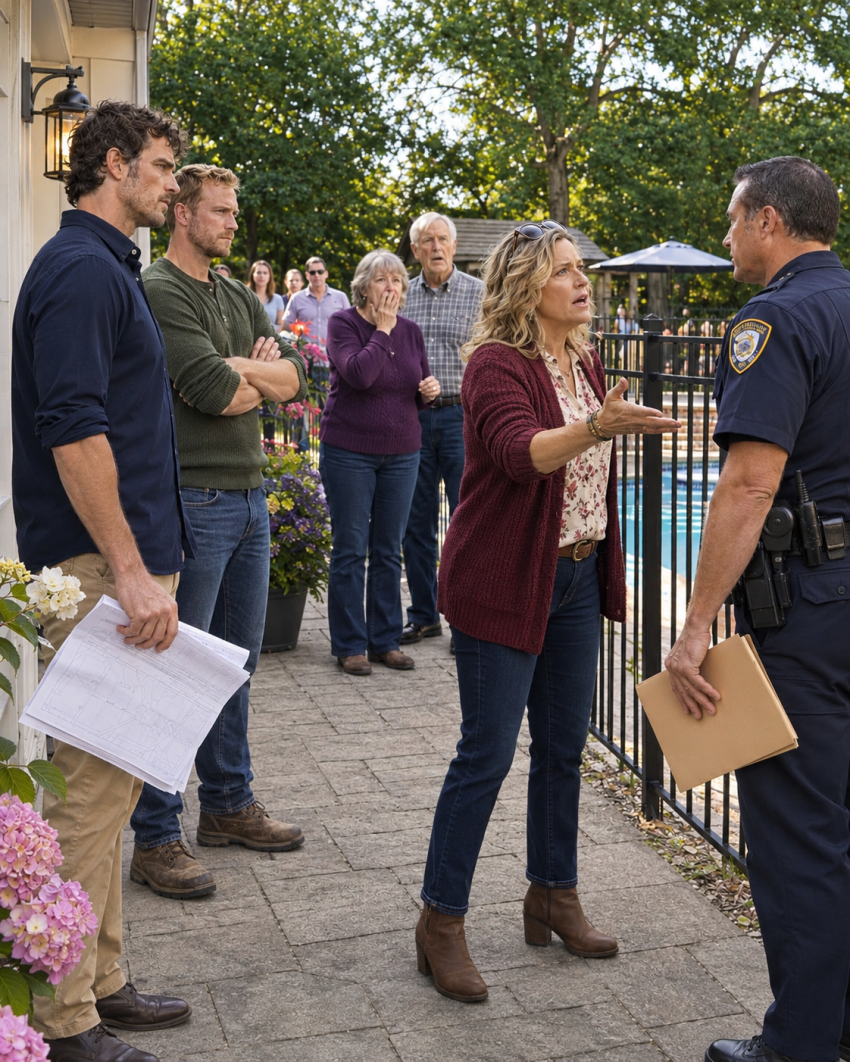
I held the page at chest height so the people at the back could see it. It was a plain white sheet, one screenshot, enlarged until the text was the size of a church bulletin.
“Naomi,” I said. “Would you like to read it, or should I?”
She didn’t answer. Her hand was still hovering over the gate latch, as if the metal might forgive her if she held very still.
Beside her, Mom lowered the casserole dish an inch. A cousin near the curb set down a cooler. Across the street, a boy in dinosaur swim trunks asked his mother, loudly, why nobody was going in the water.
“Then I’ll read it,” I said.
My name is Gideon Voss. I’m thirty-eight, and I work on a survey crew for a civil engineering firm in Rockford, Illinois. I stick flags in dirt for a living, as my father likes to say, and what I do with those flags is tell people exactly where one person’s ground stops and another’s begins. Nobody notices a good survey. They only notice when somebody has ignored one.
I should tell you about the house, because the house is the whole story.
Eleven months before that Sunday, I bought a foreclosure on Alder Court at a county auction. It was a 1962 brick ranch with a collapsed porch roof, a kitchen untouched since Eisenhower, and a concrete pool the previous owners had let fill with leaves and green water. I paid $189,000. I recorded the deed at the county recorder’s office on a gray Tuesday in June, and I drove the first stake into the northwest corner of the lot that same evening, wrapped in orange flagging tape. Surveyors do that. It’s not sentimental. It’s habit.
It was sentimental.
My marriage had ended four months earlier. Renata and I had been together eleven years, and she left on a Thursday, carefully, with two suitcases and a lawyer’s number. I’m not going to tell you what went wrong, because I don’t entirely know. I only know that I spent a winter in an apartment with a mattress and a microwave, and that the day the auction gavel came down, I felt for the first time in months like someone who owned something.
I put another $34,000 into the place. A new roof, $11,800. Plumbing, $6,400. Electrical, $5,200. Tile, flooring, a kitchen I designed on graph paper at lunch breaks. I did most of the labor myself, at night, after ten-hour days on job sites. I laid tile at midnight with a work light clamped to a stepladder. I learned what a P-trap was, and what it felt like to cry over a faucet.
The house wasn’t impressive when I bought it. It was broken.
So was I. By the time the last cabinet was hung, we were both a little better.
My family is a different matter.
My father, Cecil Voss, is sixty-eight, a retired high school football coach with a barrel chest and a voice built for sidelines. He has opinions about everything and a talent for delivering them at volume, in front of witnesses. My mother, Joyce, is sixty-six, a retired school cafeteria manager who has spent forty years agreeing with him quietly and a half-second late. And my sister Naomi is forty-one, a real estate agent with a bright, glossy smile and a gift for speaking in the imperative.
Naomi organizes. That is how she describes it. She organizes birthdays, reunions, memorials, and baby showers, and she does it the way a general organizes a campaign, with a spreadsheet and no questions. Her usual venue is whoever has the biggest yard. Nobody ever agrees. They just find out.
I had a pool. That was my mistake.
Two weeks before the cookout, I sat at my parents’ dinner table on a Sunday evening, eating meatloaf, with eight relatives crowded around. My Uncle Rudy. Two cousins. Naomi, with her husband Brent, who says almost nothing. A great-aunt in a wheelchair.
I’d mentioned, mildly, that I’d finished the tile in the back bathroom.
My father put down his fork.
“You stick flags in dirt for a living,” he said, loudly enough for everyone to hear, “and you think you can tell this family what to do with a backyard you bought at a foreclosure auction?”
I hadn’t said anything about the backyard.
“Dad,” I said.
“I’m just saying.” He smiled, wide, around the table, a man playing to the bleachers. “You’ve got a half-acre and a pool nobody uses. It’s a waste, is what it is. A family should share.”
“It’s not finished.”
“Then finish it. Fill it up. Have people over.”
“I will.”
“You won’t.” He leaned back. “You know why? Because you’re the kind of man who buys a broken house instead of fixing a broken marriage.”
The table went silent.
I want to be precise about what happened next, because I’ve gone over it. Nobody gasped. Nobody said Cecil. Naomi looked pleased, in the small, private way she gets when someone else has been sent to the penalty box. My mother stared into her water glass. My cousins studied their plates. Uncle Rudy coughed.
I sat there with a forkful of meatloaf, and I understood something I should have understood at fifteen. Nobody at that table was going to protect me from the way my father saw me.
So I would have to do it myself.
I finished my dinner. I said thank you for the meal. I drove home, and I stood in the northwest corner of my yard under a clear, hard, starry sky, and I looked at the orange flag.
The first message came Wednesday evening.
I was in the yard again, because that’s where I go. The sun was low, and I was holding a hose, not using it, watching the green water in the pool turn gold at the edges. My phone buzzed against my hip.
Naomi: We’re using your backyard for the family cookout. 52 people, two days. Set up the tables and fill the pool by Sunday.
I read it twice.
No question mark. No Would you mind? No greeting. Just instructions, like a work order.
I typed with my thumb.
Not happening.
Three dots appeared. They vanished. They came back.
Everyone already said yes. You can’t cancel something 52 people are planning around.
My property. My decision.
She answered almost instantly.
Don’t be like this. Cecil already told everyone.
I looked at that for a long moment. Cecil already told everyone. My father had decided he could grant permission to use a house he didn’t own, to fifty-two people, on a weekend of his choosing.
Cecil doesn’t speak for me, I wrote.
You have a pool you haven’t even filled. A backyard nobody uses. What are you holding on to?
I stared at the last four words.
Holding on to.
As if I’d taken something from the family. As if my backyard were a shared toy that I refused to pass around. As if eleven months of midnight tile and two thousand dollars of lumber and the quiet, unglamorous work of making a broken thing whole were a form of hoarding.
I put the phone in my pocket. I did not answer.
On Friday, my coworker Shaw showed me the group chat.
Shaw Okonkwo is thirty-five, a rodman on my crew, a stocky, cheerful man with a laugh like a screen door. His cousin Priya is married to my cousin Dev, which is how he knows my family’s business. We were eating lunch on a tailgate, in a gravel lot outside a subdivision, when he said, “Gideon. You’re not in the chat, are you?”
“What chat?”
He handed me his phone.
It was a group thread called VOSS FAMILY COOKOUT!! with a little cartoon of a hamburger. Eighty-one members. I wasn’t one of them. I scrolled up.
Naomi had posted my address on Tuesday, three hours before she’d texted me. A full street address, with a map pin.
Cookout at his place Sat + Sun! Pool will be open. Bring chairs, coolers, kids. Parking on the street. Side gate!
Forty-three people had reacted. Thumbs-up. A palm tree. A row of hearts. A cousin I hadn’t seen in eight years had written, So excited!!! Can’t wait to see the new house!
I handed the phone back.
“You okay?” said Shaw.
“I’m fine.”
“You don’t look fine.”
“I’m thinking.”
He studied me. “Thinking about what?”
“Property lines.”
He nodded slowly, with the grave comprehension of a man who knows exactly what I meant. “Ah.”
I called my attorney that afternoon.
Elliot Brandt had handled my divorce. He was fifty-four, tall and mild, with half-moon glasses and a collection of tiny anchor-patterned ties. His office was on the second floor above a dry cleaner in Rockford, and it always smelled of coffee and steam. He’d charged me a fair rate and sent me a bottle of whiskey when the decree came through.
He picked up on the third ring.
“Gideon. Everything all right?”
“My sister is planning to bring fifty-two people onto my property on Sunday. After I told her no.”
A pause. I heard a pen.
“Did you tell her in writing?”
“Yes. Text. I said, ‘Not happening,’ and ‘My property, my decision.’”
“Did she respond?”
“She said everyone’s already said yes.”
“Do you have it saved?”
“Screenshots.”
“Good. Anything else?”
I told him about the group chat. The address posted, the map pin, the eighty-one members. I told him about my father and the spare key, which I realized, as I said it, I’d given him during the renovation, so he could let the plumber in.
Brandt was quiet.
“Gideon. I’m going to give you a short list. Then you tell me what you’d like to do.”
“All right.”
“First. Change the locks. Today. All of them, including the side gate. Second. Preserve everything. Screenshots, with dates visible. Third. Send Naomi one clear written message, withdrawing any permission, stating that no one is authorized to enter, and that you will call the police if anyone does. Fourth. Contact the local police department, non-emergency line, and let them know about the planned gathering. Not to make a scene. To create a record.”
“A record.”
“If something happens Sunday, I want a time-stamped note in a police file, showing you warned them in advance.” He paused. “That’s not aggression. That’s paperwork.”
I said I’d do it.
“One more thing. You mentioned a pool.”
“Yes.”
“Is it filled?”
“No.”
“Is it fenced?”
I thought about it. “There’s a four-foot chain-link. And a gate.”
“Is the gate locked?”
“I haven’t had a lock on it.”
“Put one on,” said Elliot Brandt. “If fifty-two people, half of them children, come into a yard with an unattended pool, and somebody is hurt, Gideon, the liability sits with the owner. I’d rather it were a locked gate and a deputy than a lawsuit.”
I wrote POOL = LIABILITY on my hand, in pen.
I wrote Naomi at five o’clock. I read the text aloud, in the cab of my truck, three times before I sent it.
Naomi. I have told you twice that you do not have my permission to hold any event at my property. I am withdrawing any consent that may have been implied by anyone. No one is authorized to enter my property this weekend. If people arrive, I will contact local police. Please cancel the gathering and inform the family. —Gideon
I attached no screenshots. I didn’t need to. She’d have them.
She didn’t answer.
I sat in the truck for a minute. Then I called the Rockford Police non-emergency line, and spoke to a dispatcher with a warm, tired voice, who took my name, my address, and a summary. She put me through to a sergeant named Abernathy, who listened with the patience of a man who’d heard every kind of family dispute.
“Sir,” said Abernathy. “I’d like to confirm. You’re the legal owner.”
“Yes. Deed recorded June ninth, last year.”
“And you’ve given no one permission.”
“None.”
“And you’ve told them in writing.”
“Twice.”
“Do you have a reason to believe it’ll turn violent?”
“No. I believe it’ll turn loud.”
A dry chuckle. “I’ve worked a few of those.” A pause. I heard keys. “Mr. Voss, I’m going to put a note in the system. If you’d like, I can have an officer in the area on Sunday. Just to be visible. Would that help?”
I thought about my father, standing in the yard, with his chest out.
“Yes,” I said. “It would.”
On Thursday morning, a message came that wasn’t meant for me.
I was at my desk at the firm, at seven-twenty, drinking coffee and reviewing a plat for a subdivision outside Belvidere, when my phone buzzed. NAOMI. I almost ignored it. Then I read the preview, and set down the cup.
He doesn’t have the nerve to call the cops. Once 50 people are in his yard, what’s he going to do? Have his own family removed? Cecil already told everyone he agreed.
It wasn’t addressed to me. It was meant for a friend named Gentry, whom Naomi had been texting in the same app, and the names had crossed. I knew because the next message, a second later, said, OMG wrong chat. Ignore.
Then, thirty seconds later: Deleted.
I’d already taken the screenshot.
I read the message three times, slowly, in the fluorescent light of the office. The cubicle walls were gray. A copier hummed. Somewhere down the hall, a man laughed at a joke about fantasy football.
He doesn’t have the nerve.
I felt my jaw tighten. I felt something cold and orderly settle behind my breastbone, like a level coming to rest.
It wasn’t a misunderstanding. It had never been one. She knew I’d said no. She’d simply decided that my no was a negotiating position, a thing to be worn down, outvoted, or crowded out. She’d planned for fifty people because she believed that fifty people were a wall I wouldn’t have the nerve to push against.
I printed the screenshot on the office printer. I took the sheet out of the tray while it was still warm. I folded it once, and put it in my breast pocket.
I saw the truck on Friday.
I’d come home at four-thirty, a little early, because Elliot Brandt had told me to. I turned onto Alder Court with my windows down and the radio low, and there, in my driveway, was a sixteen-foot rental truck. Orange and white. A ramp down. A folded pile of white canvas on the lawn.
My side gate stood open.
I parked on the curb. I got out slowly. In my backyard, I could hear voices. A mallet, thudding. The metallic ring of a pole being set.
I walked through the gate.
Three people were assembling an enormous white event tent on my back lawn, forty feet by forty, with a peaked center pole and a sidewall of clear vinyl. Two men in work gloves, hauling a crossbar. And a woman I didn’t know, thin, in sunglasses, with a clipboard, directing them from the patio.
I stopped.
My eyes went, without my meaning them to, to the northwest corner.
The stake was gone.
I looked for it. My heart was doing something odd. The orange survey stake I’d driven into the ground on the day I got the deed, the first mark I’d made on the property, was not where I had left it. A little rectangle of bare dirt showed where it had been. A rubbery, flattened tuft of grass.
I scanned the fence. And there, tossed against the chain-link, among a pile of bark mulch and a coil of electrical wire, lay my stake. Orange tape, muddy, trailing in the dirt.
Someone had pulled it out. Someone had thrown it aside to make room for a tent pole.
For a moment, I couldn’t hear anything. That small piece of wood, a foot and a half long, with a nail head on top, meant nothing to those people. To them it was trash in the way.
To me, it was the first thing I’d put in the ground that was mine.
“Excuse me,” I said.
The woman with the clipboard turned. She lowered her sunglasses. She was about forty, with highlighted hair and a tight, professional smile.
“Can I help you?”
“I live here.”
“Oh!” Her face brightened with false recognition. “You must be Gideon. I’m Gentry, Naomi’s friend. We’re just getting a head start.” She gestured at the tent. “Don’t worry. We’ll be out of your way by dark.”
“Who let you in?”
“Naomi said you were fine with it.” She frowned at my expression. “And your dad gave us the key. Cecil. He said it was no problem.”
I felt the earth tilt, a degree or two.
I’d forgotten about the key. A brass Schlage, in a manila envelope, that I’d handed my father in March, when the plumber was coming and I couldn’t get off a job site. He’d put it in his pocket. He’d never returned it.
“Gentry,” I said. “I’d like you to take it down.”
“I’m sorry?”
“All of it. The tent. The poles. Everything. I’d like you to take what’s yours and leave my property.”
She stared at me. Then, to my astonishment, she laughed. A short, incredulous, bright laugh.
“You’re joking.”
“No.”
“Do you know how many people are coming on Sunday?”
“Fifty-two.”
“Your family is driving hours for this. Your great-aunt. Your cousins from Ohio.”
“That’s something Naomi should have considered before she told them it was fine.”
“Naomi said you’d…”
“Naomi lied.”
Gentry’s face hardened. The brightness left it. She looked at me, then at the tent, then at me again, and I saw, quite clearly, a woman recalculating her afternoon.
“You’re really going to ruin a whole family weekend over a disagreement about a backyard?”
There it was. The phrase again. A disagreement. As if my boundary were a point of view, and her right to override it were simply the other side of a fair debate.
“Leave,” I said.
She called Naomi from the sidewalk.
I stood in the yard, among the half-erected poles, with my arms at my sides, and listened. I couldn’t help it. The afternoon was still, and the fence was thin, and my sister’s voice, through a speakerphone, carried like a trumpet.
“He can’t kick you out. Cecil gave you the key. That’s permission.”
“He’s standing right here, Naomi. He says…”
“I don’t care what he says. A key is permission. Dad lives there too, practically. It’s family property.”
“It’s not. I just checked the county site. The deed’s in his name alone.”
“It’s a technicality!”
I stood very still.
I thought of a deed, on thick cream paper, in a manila folder in a fireproof box, with a stamp from the Winnebago County Recorder. Gideon M. Voss, sole owner. I thought of a mallet, and a stake.
I thought: a technicality.
I listened to my sister explain, at the top of her lungs, to a woman on a sidewalk, why my permission wasn’t required on my own land.
The rental truck left eleven minutes later. The two men in work gloves hauled the canvas back up the ramp, with the air of workmen who’d been told one thing and shown another. The poles rattled. The truck’s gears ground. Gentry, in her sunglasses, did not look at me as she passed.
I walked to the northwest corner.
I changed every lock that evening.
I’d already bought them. A set of three Kwikset deadbolts, a heavy-duty padlock for the pool gate, and a keyed hasp for the side fence. I’d picked them up that morning at the hardware store on Broadway, from a boy in a green apron who’d asked, politely, whether I was having trouble with burglars.
“Of a kind,” I said.
It took ninety minutes. Front door. Back door. Garage entry. The shed. The side gate, which I’d never locked in eleven months, and which now clicked shut with a sound like a sentence ending.
I attached the padlock to the pool gate. I tested it twice.
Then I walked out to the fence, and picked up my stake.
It was muddy. A little bent. The orange tape had torn halfway down, and one corner dragged. I brushed the dirt off with my thumb. I looked at the nail head, which was scratched, and the faint, faded pencil mark on the side, NW COR, in my own hand.
I carried it back to the northwest corner.
I set it in the hole it had left. I took the mallet from my truck, a three-pound rubber one, the kind I use on a hundred job sites a year, and I raised it.
Two strikes.
The stake went down, firm and clean, into the soil. The tape fluttered once, in the evening air, and hung still.
I stood back.
It was straight. It was exactly where it belonged.
I filled the pool on Saturday night.
I want to tell you why, because it surprised me.
I hadn’t planned to. It was the last item on a long list, and the most expensive. A hundred and ninety dollars of water, a pump to check, a filter to replace, a liner I’d patched in October with a vinyl kit and a prayer. I’d told myself I’d do it in the spring.
But at nine that evening, with the sun long gone and a thin crescent moon coming up behind the neighbor’s maple, I found myself standing in the backyard with the hose in my hand. I’d turned on the spigot. I’d dragged the green rubber coil across the lawn and over the coping, and let it hang.
The water began to rise.
I sat in a folding chair at the edge of the pool, in my work boots and canvas jacket, and watched it come. A slow, dark, silvery rise, an inch at a time, over a floor of pale blue paint I’d scraped and rolled myself. It made a sound I hadn’t expected. A low, steady, murmuring pour, like a kitchen faucet left running in the next room.
I watched it for six hours.
I want you to understand that I wasn’t doing it for Naomi. Not for the cookout. Not for fifty-two people, or my father, or the group chat with a hamburger. I was doing it for a man who’d bought a broken house in a cold June, and who had, somewhere in the eleven months since, forgotten to let himself enjoy the thing he’d built.
At three in the morning, the water reached the skimmer. I turned off the hose.
The pool lay still, under the stars, clear and black and perfect. A single leaf drifted across the surface. I took off my boots, and rolled my pants to the knee, and sat on the coping, and put my feet in.
It was cold. It was the best thing I’d felt in a year.
Sunday came with a hard, bright, windless sky.
I woke at seven on the couch, with a crick in my neck and a blanket over my knees. I showered. I made coffee. I walked through the house, room by room, checking windows. I stood in the kitchen I’d built on graph paper, and ran my palm along the quartz counter, and looked at the gray tile floor. It was clean. It was mine.
The yard was clean, too. The tent was gone. The pool lay full, blue and still, with the chain-link around it, and a brand-new padlock on the gate. The side fence was locked. The stake stood in the northwest corner, with its orange tape.
At eleven-thirty, Sergeant Abernathy’s cruiser pulled up at the curb.
I met him on the front walk. He was sixty, broad, with a gray mustache and a manila folder under one arm, in a pressed navy uniform. He had the unhurried manner of a man who’d spent forty years standing in the middle of other people’s trouble.
“Mr. Voss.”
“Sergeant.”
“I’ve read your file.” He glanced at the house. “It’s a good-looking place.”
“Thank you.”
“Anything new?”
I took the printout from my breast pocket. I unfolded it, and handed it to him. He read it standing on my front walk, in the sun, with his reading glasses halfway down his nose.
He doesn’t have the nerve to call the cops. Once 50 people are in his yard, what’s he going to do? Have his own family removed?
When he finished, he was silent for a moment. He folded the page.
“That your sister?”
“Yes.”
“That’s, well.” He tapped it against his palm. “That’s what we call evidence of intent.”
“Of what?”
“That she knew you’d refused. And planned to proceed anyway.” He looked at me over the glasses. “It matters, if it goes further.”
“I’d rather it didn’t.”
“I’d rather it didn’t, too.” He tucked the page into the folder. “But I’d like to hold on to a copy.”
“Of course.”
He crossed the lawn. He stationed himself beside the side gate, at ease, with his hands folded in front of him, and the new lock gleaming at his elbow. The folder stayed under his arm. He looked, I thought, exactly like what he was. A patient man, waiting for the weather.
Shaw’s truck pulled up behind the cruiser.
He climbed down in jeans and a clean flannel, with two cups of coffee. He walked up the path, handed me one, and took his place on the porch beside me.
“Figured you could use company.”
“Thanks.”
“I brought donuts.”
“I can’t eat.”
“I’ll eat yours.”
I laughed. It came out short and a little cracked.
We stood there, two surveyors on a porch, drinking coffee in the sun.
At twelve-fifteen, the first car arrived.
A silver minivan, with Ohio plates and a bike rack. It parked on the curb across the street. Doors opened. A man in a Browns jersey got out, and a woman with a baby carrier, and two small children in matching swimsuits, who ran in circles on the lawn, shrieking.
Then another car. A blue sedan. Then a Ford pickup. Then a black SUV, and a white SUV, and a rusted hatchback with a bumper sticker that said WORLD’S OKAYEST GRANDMA. Then five more. Then ten.
By twelve-thirty, both sides of Alder Court were solid with parked vehicles, bumper to bumper, as far as the corner. The neighbors had come out onto their porches. Mrs. Pellegrino, across the street, stood with her arms folded and her mouth in a thin line, watching.
People spilled out. Cousins I hadn’t seen in years. Uncle Rudy, in a Hawaiian shirt. Great-Aunt Lorraine in her wheelchair, pushed by a teenage grandson. A toddler in a sun hat. Kids in swimsuits, with towels over their shoulders and plastic floaties on their arms. Adults with folding chairs, and coolers, and trays under foil, and a man with a six-foot folding table over his head like a battering ram.
They moved up the street in a loose, cheerful, noisy stream, toward the side of my house.
The side gate! someone called. Naomi said the side gate!
I stood on my porch with my coffee, and I did not move.
Dad’s truck arrived last.
It was a white Silverado, with a Bears sticker on the back window. It pulled up in front of my house, taking up two spaces, and the engine cut off. For a moment, nothing happened.
Then the doors opened.
My mother climbed out first. She was in a lavender cardigan, with her silver hair set, holding a casserole dish in both hands, covered with foil. She looked tired. She looked, in that light, older than sixty-six.
My father got down from the driver’s side. He was in a blue polo and khaki shorts, with a Bears cap on his head and a Bluetooth speaker under one arm. He surveyed the street with the broad, proprietary satisfaction of a man reviewing a parade.
“Well!” he called, to the crowd. “Look at this turnout!”
A cheer went up. Somebody whistled.
And behind them, from the back seat of the Silverado, stepped my sister.
Naomi wore white capri pants and a coral blouse, with oversized sunglasses pushed up in her hair. She had a clipboard. She had a lanyard around her neck, with a laminated badge that said, in a cheerful font, EVENT COORDINATOR. She shut the car door with a flourish.
“Okay, everybody!” she called. She clapped her hands twice. “Gate’s around the side! Coolers to the left, kids’ stuff to the right! Pool’s open at one! No glass by the water, please!”
The crowd began to move.
Naomi strode up the sidewalk at the head of them, clipboard high, like a tour guide. Mom trailed behind, holding the casserole. Dad strode beside, with the speaker, nodding to relatives, shaking hands.
They rounded the corner of my house.
They reached the side gate.
I’ll tell you what I saw from the porch, because I’ve never forgotten it.
The front of the group stopped.
Not all at once. It happened in a ripple, like a wave running backward. Uncle Rudy, at the head, slowed, and looked, and put a hand out to the man behind him. A toddler on someone’s hip stopped talking. The man with the folding table lowered it to the grass.
Mom took two more steps.
She was carrying the casserole in both hands. She looked toward the gate, with her pale, tired, patient face. And then she saw what stood beside it, and she froze.
I watched her whole body go still. The casserole dish tilted a few degrees. A corner of foil slid. She drew a long, slow breath through her nose.
Naomi was already reaching for the latch.
She had her hand out, in the bright noon light, a slim, tanned hand with a coral manicure, and she was looking back over her shoulder at the crowd, saying something cheerful. Right through here, folks! She reached out, and wrapped her fingers around the gate.
And she finally saw who was standing beside it.
A uniformed police officer.
Navy blue, pressed, with a badge and a radio on his shoulder. A manila folder under one arm. A gray mustache. Arms folded, feet apart, in an easy stance that told you he’d stood in that spot for a while, and would stand there as long as required.
Behind him, bolted to the gatepost, gleaming silver in the sun, hung a brand-new Kwikset padlock, with a keyed hasp.
Naomi’s hand stopped in midair.
It hovered an inch from the latch. I watched her fingers curl, and uncurl, and hang there. I watched her mouth open, and close. Her sunglasses slid out of her hair and clattered to the sidewalk.
Nobody picked them up.
Behind her, scattered across the sidewalk, on the grass, and out into the street, stood fifty-two relatives with coolers, chairs, and trays of food. A toddler began to cry. A woman in the back said, in a stage whisper, “Is that a cop?”
Dad pushed through to the front.
“What,” he said, “is a police officer doing at my son’s house?”
Sergeant Abernathy didn’t unfold his arms.
“Sir,” he said. His voice was level, even, pleasantly bored. “Are you Cecil Voss?”
“I am.”
“The property owner contacted us earlier this week about a planned gathering, to which he had not consented.” He nodded at the crowd. “I’m here to help keep things peaceful.”
“Not consented?” Dad’s face went red. “Son, what the hell is this?”
He turned, and looked up at the porch, and found me.
I put down my coffee. I stood at the top of the steps, with Shaw beside me.
“Hi, Dad.”
“Gideon. What are you doing?”
“Standing on my porch.”
“You told the police?”
“I told them the truth.”
“On your own family?”
“On a group of people who planned to enter my property without my permission.” I kept my voice level. “I told Naomi on Wednesday. I told her again in writing on Thursday. I sent her a message withdrawing consent.”
“You never said that.”
“I did.”
“We didn’t get any message.”
I looked at my sister.
She was standing at the gate, with her hand still half-raised. She had gone the color of paper. Her lips were parted. Her clipboard dangled from her fingers.
“Naomi?” I said.
She didn’t answer.
“I’d like to read something,” I said.
I took the printout from my breast pocket. I unfolded it, slowly, in the sun. It rustled. In the hush, in the noon light, with fifty-two people watching, the sound was as loud as a flag.
I held it up.
“Three days ago,” I said, “at seven-twenty in the morning, my sister sent a text. It wasn’t meant for me. It was meant for a friend. But it came to my phone.”
A murmur.
“I’d like to read it to you. Because I think you ought to know what you’ve been asked to do.”
“Gideon,” said Naomi, hoarsely. “Don’t.”
“‘He doesn’t have the nerve to call the cops,’” I read. “‘Once fifty people are in his yard, what’s he going to do? Have his own family removed? Cecil already told everyone he agreed.’”
I lowered the page.
The street was dead silent. A mourning dove called from a telephone wire. Somewhere, a screen door banged.
“I never agreed,” I said. “Not to Cecil. Not to Naomi. Not to anybody. I said no on Wednesday, and I said no again on Thursday, and I said it in writing. My sister knew. She wrote it herself. She knew I’d refused, and she planned for fifty-two people anyway, because she thought nobody here would stop her.”
Uncle Rudy had taken off his cap. He held it against his chest.
“She posted my address in a group chat. Eighty-one people. With a map pin. She told you I’d said yes.” I took a breath. “I’d like to tell you that I’d said no.”
A woman near the front stepped forward.
She was about fifty, tall, with short gray hair and a sunburned nose. My cousin Marguerite, from Dayton. I hadn’t seen her since our grandmother’s funeral. She wore a tank top and sandals, and held a plastic container of potato salad against her hip.
“Naomi,” she said, very quietly. “Is that true?”
My sister didn’t speak.
“Naomi. Did Gideon say no?”
“It’s, it’s complicated.”
“Did he say no?”
“I thought he’d come around.”
“Naomi.” Marguerite’s voice was low and shaking. “You told me he was excited. You said he’d been wanting to host. You said he’d called you.”
“I assumed…”
“You said he called you.”
A ripple went through the crowd. Heads turned. Somebody muttered, “Well, I’ll be.” A man in a Cubs shirt set his cooler on the sidewalk, with a thud.
“I drove four hours,” said Marguerite. Her voice cracked. “With two kids. I took a vacation day.”
“I know. I’m sorry. I…”
“I told my boss it was a family reunion.” She looked at me, then, across the lawn. Her eyes were wet. “Gideon. I’m so sorry. I had no idea.”
“It’s not your fault,” I said.
“I should’ve called.”
“You were told something that wasn’t true.”
She pressed her lips together. She nodded. And then, to my surprise, she set down the potato salad on the curb, very carefully, as if it might shatter, and she folded her arms, and she turned to face my sister.
“I’d like an explanation,” she said.
Naomi looked around.
I watched her do it. I watched her eyes move across the faces, one by one, the cousins, the uncles, the neighbors on their porches, the great-aunt in the wheelchair, the child in the sun hat. I watched her search for an ally. A smile. A laugh. Anything.
She found none.
Mom had put down the casserole. She’d set it on the grass, quietly, and she stood with her hands clasped in front of her cardigan. She wasn’t looking at Naomi. She was looking at me.
Dad had taken off his Bears cap. He held it in both hands. His broad, ruddy face had gone slack and gray. He looked, for the first time in my memory, like a man who’d stepped into a room and found the furniture rearranged.
“Naomi,” he said. “You said he agreed.”
“I thought he did.”
“You told me he said yes.”
“I assumed, Dad. You said it was fine.”
“I said it was fine because you said…” He stopped. He looked from her to me, and back. “Cecil already told everyone he agreed. That’s what it says.”
“It’s, I was just…”
“I told everyone?” His voice rose. “I never told anybody anything. You told me it was settled.”
“Dad, please.”
“I gave them the key because you said he’d asked me to.”
The silence stretched.
I stood on my porch and watched my father put it together. It took a long time. It was like watching a man read a map in a language he didn’t speak. His eyes narrowed. His mouth worked. His big, scarred hands tightened on the brim of the cap.
“You used me,” he said.
I’d like to say I felt triumph.
I didn’t. What I felt, standing on my own porch, in my own sun, with my father’s face going slowly gray, was something much older and quieter. It was a long, heavy tiredness. The feeling of a man who’s been carrying a box for a very long time and has finally been told he can set it down.
I walked down the steps.
I crossed the lawn, in my work boots, and stopped ten feet from my father. He looked up at me. His eyes were wet.
“Dad,” I said.
“Gideon.”
“I’d like to say something. And I’d like you to hear all of it.”
He nodded.
“Two weeks ago, at your table, you said I buy broken houses instead of fixing broken marriages.” I kept my voice steady. “You said it in front of eight people.”
“I was…”
“Let me finish.”
He shut his mouth.
“It hurt,” I said. “I won’t pretend it didn’t. It was the worst thing anyone’s said to me in a year. But I’ve thought about it for two weeks, and I think you’re partly right.”
His eyes widened.
“I did buy a broken house. And I did fix it. It took eleven months and thirty-four thousand dollars and every night I had.” I looked at the house, at the gray brick, the new porch roof, the curtain in the front window. “And it was the best thing I’ve ever done.”
“Gideon…”
“Because that’s the thing about a house. If you fix it, it stays fixed. A house doesn’t leave. It doesn’t lie to you. It doesn’t tell you you’re a failure at a dinner table.” My voice cracked, and I let it. “It’s just there. And it’s yours.”
My mother had put a hand over her mouth.
“I’m not saying it to be cruel,” I said. “I’m saying it because I’d like you to understand why I locked the gate.”
Dad was silent for a long time.
He stood on my lawn, in his Bears cap and khaki shorts, with a Bluetooth speaker under one arm and a crowd of fifty-two people behind him. A breeze moved the maple. Somewhere on the street, a car door shut. A child asked a question, and was hushed.
“I said that,” he said, finally. His voice was low and rough. “About the marriage.”
“Yes.”
“In front of everybody.”
“Yes.”
“I shouldn’t have.”
I didn’t answer.
“I don’t know why I did.” He turned the cap over in his hands. “I think I was, I was jealous.”
I stared at him.
“Of what?”
“You.” He let out a short, cracked, humorless laugh. “You went out and bought a house. By yourself. After everything. And you fixed it. With your hands.” He swallowed. “I never, I coached for thirty-six years. I never built a thing. I told people where to stand. I yelled. And you, you stuck a flag in the dirt and made something.”
“Dad…”
“I’m sixty-eight years old, and I couldn’t tell you where my own water shutoff is.” He pressed his lips together. His eyes were streaming. “I think I wanted to take it down a peg. Because it made me feel small.”
I felt something give, in my chest, like a knot coming loose.
“I’m sorry,” said my father. “I’m so sorry, Gideon.”
I’d like to tell you we embraced.
We didn’t. Not then. I stood very still, with my hands at my sides, and I looked at my father, and I let his apology settle. It was the first one he’d ever made me. It sat between us in the sunlight, plain and heavy and not at all adequate.
“Thank you,” I said.
“That’s all?”
“For now.”
He nodded slowly. “That’s fair.”
I turned to Naomi.
She hadn’t moved. She stood at the gate, with her hand at her side, and her clipboard crumpled against her thigh. Her face was blotchy. Her mascara had begun to run. She looked, in the hard noon light, about fifteen years old.
“Naomi,” I said.
“I’m sorry.” It came out in a whisper. “I’m so sorry, Gid.”
“For what?”
“All of it.” She wiped her face with the back of her wrist. “For the text. For telling everyone. For the tent.” Her voice broke. “I pulled out your stake.”
“Gentry did.”
“I told her to.”
I stared at her.
“I said, ‘It’s just a stick,’” Naomi whispered. “I said, ‘He won’t even notice.’”
I felt a sharp, quick pain, under the ribs. I looked at her, my older sister, who had taught me to tie my shoes, and who had once walked three miles in a snowstorm to bring me a thermos of soup at a bus stop.
“I noticed,” I said.
“I know.” She was crying openly now. “I know you did. I’m so sorry.”
I won’t tell you everything that happened in the next hour.
I’ll tell you that nobody went through the gate. Sergeant Abernathy, with the dignity of a man who has seen worse afternoons, thanked the crowd for their cooperation, and suggested, in a mild baritone, that everyone might want to head home. The children, who’d been promised a pool, were led away in a reluctant, wailing line. Marguerite packed her potato salad in the trunk of her Honda, and came and hugged me, hard, and said, “Call me. Please. I’d like to see the house when it’s quiet.”
“I’d like that.”
“I mean it.”
“I know you do.”
Uncle Rudy shook my hand, wordlessly, and went away. Great-Aunt Lorraine, in her wheelchair, caught my wrist as her grandson wheeled her past, and said, in a thin, shaky voice, “You were always the sensible one, Gideon.” I didn’t know what to say. I kissed her cheek.
By two o’clock, the street was nearly empty. A few relatives lingered on the curb, uncertain. A child’s plastic flip-flop lay on the grass.
Mom stayed.
She’d picked up the casserole, and stood with it on the sidewalk, in her lavender cardigan, looking at the house. She didn’t speak. When I came toward her, she gave a small, tired smile.
“I made your favorite,” she said. “Chicken and rice.”
“Thank you.”
“I wasn’t sure you’d want it.”
“I do.”
“I should have said something.” Her voice was barely audible. “At the table. Two weeks ago. I should have said, ‘Cecil, that’s enough.’”
“Yes.”
“I never do.”
“No.”
“I’ve been, I’ve been quiet a very long time.” She pressed her lips together. Her eyes filled. “I don’t know how to stop.”
I took the casserole from her hands. It was warm through the foil, and heavy, and smelled of paprika and onion.
“You could start,” I said, “by coming in.”
We ate in my kitchen.
It was the strangest meal I’ve ever had. My mother sat at the island, on a stool, with her hands around a cup of tea. My father sat across from her, on the other stool, with his cap on his knee, looking at the quartz as though it might bite. Naomi leaned against the sink, with her arms crossed, staring at the floor. Shaw, who had refused to leave, sat at the table with a plate of chicken and rice and the unembarrassed appetite of a man who’d missed breakfast.
Nobody said much. The casserole was good. I ate two helpings.
At about three, my father cleared his throat.
“Gideon.”
“Yes?”
“This is a nice kitchen.”
“Thank you.”
“You did the tile?”
“Yes.”
“By yourself?”
“Mostly.”
“It’s straight.” He ran a thick finger along the grout line. “I tried to lay a patio once. In 1994. Your mother made me hire a man.”
“I remember.”
“It looked like a, a bad dream.” He laughed, rustily. “Took him three days to fix.”
Mom put a hand over her mouth.
“I’d like to learn,” said my father.
“Learn what?”
“How to do that.”
I looked at him. A big, heavy, stooped man in a blue polo, with gray stubble on his chin and the beginnings of tears in his eyes.
“It’s not hard,” I said. “It’s patience.”
“I’ve got a lot of time.”
“Then come Saturday.”
He blinked. “Saturday?”
“I’ve got a bathroom to finish. It needs somebody to hold the level.”
He stared at me. His mouth worked. His eyes were bright and wet.
“I can hold a level,” he said.
“I know you can.”
“I’d be,” he cleared his throat, “I’d be honored.”
Naomi stayed after they left.
It was five in the afternoon. The sun lay low and gold across my yard. The pool glittered, perfectly blue. She sat on the edge of the porch, with her shoes off and her feet on the lawn, and I came out and sat beside her.
For a long time we said nothing. A robin hopped across the grass. A neighbor’s sprinkler ticked.
“I’ve been a bully,” said Naomi.
“Yes.”
“I didn’t know it.”
“I know.”
“I thought I was organizing.” She laughed, a short, wet sound. “I thought, if I just keep everyone together, everybody’s happy.”
“Everybody wasn’t.”
“No.” She picked at her cuticle. “I never asked. Not once. I just decided.”
“You always did.”
“When we were kids,” said Naomi, slowly, “you’d come to me. And you’d say, ‘Can we play outside?’ And I’d say, ‘Okay, but we’re playing my game.’”
“I remember.”
“I thought that was the same as asking.”
I looked at her. At her blotchy, tired, middle-aged face, with the first fine lines at the corners of her eyes. At the girl who’d walked three miles in a snowstorm.
“Naomi,” I said. “I’m going to tell you what I want.”
She turned.
“I want you to ask. That’s all. Before you plan. Before you post. Before you decide for fifty-two people. I want you to knock on my door, and say, ‘Gideon, would it be all right if…’”
“And if you say no?”
“Then you say, ‘Okay.’”
She was quiet for a long moment.
“That’s the hardest thing anyone’s ever asked me,” she said.
“I know.”
“I’m not sure I can.”
“I’ll help.”
She laughed, wetly. She put her head on my shoulder. We sat there, in the late sun, a brother and sister on a porch, while the shadows lengthened over the lawn.
“Can I ask you something now?” she said.
“Go ahead.”
“Could we have a cookout? Someday? At your house?”
I thought about it. I thought about a pool I’d filled at midnight, for myself, and a yard I’d rescued from weeds.
“Yes,” I said.
She lifted her head.
“In July. A small one. Twelve people, max. I’ll set the date. I’ll decide the menu. And you’ll bring the potato salad.”
“I don’t make potato salad.”
“Then you’ll learn.”
She burst out laughing. She wiped her eyes. “Okay,” she said. “Okay. I’ll learn.”
It’s been a year.
We held the cookout in July. Twelve people, as promised. Mom and Dad. Naomi and Brent. Marguerite, with her two kids, who spent six hours in the pool and left reluctantly, with wrinkled fingers. Shaw, with his wife and a Crock-Pot of baked beans. Great-Aunt Lorraine, in her wheelchair, in a straw hat, with a cup of lemonade.
I grilled burgers. Dad held the platter. Naomi brought a potato salad that was, in a word, catastrophic, a gluey, vinegar-soaked disaster that nobody could finish. She stood at the picnic table with her arms folded, in a sundress, daring someone to comment.
“It’s, uh,” said Brent, who rarely speaks. He took a bite. He chewed. “It’s very bold.”
The table roared. Naomi, to my astonishment, laughed hardest of all.
I raised a glass, with a cold beer in it, and the sun going gold behind the maple.
“I’d like to say something,” I said.
They quieted.
“This is my house. It took eleven months, and thirty-four thousand dollars, and a lot of tile. I almost didn’t have anyone over.” I looked around the long picnic table, at the faces, the plates, the children in towels. “I’m glad you came.”
“To the house,” said my mother, quietly.
“To the house,” said everyone.
And glasses clinked, one after another, and a child shrieked in the pool, and the smoke from the grill drifted up through the leaves, and somewhere in the northwest corner of the yard, a small orange stake flapped its tape in the evening breeze.
Dad comes on Saturdays.
He arrives at eight, in a work shirt and old jeans, with a thermos of coffee and a level he bought himself at the hardware store. He holds the other end of things. He hands me tools. He asks questions, humble, curious ones, in the tentative voice of a man learning a language late in life. What’s a thinset? Why do you back-butter? Where do the spacers go?
We’ve done the bathroom. We’ve done the mudroom. In September, we replaced a rotten section of the back deck, and he sawed a board crooked, and stood looking at it for a full minute, with an expression of such stricken disbelief that I had to turn away to hide my laughing.
“It’s an eighth off,” he said.
“It’s fine.”
“It’s not fine. It’s crooked.”
“It’s yours,” I said.
He looked at me. And a slow, startled smile spread across his broad, ruddy face.
“It is, isn’t it?” he said. “I made that.”
On the first Saturday in October, we were laying a flagstone path, kneeling side by side in the dirt, when he said, without looking up, “I told your mother something last night.”
“What?”
“That I’d like to apologize to Renata.”
I paused with a stone in my hands.
“What?”
“For the thing I said.” He tapped a flagstone into place with a rubber mallet. “At dinner. About the marriage. I got it wrong. It wasn’t you that broke it.”
“Dad. You don’t know that.”
“I know you.” He sat back on his heels. His eyes were steady. “You’re a man who fixes things. If it could’ve been fixed, you’d have done it.”
I couldn’t speak.
“I’m just saying,” he said gruffly. “I was wrong. I’d like you to know I know it.”
I set down the stone. I put my hand on his shoulder. It was broad, and warm, and a little trembling.
“Thank you,” I said.
“Don’t get sentimental,” said my father. “Hand me the level.”
I did.
Last week, Naomi called.
It was a Wednesday evening, in the dusk. I was standing in the backyard, with the hose in my hand, watching the last light slide over the pool. The water was cool and clear. The maple had begun to turn.
“Gideon?”
“Hi, Naomi.”
“I’m calling to ask something.”
“Go ahead.”
“Would it be all right,” she said, and I could hear her swallow, “if I brought Mom and Dad over on Sunday? For lunch? Just the four of us. I’d bring the food. You wouldn’t have to do anything.”
I looked at the yard. At the fence. At the northwest corner, where a small orange stake stood in the grass, its tape bleached by the sun, a little frayed at the end.
I thought of a woman at a gate, with her hand in the air.
“Naomi,” I said.
“Yes?”
“That’s the nicest way anyone’s ever asked me.”
A long silence. A small, wet laugh.
“I practiced,” she said.
“It worked.”
“So is that a yes?”
“Yes,” I said. “Come at noon. Bring the potato salad.”
“I will not.”
“Please.”
“It’s terrible.”
“I know. Bring it anyway.”
She laughed, a real, unguarded, helpless laugh. I stood in my yard, in the gold light, with a hose in my hand, listening to my sister laugh, and I felt something in my chest settle, small and quiet, like a stake driven true.
I hung up. I turned off the water.
I walked to the northwest corner, and put my hand on the stake. The wood was warm from the day. The nail head was worn smooth.
NW COR, it said, in faded pencil, in my own hand.
I didn’t pull it up. It wasn’t going anywhere. It had been the first thing I’d put in the ground, and it would be the last thing I’d take out.
A line on a map. A mark on the earth. A place where one thing ended and another began.
It wasn’t a wall.
It was just a promise that when someone came to the gate, they’d have to knock.
And I’d be home to answer.