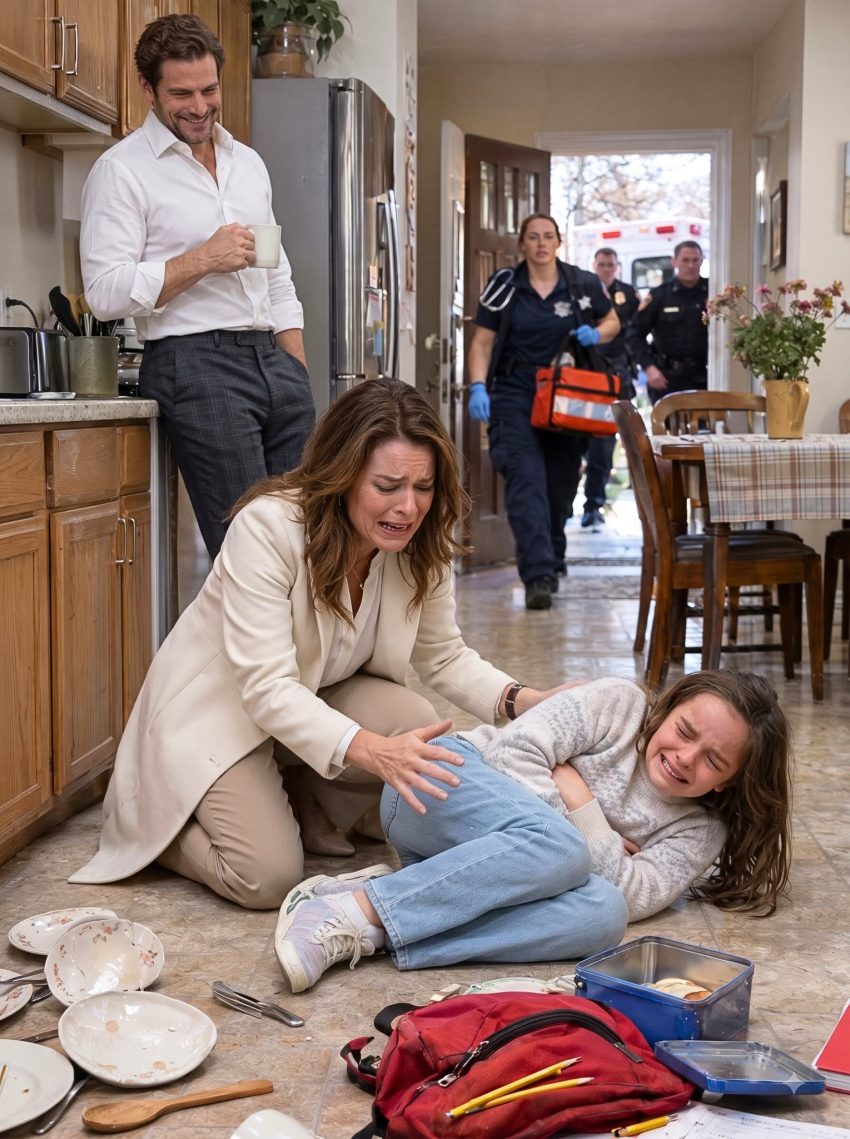
I left my nine-year-old daughter, Sophie, at home with my husband, believing she would be safe until I returned from work. Instead, I found her curled up on the kitchen floor, struggling to breathe, while Daniel calmly admitted that he had kicked her in the ribs.
When I reached for my phone, he ordered me not to call an ambulance. I called 911 anyway, unaware that the decision would expose years of fear, manipulation, and secrets within our marriage.
My name is Elena Mercer, and I’m thirty-six years old. I worked as a medical billing specialist at an outpatient clinic in suburban Columbus, Ohio, where my responsibilities required patience, organization, and the ability to remain calm during stressful situations.
For four years, I had mistakenly believed those same skills could preserve my marriage. I thought that anticipating Daniel’s moods, avoiding arguments, and keeping our household orderly would protect Sophie from his increasingly controlling behavior.
Daniel entered our lives when Sophie was five. As a regional sales manager for a commercial building supplier, he initially appeared dependable and generous, showing genuine interest in her drawings and promising us a stable family life.
Over time, however, his behavior changed. He criticized minor mistakes, questioned ordinary decisions, and treated any disagreement as disrespect toward the man who financially supported our household.
Whenever Sophie forgot to put away her belongings or accidentally spilled something, I rushed to correct the problem before Daniel noticed. I convinced myself that preventing arguments was the same as keeping my daughter safe.
That illusion ended on a rainy Tuesday afternoon in late October. I returned to our modest house on Maplewood Drive shortly after four o’clock, expecting to prepare dinner and spend a quiet evening with my family.
Instead, I found the house unusually silent. Sophie’s sneaker lay near the kitchen entrance, while her overturned backpack had scattered school papers and colored pencils across the floor.
I discovered her lying beside the kitchen table, holding her side and taking shallow, painful breaths. Her frightened expression immediately told me that something serious had happened.
“Sophie, sweetheart, what happened? Tell Mommy where it hurts.”
She looked toward me but seemed too frightened to explain. When her eyes shifted toward the sink, I turned and found Daniel standing there with a coffee mug, appearing more irritated than concerned.
“What happened to her, Daniel?”
He explained that Sophie had refused to clean up her belongings and had challenged his authority. Then, without showing any remorse, he admitted what he had done.
“I kicked her in the ribs. I didn’t expect her to fall like that. She’s making a bigger deal out of it than necessary.”
I could barely comprehend his words. My daughter was visibly struggling, yet Daniel continued insisting that her behavior had justified his reaction.
“Mommy, it hurts when I breathe. Please help me.”
I immediately reached for my phone, but Daniel stepped closer and demanded that I put it away. He warned that involving emergency services would damage his career and create unnecessary trouble for our family.
“Don’t call an ambulance, Elena. If she’s still complaining later, we’ll take her ourselves.”
For years, I had responded to his threats by trying to calm him down. This time, I looked at Sophie and realized that she was waiting to see whether I would protect her or surrender to his demands again.
I dialed 911 and explained that my nine-year-old daughter had been physically hurt by an adult and was having difficulty breathing. I gave the dispatcher our address and requested both medical assistance and police.
Daniel warned that our marriage would be over if I continued. I ignored him and stayed beside Sophie, reassuring her that help was coming.
Within minutes, emergency sirens approached our neighborhood. Daniel’s expression changed as he realized that someone outside our household was finally going to learn what had happened.
But when the paramedics entered our kitchen, Daniel calmly told them an entirely different story.
The five minutes we waited for emergency responders felt unbearably long. Daniel paced around the kitchen, repeatedly accusing me of destroying our family, while I remained beside Sophie and followed the dispatcher’s instructions.
My daughter was pale and exhausted, and every breath seemed uncomfortable. As I gently brushed the hair away from her forehead, she whispered something that nearly broke my heart.
“I’m sorry, Mommy. I should’ve picked up my backpack.”
I assured her that she had done nothing wrong and that no child deserved to be hurt for making an ordinary mistake. She looked at me uncertainly, as though she had spent so long being blamed that she struggled to believe my reassurance.
When the ambulance arrived, Daniel immediately changed his behavior. He straightened his clothes, adopted a concerned expression, and hurried to greet the two paramedics at the door.
Owen Price, an experienced paramedic with a graying beard, entered carrying medical equipment. His partner, Mara Collins, followed closely behind, carefully observing the kitchen and the people inside it.
Daniel stepped forward before I could explain what had happened.
“My stepdaughter fell from a kitchen chair while reaching for something on top of the cabinet. My wife panicked and called an ambulance, but it was an accident.”
His confident delivery stunned me. Only minutes earlier, he had admitted hurting Sophie, yet now he was presenting himself as a worried parent dealing with an unfortunate household mishap.
Owen immediately knelt beside Sophie and began examining her. Meanwhile, Mara studied the overturned backpack, the scattered school supplies, and the distance between the furniture and the place where Sophie had been lying.
“He’s lying. Daniel told me himself that he kicked Sophie because she wouldn’t listen to him.”
Daniel interrupted, claiming that I was emotionally unstable and attempting to use a marital disagreement against him. He then turned toward Sophie and urged her to confirm his version of events.
“Sophie, sweetheart, tell them you slipped off the chair.”
My daughter remained silent, her frightened eyes moving between Daniel and the paramedics. Owen continued his examination and identified signs of a possible chest injury that required urgent hospital assessment.
Mara instructed Daniel to leave the kitchen so the medical team could work without interference. He protested, insisting that he had the right to remain beside his stepdaughter, but she firmly repeated her request.
When Daniel finally stepped into the adjoining room, I approached Mara while Owen continued caring for Sophie. I gently caught her sleeve and spoke quietly enough that Daniel couldn’t hear me.
“Please don’t let him near Sophie at the hospital. She’s terrified of him, and I’m afraid he’ll pressure her to say she fell. He admitted hurting her, then lied to you. Please document everything and make sure child protection is notified.”
Mara listened without interrupting. She glanced toward Daniel, who was watching us from the doorway, before turning back to me.
“I’ll take care of it.”
Those four words were the first indication that someone outside our family understood how serious the situation had become. I returned to Sophie while the paramedics prepared her for transport.
Five minutes later, Owen carefully moved Sophie toward the ambulance. Daniel appeared wearing his coat and announced that he would accompany them to the hospital.
Mara stepped between him and the entrance, calmly explaining that he would not be permitted to ride with Sophie because of the suspected circumstances surrounding her injuries.
“The child’s mother will accompany her. You may travel separately, but you will not be allowed into the trauma treatment area.”
Daniel’s composure disappeared. He demanded to know what I had whispered, threatened to report Mara, and claimed to have influential connections within the county.
Mara refused to argue and directed me toward the ambulance. Daniel then warned that if I left with Sophie, I would lose access to our home, money, and possessions.
“If you walk out that door, Elena, don’t expect to come back. You’ll leave this marriage with nothing.”
I picked up my purse and Sophie’s backpack without responding. For the first time in four years, his threats no longer determined what I would do.
As the ambulance pulled away, I held Sophie’s hand and promised myself that I would never again allow Daniel to frighten her into silence.
But during the journey to the hospital, Sophie quietly revealed something that made me realize the incident had begun long before I returned home.
“Mommy, Daniel was angry because of the picture I drew.”
I leaned closer, confused by her words.
“What picture, sweetheart?”
She looked at me with frightened eyes and began explaining what Daniel had discovered in her drawing.
As the ambulance traveled toward downtown Columbus, I held Sophie’s hand and listened to her explain the drawing that had angered Daniel. She had drawn our house surrounded by a tall iron fence with a locked gate, and he had interpreted the picture as an insult.
“He said I made our house look like a prison. He tore up my drawing and got really angry with me.”
Sophie struggled to continue because speaking made her chest uncomfortable. I assured her that she didn’t need to explain anything else until she felt better, but her words revealed how frightened she had become inside our own home.
At the hospital, the medical team immediately examined Sophie and arranged imaging to determine the extent of her injuries. Dr. Priya Shah, the attending physician, spoke gently to my daughter before asking me to explain what had happened.
I repeated Daniel’s admission and described how he had forbidden me from calling emergency services. I also explained that he had subsequently told the paramedics Sophie had fallen from a chair.
Dr. Shah confirmed that Mara Collins had documented the conflicting accounts. Because the circumstances suggested intentional harm, the hospital had notified child protective services and the police.
“Your daughter is receiving appropriate care, Mrs. Mercer. Security has also been informed that her stepfather must not enter this treatment area.”
Several hours later, the preliminary results showed that Sophie had sustained two fractures on the right side of her ribcage and a localized lung injury. Fortunately, the doctors found no internal bleeding, but she needed continued observation and pain management.
That evening, Leah Brooks, a senior investigator with Franklin County Children Services, arrived to interview me. She asked about Daniel’s behavior throughout our marriage, including his disciplinary methods and the way he controlled our finances.
As I answered, I began recognizing incidents I had previously dismissed as isolated disagreements. Daniel had once gripped Sophie’s arm hard enough to leave marks, forced her to stand in a corner for hours, and removed her bedroom door after accusing her of disrespect.
“I kept trying to calm him down. I thought that if I prevented arguments, I could protect Sophie.”
Leah explained that accommodating Daniel’s demands had never addressed the danger. She also told me that investigators were reviewing the medical evidence and that Daniel was being questioned by detectives.
A temporary protection order would be requested, but Sophie couldn’t safely return to our house while Daniel retained access to it. I immediately offered my mother’s home in Delaware, Ohio, as an alternative.
Before the interview ended, Leah warned that Daniel had already hired an attorney. He was claiming that I had fabricated the allegations because of a marital dispute.
My phone then received several threatening messages from Daniel. He insisted that I had made a terrible mistake, threatened legal action, and reminded me that most of our financial resources were under his control.
I showed the messages to Leah and told her I had no intention of returning to him. For the first time, I understood that protecting Sophie would require more than escaping the house.
The following afternoon, my mother, Nora Vance, welcomed us into her home. Although she had initially struggled to believe Daniel could behave so cruelly, seeing Sophie’s condition erased her doubts.
Nora prepared my childhood bedroom with clean sheets and warm quilts. Sophie fell asleep shortly after arriving, while my mother and I discussed Daniel’s increasingly aggressive messages downstairs.
Over the next several days, Sophie slowly began recovering physically, but ordinary household noises still frightened her. Whenever a car stopped outside, she looked toward the door as though expecting Daniel to appear.
On Friday morning, I found her sitting on the staircase wearing her coat and shoes. Her backpack was packed with clothes, drawing pencils, and her favorite book.
“Why are you ready to leave, sweetheart?”
Sophie explained that she wanted to be prepared when Daniel found us. She promised that she wouldn’t delay our escape by forgetting her belongings again.
I sat beside her and explained that she no longer needed to prepare for another hurried departure. Daniel had been ordered to stay away, and we would remain somewhere safe while the authorities handled the investigation.
“We aren’t running anymore, Sophie. You don’t have to earn your safety by being quiet or doing everything perfectly.”
She slowly relaxed and allowed me to embrace her. Later, Nora placed a wicker basket beside the entrance so Sophie would always have somewhere to leave her shoes without worrying about being scolded.
It seemed like a small change, but watching Sophie place her shoes inside gave me hope that she could eventually feel secure again.
What I didn’t yet realize was that Daniel had already begun preparing a legal and financial campaign designed to force us back under his control.
By the second week of November, Daniel had hired Marcus Sterling, an aggressive divorce attorney known for handling complicated financial disputes. His legal filings accused me of manipulating Sophie, challenged the explanation for her injuries, and demanded visitation rights along with restrictions on our marital assets.
I brought the documents to Claire Jenkins, a family law attorney who had agreed to represent me without charging legal fees. After reviewing Daniel’s claims, she explained that he was using his financial advantages to pressure me into abandoning the case.
Daniel earned more than $140,000 annually, while my salary as a medical billing specialist was approximately $32,000. He controlled our primary bank accounts, investments, mortgage, and health insurance, leaving me with only $2,000 in savings that I had accumulated before our marriage.
“He’s counting on you becoming desperate enough to negotiate. We need to establish your financial independence while protecting Sophie.”
Claire explained that the medical evidence strongly contradicted Daniel’s account. Mara Collins had documented his false explanation, while Dr. Shah’s findings supported the conclusion that Sophie’s injuries resulted from a direct impact rather than an accidental fall.
Daniel’s attorney had also requested Sophie’s school counseling records, apparently hoping to portray her as an unreliable child. However, those records contained information that supported our concerns.
Grace Bennett, Sophie’s school counselor, had documented her fear of Daniel’s disciplinary outbursts over the previous eighteen months. Three months before the incident, Sophie had even explained that she tried to remain unnoticed so Daniel wouldn’t become angry with me.
Reading those notes was devastating because they revealed how much Sophie had concealed. I had believed that managing Daniel’s moods protected her, but she had been silently adjusting her entire behavior to avoid upsetting him.
Claire began preparing requests for custody protection, financial support, and access to marital property. Meanwhile, I returned to work with a flexible schedule arranged by my supervisor so I could attend Sophie’s medical appointments.
Although our circumstances remained uncertain, my paycheck became increasingly important. Every hour I worked helped us maintain a life that no longer depended entirely on Daniel’s decisions.
Sophie also returned to school under additional safety precautions. One afternoon, she proudly showed me a drawing of a yellow house surrounded by sunflowers, with a wooden gate that stood wide open.
“A safe house has a gate you can open whenever you want. Nobody should be able to lock you inside.”
I promised that we would plant sunflowers together when the weather allowed. Her drawing reminded me that recovering from fear involved more than keeping Daniel physically away from us.
Later that month, a court order allowed me to retrieve our belongings from the Maplewood Drive house. Two sheriff’s deputies supervised the ninety-minute visit, while Daniel was required to remain away from the property.
My mother accompanied me, and we hired movers to collect Sophie’s furniture, clothing, books, and personal possessions. The house looked neglected, with dirty dishes in the kitchen and unopened mail near the entrance.
I entered the master bedroom to retrieve identification documents, tax records, and financial statements. While searching a locked filing cabinet, I discovered a white envelope marked Personal among Daniel’s paperwork.
Inside was a financial agreement dated six months earlier. It described a transfer of $420,000 from a domestic corporate holding account into a private offshore trust in the Cayman Islands under Daniel’s name.
An accompanying document revealed that Daniel had consulted a divorce attorney nearly five months before he injured Sophie. The dates suggested that he had been preparing to separate from us long before the emergency that finally ended our marriage.
I realized that his threats about leaving me without money weren’t merely angry remarks. He had apparently been arranging his finances to protect a substantial amount of wealth while keeping me unaware of his plans.
Rather than confront him, I secured the documents and finished collecting our belongings. I knew Claire would need to examine the records before we could determine their legal significance.
As we drove away, I looked back at the house where I had spent years trying to prevent Daniel’s anger. For the first time, I understood that I wasn’t abandoning a secure family life; I was escaping a situation that had never been safe.
And the financial documents hidden in Daniel’s cabinet were about to become the evidence that changed our entire legal battle.
When I gave Claire Jenkins the financial documents discovered in Daniel’s filing cabinet, she immediately recognized their importance. The offshore trust agreement suggested that Daniel had concealed substantial assets while simultaneously claiming that I had no financial resources of my own.
Claire arranged for a forensic examination of his financial records. Over the following weeks, investigators uncovered evidence of undisclosed transfers and questionable financial transactions that significantly weakened Daniel’s position.
Meanwhile, Mara Collins provided a sworn statement describing what she had witnessed during the emergency response. Her testimony detailed Daniel’s misleading explanation, his attempts to intimidate me, and the discrepancies between his account and Sophie’s documented injuries.
The medical findings also supported the allegations against him. Combined with Sophie’s counseling records and the financial evidence, they gave Claire a much stronger foundation for the upcoming hearing.
By mid-January, we appeared before Judge Evelyn Vance at the Franklin County Court of Common Pleas. Daniel sat beside his attorney, Marcus Sterling, wearing an expensive charcoal suit and maintaining the composed expression I remembered from our marriage.
For years, that expression had made me question my own judgment. This time, I sat beside Claire with the knowledge that our case rested on documented evidence rather than Daniel’s ability to control the conversation.
The court reviewed the medical records, Mara’s testimony, and the findings of the financial investigation. The evidence established a troubling pattern of intimidation and revealed that Daniel had concealed assets while preparing for a possible divorce.
After considering the submissions, Judge Vance issued rulings that fundamentally changed our circumstances. Daniel was denied visitation with Sophie, and a five-year protection order prohibited him from contacting her.
The court also ordered the Maplewood Drive property sold, with eighty percent of its net equity allocated to a trust for Sophie’s medical and educational needs. Daniel’s concealed offshore assets were frozen, and financial support obligations were imposed against his income.
At the conclusion of the hearing, a police detective served Daniel with criminal charges relating to child endangerment and domestic assault. He would now have to answer for his actions through the criminal justice system as well.
As officers prepared to escort him away, Daniel turned toward me. His expression carried the same resentment that had once frightened me into apologizing for things I hadn’t done.
I met his gaze without speaking. For the first time, I no longer felt compelled to explain myself, defend my decisions, or ask for his permission to protect my daughter.
By April, Sophie and I had moved into a modest two-bedroom garden apartment in Delaware, only a few minutes from my mother’s house. Our furniture was mostly secondhand, but the rooms were bright, comfortable, and entirely our own.
Sophie helped decorate her bedroom and painted a small pine bookshelf in three shades of blue. We placed Grandma Nora’s wicker basket near the entrance, where Sophie continued leaving her shoes after school.
Her ribs had healed, and she gradually regained the confidence that had disappeared during our years with Daniel. Although recovery took time, she was no longer constantly watching the doorway or preparing to leave at the first unexpected noise.
One Saturday morning, Nora arrived carrying several sunflower seedlings. Sophie had been waiting eagerly because she still remembered the promise I had made after seeing her drawing of the yellow house.
We spent the morning preparing the small garden behind our apartment. Sophie carefully placed the seedlings into the soil while Nora explained how their roots would strengthen as they grew.
Near the back fence stood a wooden gate opening onto a quiet alley lined with lilac bushes. Sophie noticed it while working and walked over to examine the old iron latch.
She lifted the latch and pushed the gate outward. It opened easily, allowing the morning sunlight to fall across the garden path.
“Look, Mommy. It stays open.”
I watched her smile and remembered the drawing that had angered Daniel months earlier. Back then, Sophie had imagined our old house surrounded by a locked fence because she felt trapped inside it.
Now she stood in a garden she could explore freely, surrounded by people who cared about her safety and happiness. The difference between those two drawings represented everything we had struggled to achieve.
“Yes, sweetheart. It stays open.”
Sophie returned to planting sunflowers while Nora helped her arrange the remaining seedlings. I sat nearby, grateful that our ordinary morning no longer depended on anticipating someone else’s anger.
We had lost the house, the marriage, and the future I once believed we were building. But Sophie had gained something far more important: a home where she could make mistakes, speak freely, and grow without fear.
For years, I believed keeping the peace meant keeping everyone quiet. I finally understood that real peace meant giving my daughter a life where she never had to be afraid of being heard.