The first name was Alicia’s maiden name, Alicia Marie Brandt, typed in the registered-agent box of a company called Lakeshore Consulting Partners LLC. The second name sat on the line below it, and I knew it the way you know a face from a wanted poster you spent years looking at.
Gordon J. Pruitt.
“Ronald,” Veronica said quietly. “Do you know him?”
“I put him in federal prison in 2009.”
She didn’t answer. Outside the study window, the lake lay flat and gray under a low December sky.
My name is Ronald Hale. I’m sixty-seven. For thirty-eight years I was an assistant United States attorney in Sacramento, and for twenty-two of them I prosecuted financial crimes. I’m a patient man by training. I learned that most frauds don’t collapse because of a brilliant investigator. They collapse because somebody keeps copies.
My wife, Eleanor, died in 2018 of ovarian cancer. We bought this house on Lakeshore Boulevard in 1991 for $310,000. Three stories, a deep porch, and a study with floor-to-ceiling shelves where I keep my first-edition detective novels and a very bad painting of a trout. It’s worth $2.4 million now. I’d never thought of that as the interesting thing about it.
My son, Kyle, is thirty-nine. He’s an insurance manager, a gentle, rumpled man with Eleanor’s eyes and a habit of saying “it’ll be fine” when it won’t. He’s never been good at conflict. I raised him, and I’ll own my share of that.
His wife, Alicia, is thirty-six. She’s polished, quick, and warm in the way of a person who has studied warmth. They have two children. Lisa is twelve and reads everything. Jacob is nine and has never been still.
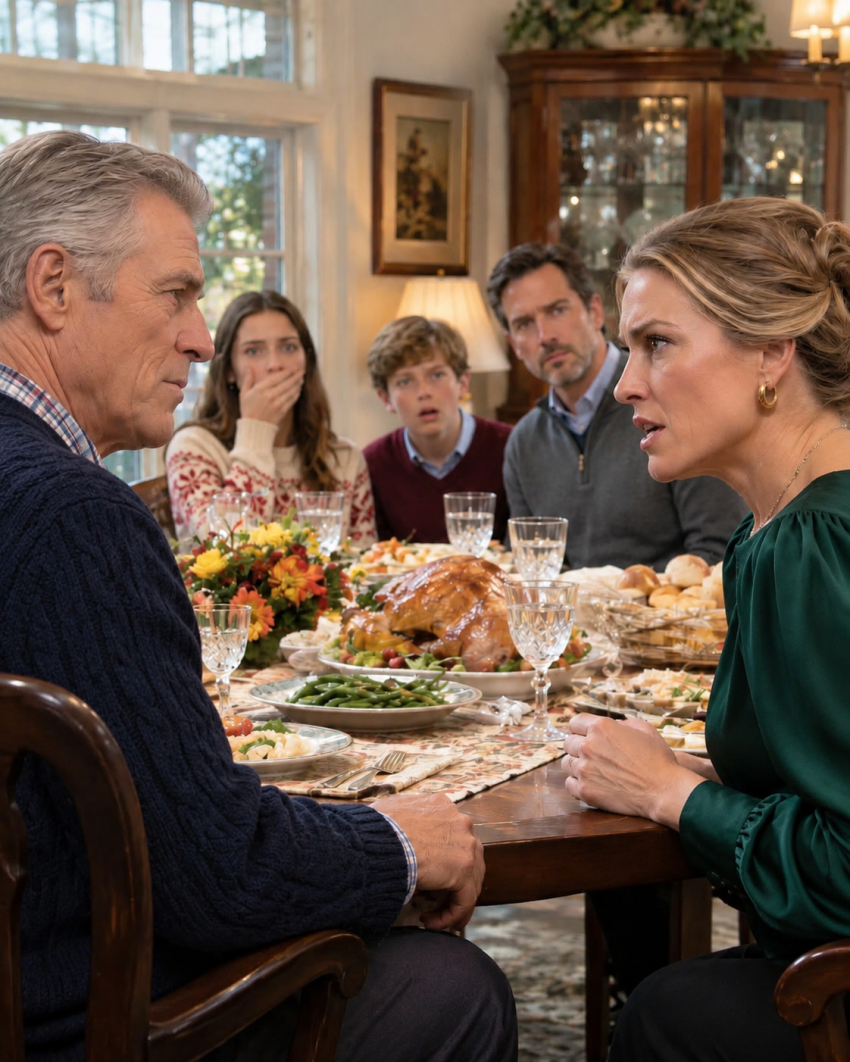
You know about Thanksgiving. The good china, the turkey from my mother’s recipe, the children’s beds made up. Don’t bother coming to the lake house for Christmas, you grumpy old man. Kyle looking at his plate.
I said I appreciated her honesty. I want you to understand why. In my old job, when a witness lies to you and doesn’t know you’ve noticed, the worst thing you can do is react. You say thank you. You go home and you write it down.
That night I sat in my study with the lamp off. I wasn’t hurt, exactly. I was doing arithmetic. Kyle earns $78,000. Alicia drives a new BMW, wears handbags that cost more than my first car, and posts from restaurants in Napa. They told me, repeatedly, that they couldn’t afford a house.
Somebody was paying for something.
You know how I got to the foundation. A charity called Light of Hope, a website with photographs of Alicia holding oversized checks, Alicia listed as executive director and Kyle as treasurer. I pulled the foundation’s Form 990 and set it beside the fundraising totals on its website. Two years running, the website claimed more than the tax filing reported.
That alone proves nothing. Pledges aren’t receipts. Reporting periods differ. I told myself that for two days.
Then I called Veronica Okafor. I’d worked with her when she was an IRS criminal investigator, a small, dry, relentless woman who once found a million dollars in a florist’s flower-delivery ledger. She runs her own firm now. She said, “Ronald, this isn’t social, is it?”
I said, “My daughter-in-law’s charity. And possibly my son.”
There was a pause on the line. Then she said, “Send me everything. I’ll be careful.”
She came to the house a week later with a notepad. She came again two weeks after that with a leather portfolio the size of a suitcase. We sat in my study with the shades half drawn and the paper spread across my desk like a hand of solitaire.
She’s methodical. She’d built a chart. At the top was Light of Hope Foundation. Beneath it, in a column, were four companies. Lakeshore Consulting Partners. Northgate Program Services. Delta Outreach Solutions. HopeBridge Administrative Group. Arrows ran from the foundation to each of them.
“These are vendors,” said Veronica. “The foundation’s filings list them as ‘program service providers.’ It paid them a combined $412,000 over three years.”
“For what?”
“Consulting. Outreach. Administration.” She tapped a line. “I can’t find a single employee, office, or phone number for any of them. Two share a mailing address, a UPS box in Roseville.”
“Who owns them?”
She slid out the page you’ve already seen. I put on my reading glasses.
Alicia Marie Brandt. Registered agent, Lakeshore Consulting Partners.
Gordon J. Pruitt. Managing member, Northgate Program Services, and signatory on the Delta and HopeBridge bank accounts.
I took my glasses off.
I’ll tell you about Gordon Pruitt, because it matters.
In 2007, I was lead prosecutor on a case against a man who ran a “charitable” fund-raising operation out of a strip mall in Folsom. It was called the Children’s Relief Alliance. It raised about nine million dollars, mostly from elderly donors on the phone, and spent about forty cents of it on children. Gordon Pruitt was the operation’s treasurer. He was a rumpled, genial man with a bow tie and a way of calling everyone “friend.”
He’d kept two sets of books. We found the second in his wife’s sewing room, inside a quilt.
He pleaded guilty to wire fraud and money laundering in 2009. I stood at the lectern and asked for ten years. The judge gave him eight. I saw him last in the hallway outside the courtroom, in a gray suit, being led away. He looked at me over his shoulder and said, almost fondly, “You’d have made a hell of an accountant, Ron.”
He’d been out since 2016.
I looked at Veronica. “How would my daughter-in-law know Gordon Pruitt?”
“That’s the question.” She lowered her voice. “Ronald, I’d like you to see one more thing.”
It was a photograph. A grainy shot, taken from across a street, of two people at an outdoor café table. A man in his seventies, white-haired, in a bow tie. A woman in her thirties, in sunglasses and a camel coat.
I knew the coat. I’d given it to her for her birthday.
“Taken in March,” said Veronica. “In Roseville. I had a colleague follow the UPS box.”
I looked at it a long time. The woman was laughing, with her hand on the old man’s wrist. It was the easy laugh of two people who’d known each other years. It wasn’t the laugh of a stranger.
“That’s not a business meeting,” I said.
“It might be. I don’t know.”
“It’s my daughter-in-law.”
“I know.” She took off her glasses and rubbed her eyes. “Ronald, I have to say something. You’ve been a friend. But I’m going to say it as a professional.”
“Go on.”
“If this is what it looks like, it’s a fraud on donors. A big one. And your son’s the treasurer. He signed the tax filings. If anyone in the government looks at this, he’s exposed regardless of what he knew.”
I put my hands flat on the desk.
“Does he know?”
“I don’t know. I’d like to find out before anyone else does.”
That’s where I was, on the night of December twenty-fourth, sitting alone in my study with a cup of cold tea.
I’ll tell you what Christmas was like. I’d told Kyle on the phone, in a pleasant voice, that I’d be fine. I’d said I’d planned a quiet few days. He’d sounded relieved, which I noted.
On the twenty-third, I drove to the grocery store and bought a small ham, a loaf of rye, and a bag of oranges. On Christmas Eve, I lit a fire. I put a record on, an old Bing Crosby Eleanor loved. I didn’t open the presents I’d bought for Lisa and Jacob. I’d planned to give them in person.
At seven, I sat at the kitchen table and ate a sandwich. At nine, I read Chandler. At eleven, I carried a stack of Veronica’s pages to the study and began to go through them again, one by one, with a pencil.
I found it at 11:40.
It was a bank record. A wire confirmation, from the Delta Outreach account, dated October fourteenth. $28,000. The beneficiary’s name had been blacked out in the copy Veronica obtained. But the routing number hadn’t.
I looked up the routing number on my laptop. It belonged to a credit union in Davis, California.
I looked up the account type. A trust account. A college savings trust.
I leaned back in my chair. The fire popped. Outside, the lake was black.
I called Veronica. It was nearly midnight. She picked up on the first ring.
“Ronald.”
“The twenty-eight thousand. October fourteenth. Do you know where it went?”
“I’m working on it.”
“I think it went to a 529 plan.”
Silence. Then, slowly: “For whom?”
“I don’t know. But I know who has a 529 at Davis Federal.”
I closed my eyes.
“My grandchildren,” I said.
I’d set them up myself. In 2017, when Lisa was three and Jacob was a baby, I opened a 529 college savings account for each. I’d put in $15,000 apiece. I never told Alicia the account numbers, but I’d told Kyle. He’d been the custodian on both, at my request. I’d wanted to be sure the money would go to the children, not to anyone’s whim.
Somebody had wired $28,000 from a shell company into one of them.
I sat with that for a minute. It didn’t make sense. A thief doesn’t deposit.
Then I thought about it the way I used to think about a case. Why does a person put dirty money into a clean account?
“Veronica,” I said. “She’s cleaning it.”
“What?”
“She’s washing it. Through the kids. A 529 is a protected account. It grows tax-deferred. It’s about the cleanest place in the world to park funds, and nobody looks at a child’s college plan.” My voice was level. “She’s been moving money from the foundation, through the shells, into the children’s accounts. And then, someday, she’d withdraw it. As ‘education expenses.’”
“Ronald.”
“It’s elegant.” I heard how grim I sounded. “Gordon taught her that. It’s the same move he used in 2005.”
I looked at the clock. It was 11:56.
“I need to talk to my son,” I said.
I didn’t get the chance. At 12:01 a.m., my phone rang.
It was Kyle.
I stared at the screen. In nineteen years, he’d never called me at midnight. I answered on the second ring.
“Dad?”
His voice was high and cracked. I could hear a baby’s wail, or a kettle, or the wind. I could hear Lisa crying in the background.
“Dad. Dad, you’re all over the news.”
“I’m what?”
“Channel Ten. Channel Three. It’s on every station. They’re saying, Dad, they’re saying a federal investigation, and they say your name. ‘Retired prosecutor Ronald Hale.’ They have your picture. What on earth have you done?”
I stood. My chair scraped.
“Kyle, slow down. What exactly are they saying?”
“That you gave documents to the, to the U.S. attorney’s office. About the foundation. About Alicia.” He was sobbing now. “Dad, they’re saying the FBI’s at our house. They’re on the lawn. There’s a van. Lisa’s in her pajamas.”
I closed my eyes.
I hadn’t given anything to anyone. I’d given it to Veronica. She’d been working with a contact at the U.S. Attorney’s office, I realized, since the second week. She hadn’t told me. She’d said, I’d like to find out before anyone else does. She’d done that. And found that someone else already had.
“Kyle,” I said. “Listen to me. Is your door open?”
“They’ve got a warrant.”
“Let them in.”
“Dad!”
“Let them in. Do not touch anything. Do not let Alicia touch anything. Put the children in the car with a coat, and tell the agent in charge you’d like a lawyer.”
“I don’t have a lawyer.”
“You do. I’m sending one.” I was already looking for my keys. “Kyle, I’m coming.”
I drove down Lakeshore Boulevard at midnight on Christmas Day. It was clear and cold, with a thin frost on the road and every house lit with lights. A plastic Santa waved from a lawn. A man in a bathrobe walked a dog.
Kyle and Alicia live in a cul-de-sac in Natomas, in a four-bedroom house that I’d learned, six months before, they didn’t own. They rented it from an LLC. I’d never asked whose. I’d assumed a landlord.
I saw the lights from two blocks away.
There were four black SUVs and a van at the curb. A strip of yellow tape ran across the lawn. Agents in dark jackets with white letters on the back moved in and out of the front door, carrying boxes. Neighbors stood on porches in coats and slippers.
I parked and got out. A young agent put up a hand.
“Sir, this is an active scene.”
“I’m Ronald Hale. I’m Kyle Hale’s father.”
“Sir, I can’t.”
“I was an AUSA in this district for thirty-eight years,” I said. “I know Special Agent Pruitt. No relation.”
He blinked.
“I’d like to speak to her. And I’d like to see my grandchildren.”
They’d put the children in a car. A gray Ford, with the heater running. Lisa, in pajamas and a puffy coat, sat in the back seat with her arms around Jacob. Jacob had a stuffed bear. A kind-faced woman agent sat in the front seat with a thermos and a coloring book, saying nothing.
I opened the back door. Lisa looked up. Her face was wet.
“Grandpa.”
“Hello, sweetheart.”
“They came in so fast.” Her voice was thin. “Mommy was yelling. Daddy was just standing there. And then the men said they were looking for papers.”
“I know.”
“Is it because of you?”
I stopped.
She’s twelve. She reads everything. She looked at me with Eleanor’s steady gray eyes.
“No,” I said. “It isn’t because of me. It’s because of something that was already true.”
“What?”
“I’ll tell you when you’re older.”
“I’m twelve.”
“I’ll tell you when you’re thirteen,” I said.
She almost smiled. Jacob, in her arms, whispered, “Grandpa, are you in trouble?”
“No, buddy.”
“Are we?”
I looked at him. I’d been a prosecutor for thirty-eight years. I’d said a great many things to a great many frightened people. I’d never found a good answer.
“You’re not,” I said. “I promise.”
I got in. I put my arm around them both. Lisa put her head against my coat. Jacob burrowed against my side. We sat there in the warm dark with the heater ticking and the strobe of lights across the windshield.
“Merry Christmas,” said Jacob, in a very small voice.
“Merry Christmas,” I said.
I won’t pretend I knew what came next. I’d sat on the other side of this table. I knew the sequence. Search warrants, seizure, grand jury subpoenas, target letters. Months of waiting.
But a few things happened that night I hadn’t anticipated.
Special Agent Imani Pruitt came to the car at one-fifteen. She was fifty, small and square, in a navy windbreaker, with short gray hair and a flat, tired voice. I’d worked with her husband, a retired agent. She opened the car door and looked at the children, and then at me.
“Mr. Hale.”
“Agent Pruitt.”
“I’m sorry for the circumstances.”
“So am I.”
“The children will be released to a family member. We’d prefer you.” She paused. “It’s your son’s choice. He’s been asked to step aside for questioning.”
“Is he under arrest?”
“Not at this time.”
“Is Alicia?”
“I can’t say.” She lowered her voice. “Sir, may I ask? Did you know about this?”
I took a moment.
“I knew the foundation’s numbers didn’t match,” I said. “I hired a private investigator. She handed it to your office. I didn’t know until tonight that she had.”
Agent Pruitt nodded slowly.
“Mr. Hale,” she said. “I think you should talk to your son.”
He was sitting on the front steps. They’d let him out of the house, with an agent beside him, but they hadn’t yet taken him anywhere. He sat in a gray sweatshirt and jeans, with his hands between his knees, looking at the lawn.
I sat down next to him. The steps were cold.
“Dad.”
“Kyle.”
He didn’t look at me. His breath came out in white puffs.
“I didn’t know,” he said.
I waited.
“I swear to you. I signed the forms. I’m the treasurer. She said it was a formality.” His voice cracked. “I never read them. I never, she handled the books. I just signed.”
“I believe you.”
“You do?”
“I do.” I looked at the lawn. A neighbor’s Christmas lights blinked red and green. “I think you signed because you wanted her to be happy.”
He put his face in his hands.
“I’m a coward,” he said, through his fingers. “I’ve been a coward my whole life. I sat at that table at Thanksgiving. I looked at my plate.”
“I saw.”
“I wanted to say something.”
“I know.”
“I couldn’t.”
“Why?”
He didn’t speak for a long time.
“Because she’d have left,” he said. “And I couldn’t stand it.”
I put an arm around his shoulders. He’s six-one, a big, soft, rumpled man, and he leaned into me, heavily, like a child. I felt him shaking.
“Kyle,” I said. “I’m going to tell you something. And you’ll want to remember it.”
“Okay.”
“The agents will ask you questions. Don’t answer them without a lawyer.”
“I don’t have one.”
“You do. Her name’s Marguerite Reyes. She’s the best white-collar defense attorney in Sacramento. I put three of her clients in prison and she still sent me a fruit basket.” I took a breath. “She’s on her way. I called her from the car.”
He laughed. It was wet and cracked.
“Dad, I can’t afford.”
“I’m paying.”
“I can’t ask.”
“You’re not asking.”
He wiped his face on his sleeve.
“Second,” I said. “You’ll tell her everything. Everything. The signatures, the filings, how much you knew, when you knew it. Even if it’s bad. Especially if it’s bad.”
“Okay.”
“And third.”
“Yes?”
“Whatever Alicia says, whatever she asks you to say, you’ll tell the truth. Even if it hurts her.”
He stared at me.
“Dad, she’s my wife.”
“I know.”
“I love her.”
“I know that, too.”
“I can’t.”
“You can,” I said. “I’ve watched men do it. It’s the hardest thing there is.”
Alicia came out at two.
I’d been waiting. She came through the front door between two agents, in a silk robe, with her hair in a rope over one shoulder. She wasn’t in handcuffs. She walked with her chin up and her back straight, a tall, pale, magnificent woman, in bare feet on a frozen walk. Neighbors stared from their porches.
She saw me.
She stopped.
I stood. My knees cracked. I’m sixty-seven, and I’d been sitting on a cold step for an hour.
For a long moment, we looked at each other. Her eyes were very bright and very dry. She’d put on lipstick. I noticed that. I thought, she’s been rehearsing.
“Ronald,” she said.
“Alicia.”
“I suppose I should thank you.”
“For what?”
“For the Christmas present.” Her voice was light and brittle. “I’d hoped for a sweater.”
An agent shifted beside her. Kyle had stood up. He stood at my shoulder, white-faced.
“Alicia,” he said. “What did you do?”
She turned her head. She looked at her husband the way you’d look at a tool that had broken.
“I took care of us,” she said.
“By stealing?”
“By surviving.” She said it very quietly. “You don’t know what that means, Kyle. You’ve never had to.”
I’d like to tell you what I felt, and I’m not sure I can.
I’d spent thirty-eight years looking at people like her across a courtroom. I’d seen the same expression, the same bright, dry, hard look. It’s the look of someone who has decided that the world is a machine, and that her only choice is whether to feed it or be fed.
But I also saw something I’d missed at Thanksgiving. She was shaking. It wasn’t visible. It was in her hands, which she’d folded very tightly in front of her robe.
“Alicia,” I said. “Where did you learn it?”
She stared.
“The washing. The 529s. Gordon Pruitt taught you.”
A flicker. Very small. Her chin lifted.
“I don’t know a Gordon Pruitt.”
“I have a photograph.”
She didn’t move.
“Roseville,” I said. “March. A café. You were wearing the coat I gave you.”
For the first time, I saw her face change. It didn’t crack. It simply stopped. It was like watching a clock halt at an hour.
“He’s my father,” she said.
Nobody spoke. A van door slammed. A dog barked somewhere down the block.
I heard Kyle make a small sound, like a man who’s been struck in the stomach.
“Your what?” I said.
“Gordon Pruitt is my father.” She said it flatly. Her voice was a thread. “My name was Brandt. My mother’s. She changed it, when he went to prison. She took me to Fresno. I was nine.”
I stood very still.
“Eight years,” said Alicia. “I visited every month. I took the bus. I sat in a plastic chair and he told me stories about the old days. About how smart he’d been.” Her mouth twisted. “About the prosecutor who’d caught him.”
She looked at me.
“He said you were the only honest man he ever met.”
I’d like to say something clever. I didn’t. I stood on a frozen lawn in the middle of the night, in my overcoat, with my son’s trembling shoulder against mine, and felt the whole thing turn over, like a stone with a living thing beneath.
“You married my son,” I said slowly.
“Yes.”
“Knowing who I was.”
“Yes.”
“Why?”
She didn’t answer for a long time. A cold wind came up the street, rattling the plastic Santa.
“At first,” she said, “I wanted to see what you were like.”
“And then?”
“And then I met Kyle. And he was so, he was so gentle.” Her voice cracked, for the first time. “And I thought, I could stop. I could have a house with a porch and a husband who made pancakes. I could be someone else.”
Kyle made a sound. It was a half sob.
“But it was hard,” said Alicia. “I didn’t know how. And my father needed money. He’d been out three years. Nobody would hire him. He was sixty-eight, with a record. He said, ‘Allie, I’m drowning.’”
“So you helped.”
“I helped.” She laughed, bitter and thin. “It’s what daughters do.”
I closed my eyes.
I’d put a man in prison. I’d done it carefully, and fairly, and I’d never doubted it. I’d never once thought of the nine-year-old on a bus.
It’s a strange thing to feel sorry for someone who has hurt you. I’d done it before, with defendants. I’ve learned to put it in a drawer.
I couldn’t, that night.
“Alicia,” I said. “How much money?”
“I don’t know.”
“You do.”
“Four hundred and twelve thousand.” Her voice was flat. “Over three years. Most of it went to Dad. Some to us. Some to the kids.”
“The 529s.”
“I thought, if I put it there, it’d be safe. For them. If anything happened.” She pressed her lips together. “I didn’t want them to have nothing.”
“That’s not safe. That’s evidence.”
“I know that now.”
“They could be forfeited.”
“I know.” She swallowed. “I didn’t think.”
An agent touched her elbow. “Ma’am, we’ll need you to come.”
She nodded. She didn’t move. She looked at Kyle.
“I’m sorry,” she said.
He didn’t answer. He stood with his arms wrapped around himself, shaking.
“Kyle.”
“I don’t, Alicia, I don’t know who you are.”
“I know.”
“I don’t know if I ever.”
“I know,” she said. “I’m sorry. I wanted you to be the one thing that wasn’t a lie.”
She turned. She walked toward the black SUV, in her bare feet, with an agent on either side. At the door, she stopped. She looked back, not at him, but at me.
“Ronald,” she said. “The children.”
“I have them.”
“Be kind to them.”
“I will.”
“Tell Lisa,” she began. She stopped. Her mouth worked. “Tell her I read the book she gave me. The one about the horse. Tell her I cried.”
I nodded.
She got in. The door closed. The SUV pulled away, slowly, down the dark cul-de-sac.
It took eleven months. I’ll give you the pieces.
Alicia was indicted in February. Wire fraud, money laundering, and conspiracy. Gordon Pruitt, seventy-one, was arrested in Roseville the same morning. He’d been living in a one-bedroom apartment above a dry cleaner, with a computer, three prepaid phones, and a quilt.
I didn’t go to either hearing. I’d thought about it. I stood in the parking lot of the federal courthouse for ten minutes in a gray overcoat, watching people go in. Then I drove home.
Kyle did what I’d asked. He told Marguerite Reyes everything. She sat with him for three days in a conference room, with a pot of coffee and a legal pad, and when she finished, she said, “Mr. Hale, you’re a very honest man. It’s going to help.”
It did. He cooperated fully. He handed over every document, every email, every text. He gave a proffer, with immunity, to the U.S. Attorney’s office. He testified before the grand jury in March. He was never charged.
Alicia took a plea in August. Twenty-seven months in federal prison, followed by three years of supervised release, and restitution of $412,000. She’d cooperated, too, in the end. She gave the government Gordon’s methods, his shell companies, his accounts. The prosecutor, a thin, quiet woman named Delphine Okafor, told me afterward in a hallway, “Her statement was the most honest I’ve heard in twenty years.”
“I’m not surprised.”
“Why?”
“She learned it from someone who was once honest,” I said. “Before he wasn’t.”
I took the children that winter. Kyle asked me to. He sat at my kitchen table on the first of January, in the gray sweatshirt, with his hands wrapped around a mug.
“Dad, I can’t do it alone.”
“You won’t.”
“I mean the house. The mortgage. I can’t, I lost my job.”
I’d known. The insurance company had let him go in January, when the news broke. He’d kept it from me for two weeks.
“I’d like you to move in,” I said.
He stared.
“Here?”
“It’s a big house. Four bedrooms. There’s a room for each of you.”
“Dad.”
“Not as charity.” I held up a hand. “As a lease. Eight hundred a month. You’ll cook dinners. You’ll do the dishes. And you’ll find work.”
His eyes filled.
“I don’t deserve it.”
“No,” I said. “But the children do.”
He put his face in his hands.
They moved in on a snowy Saturday. Kyle carried the last box up the porch steps himself. Lisa came behind him with a stuffed horse under one arm. Jacob raced past all of us and up the stairs, shouting, “I call the room with the window!”
I stood at the bottom of the staircase in my cardigan, watching them go up.
Lisa stopped on the landing. She looked down at me. Her gray eyes were serious.
“Grandpa?”
“Yes?”
“Are you still going to tell me? When I’m thirteen?”
I thought about it.
“I think I’d rather ask what you want to know.”
She considered it. She came down two steps.
“Is Mommy a bad person?”
I took off my glasses. I looked at the grain of the banister, where Eleanor had gripped it for twenty-seven years.
“I don’t think there are bad people,” I said. “I think there are people who do bad things. And sometimes they’re the same people who read about horses and cry.”
She nodded slowly.
“Can I write to her?”
“I’d like that.”
“Will you read it first?”
“If you want.”
“I don’t,” said Lisa. She came down the last steps and put her arms around my waist. She smelled of crayon and snow. “I just wanted to ask.”
Kyle found work in April. It was an adjuster’s job at a small insurance office in Elk Grove, for $52,000. He took it. He told me it was the first time he’d felt employed in six years.
He’s paying me $800 a month. Every first, by check, with the number in the memo line. Payment 8 of 36. I’ve put it all into a savings account in the children’s names, in a plain, boring money-market fund, with no tax advantages whatsoever.
I visited Alicia in September. It was a federal camp in Dublin, California, a low beige complex with a fence. I’d filled out a form. I’d sat in a plastic chair in a visiting room that smelled of floor wax and boiled coffee.
She came in wearing khaki. She’d cut her hair. Her face was bare and pale. She looked about nineteen.
She sat across from me.
“Ronald.”
“Alicia.”
“You didn’t have to.”
“I know.”
“Why did you?”
I’d thought about it for weeks.
“Because somebody visited your father,” I said. “Every month. On a bus.”
She put her hand over her mouth.
“He’s at Lompoc,” she said, when she could. “Fifteen years, probably.”
“I’m sorry.”
“Are you?”
“I put him there once. I’d do it again. But I’m sorry it cost you.”
She laughed, thin and wet.
“That’s the most honest thing anyone’s said to me in a year.”
“I’ve had practice.”
We talked for an hour. I won’t give you all of it. She asked about the children. I told her about Lisa’s book report, Jacob’s soccer game, the way Kyle burned the pancakes and Jacob ate them anyway. She listened with her hands in her lap.
At the end, a guard called time. She stood. She hesitated.
“Ronald, may I ask something?”
“Of course.”
“At Thanksgiving. When I said it. ‘Grumpy old man.’”
“Yes.”
“Why didn’t you fight?”
I looked at her. At a woman of thirty-seven in prison khaki, who’d once told me not to come for Christmas.
“Because I’d learned,” I said, “that a person who’s lying doesn’t need an argument. She needs time.”
“Time to what?”
“To run out of story.”
She stared. Then, slowly, she smiled. It was small, and crooked, and entirely unguarded.
“Dad would’ve liked you,” she said.
“Your father did like me.”
“Did he?”
“He said I’d have made a hell of an accountant.”
She laughed so hard she had to sit down again. The guard glanced over. She put her hand over her eyes.
“I’m sorry I called you grumpy,” she said.
“I am grumpy.”
“You’re a little grumpy.”
“I’d have said ‘a great deal.’”
She wiped her eyes. She looked at me for a long time.
“Merry Christmas, Ronald,” she said.
“It’s September.”
“I know. I’m early.”
It’s December again.
I’m sixty-eight. I live in the house on Lakeshore Boulevard, with my son and two grandchildren and a stuffed horse named Biscuit. The lake is flat and gray. A thin frost lies on the porch rail.
On the twenty-fourth, I lit the fire. I put on the Bing Crosby. Lisa and Jacob came down the stairs in their pajamas, and we sat on the floor and opened presents. I’d given Jacob a tackle box. I’d given Lisa a first edition of National Velvet, from a shop in San Francisco, for $140.
She held it in both hands. She didn’t say anything. She turned it over and looked at the title page.
“It’s signed,” she whispered.
“By the author.”
“Grandpa.”
“I thought you’d like it.”
“It’s the horse one.”
“It is.”
She put it against her chest. She was twelve, going on thirteen, and her eyes were wet.
“I’m going to send her a copy,” she said. “Not this one. A paperback. With a note.”
“I think she’d like that.”
“What should I write?”
I looked at the fire.
“Whatever’s true,” I said.
At midnight, my phone buzzed on the mantel.
I picked it up. A text from an unfamiliar number, with a California prefix.
Merry Christmas, Ronald. I read the horse book again. It still makes me cry. — A.
I typed with two fingers.
Merry Christmas, Alicia. Lisa says to tell you she’s sending one of her own. Be well.
I pressed send. I put the phone down. I looked at the room, at the tree, at the lake dark in the window.
A year ago, I’d sat alone in a study, with a cup of cold tea, listening to the house tick. I’d thought I was doing arithmetic.
I’d been doing something else. I’d been waiting for the story to run out.
It had. And what was left, when it did, was this: a sleeping child, a tired son, a fire, a book. A text from a prison. A good deal of paper in a locked drawer.
I got up. I took the afghan from the sofa and spread it over the children, one corner at a time. I tucked it under Jacob’s chin. I put my hand on Lisa’s hair, very lightly, the way Eleanor used to.
Then I turned off the lamp, and sat down in the dark with them, and kept watch.