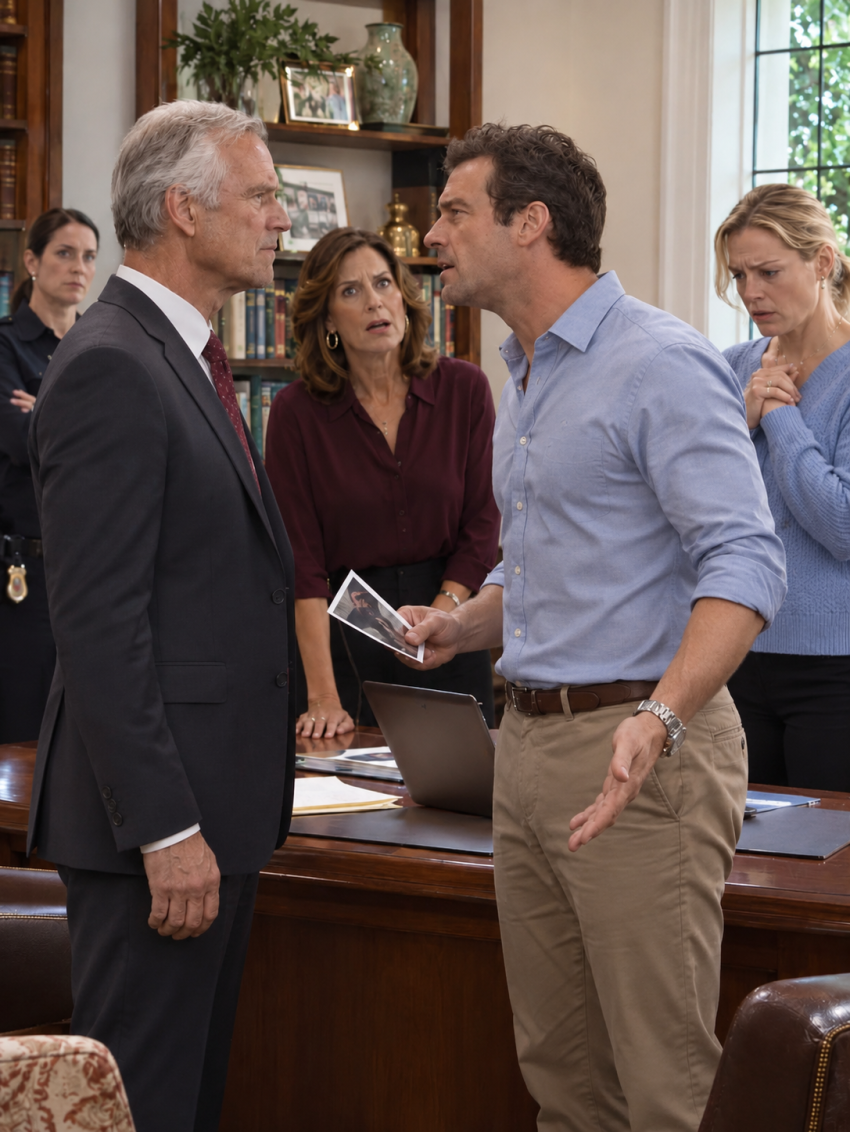
“Mr. Delaney,” she said. “I’d like you to read the heading aloud.”
My son didn’t want to. I watched him not want to. Beside him, Adrienne had stopped turning the music box.
“‘Surveillance and Records Summary,’” he read. His voice had gone thin. “‘Prepared for Colleen M. Delaney. Subject: Dominic R. Delaney and Adrienne K. Delaney.’”
“Date?”
“March fourth.”
“Fourteen months before your mother died,” said Inez.
My name is Ray Delaney. I’m sixty-four. I repaired school buses for the Pittsburgh public schools for thirty-one years. I can tell what’s wrong with an engine from the sound it makes before the key is turned all the way. I should have been able to do that with my own son.
Colleen and I bought our brick house on Brandon Street when we were twenty-six, with $4,000 down and a handshake from a banker who’d known my father. She taught herself accounting from library books at the kitchen table, with Dominic on her lap, holding a pencil in one hand and a spoonful of applesauce in the other. By forty she was keeping books for six small businesses. By fifty-five she was tired in a way she didn’t discuss.
She died on a Tuesday in October, of pancreatic cancer, eleven days after hospice moved her into the front room. She was sixty-three. I held her hand. She said, in the last clear hour, “Is Dominic here?”
You know how many times she asked. Ninety-one. I kept a tally on the back of the pharmacy calendar. I’d tell her, “He’s on his way, honey.” She’d smile and close her eyes.
I’ve never told a worse lie.
You know about the call. The airport. Adrienne’s already stressed, and we’re about to board. I’ll call you when we land. My son is forty, a regional manager for a medical-supply company, handsome and quick, with Colleen’s dark eyes and a laugh that works on strangers. His wife, Adrienne, is thirty-seven. She sells high-end real estate, wears cream cashmere, and has a smile that seems to be reading a price tag.
They flew to Lisbon. They didn’t come to the funeral. Six people did: my sister Maureen, two neighbors, a priest, Colleen’s old boss, and a girl from the hospice who sat in the back and cried.
I stood up in front of that small room and talked about a woman who’d once stayed awake for three nights because a six-year-old had pneumonia. I didn’t mention the empty chair. I didn’t think I could say it and stay standing.
Six weeks later, Inez Okonkwo called. She’d been Colleen’s attorney, a brisk, silver-haired woman of sixty with a sign on her desk that said READ THE INSTRUMENT. I’d met her twice, at a wedding.
I drove downtown in my gray Buick and sat in a leather chair that was too deep. She slid a folder across the desk. I told her there was a mistake. We had a house and nine thousand dollars in savings.
She said, “Mr. Delaney, I’d like you to read this slowly.”
Six properties. A brokerage account. A life insurance policy. A total, with the house, of $4.3 million.
I looked at it for a long time. I read it twice.
“Where did it come from?”
“Seventeen years ago,” said Inez, “your wife inherited a duplex from an aunt in Altoona. It was in poor condition. She renovated it herself, on weekends, while you were at work. She rented both halves. She used the income to buy another.”
“She never told me.”
“She meant to. On your sixty-fifth birthday.”
I put my hand over my mouth.
I’d like to tell you what I felt, because it wasn’t what you’d expect. It wasn’t joy, or even surprise. It was the slow, sinking feeling of finding out the engine you’ve been listening to for forty years had a second one running underneath it.
She’d done it quietly. She’d done it so I’d never have to ask anyone for anything.
“Mr. Delaney,” said Inez. “There’s something else. I’d like you to take your time.”
She held out a plain wooden cigar box, scuffed at the corners. It had been in a bank vault since August.
“She asked me to give you this. After the estate was in order. She said you’d know when.”
I held it in both hands. It was lighter than I expected.
I didn’t open it in her office. I carried it home on the passenger seat of the Buick, belted in, like a child. I set it on the kitchen table beside Colleen’s reading glasses, which I hadn’t moved.
Then the phone rang. Dominic.
You know the call. He sounded like the boy at the bottom of the stairs again, small and sorry. He was worried about me alone. He wanted to apologize for the funeral. He’d help with the paperwork.
“How do you know there’s paperwork?” I said.
A pause. A thin, bright laugh. “Dad, I just meant the usual things. After someone passes.”
I put my hand flat on the cigar box.
“Come Saturday,” I said. “Both of you.”
I hadn’t planned to. It came out of me like a sneeze.
They came at ten. Adrienne walked in first, in a camel coat and sunglasses, and I watched her take the room. The grandfather clock, the china cabinet, the three oil paintings Colleen had bought at a church auction in 1994. Her eyes did a quick, silent sum.
Within ten minutes, she’d said the house was “a lot for one person.” Dominic asked, softly, whether I’d been forgetting things. Adrienne wondered whether I’d consider a place nearer to them. She mentioned a community in Fox Chapel with a memory-care wing, “just in case.”
I said I wasn’t forgetting anything.
She took a card from her purse. A psychiatrist’s, in Shadyside. An appointment, she said, for Tuesday. “Grief affects judgment, Ray. And you’ve got financial decisions.”
“I didn’t ask for an appointment.”
“We made it for you.”
I stood up. I asked them to leave. Dominic stopped in the doorway, in a navy quarter-zip, with his hand on the frame. He said, “You’re going to need us, Dad.”
He said it like a weather report.
That night, I opened the cigar box. I sat at the kitchen table under the yellow light, with the clock ticking and the kettle gone cold.
Inside were letters. Forty or so, in plain envelopes, each with RAY on the front in Colleen’s slanting hand. Some were old, the paper soft as cloth. The earliest was dated 2008.
I read the last one first. It was written in the shaky hand she’d had at the end, in pencil, on a page from a hospice notepad.
Ray. I built it because I couldn’t stand the thought of you ever having to ask that boy for anything.
I put my hand over my eyes.
Under the letters lay a manila folder, fat as a phone book. On the tab, in her handwriting: Please read this before you feel sorry for anybody, including me.
I opened it.
It was a private investigator’s file. Eighty-four pages. A man named Gordon Pruitt had signed the cover letter: Surveillance and Records Summary, prepared for Colleen M. Delaney, March 4.
I read it until two in the morning. I’ll give you the shape.
Colleen had hired him fourteen months before she died, after a Thanksgiving I remember badly. Dominic had corrected her grammar over the turkey. Adrienne had called our kitchen “dated.” Colleen had gone upstairs, afterward, and not come down.
She’d asked Pruitt one question. Is my son in trouble?
He found out. Dominic owed $212,000. Credit cards, a failed “boutique investment” in a Lisbon restaurant, and a second mortgage on a house they’d bought for $740,000 and couldn’t afford. Adrienne’s real-estate business had been struggling since 2022. They’d taken out three personal loans. They’d stopped paying the last of them in August.
And there was a page near the back, headed Communications. Pruitt had obtained, through a source I won’t name, a series of text messages between Dominic and Adrienne. Dated that spring.
I read them in the yellow light, at my kitchen table, with my wife’s reading glasses beside my hand.
Adrienne: Your mom’s sicker than you said. What’s the house worth?
Dominic: Idk. Maybe 350.
Adrienne: And your dad’s on the deed?
Dominic: Both.
Adrienne: So when she goes, it all goes to him. And when he goes, it’s us.
Dominic: That’s dark, babe.
Adrienne: It’s math. How long do you think he lasts?
I put the pages down. My hands were steady. I’d like you to know that. I’ve repaired brake lines. I know the feeling of a part that’s been quietly failing.
I read on. There was a message from May.
Adrienne: If she dies before the Lisbon trip, we’ll have to cancel. I’m not canceling.
Dominic: Mom’s not going to die before June.
Adrienne: You said that in March.
I read the last one, from September, three weeks before Colleen died.
Dominic: The hospice woman called. She says it’s days.
Adrienne: Then we go now. Before it’s real.
Dominic: Before what’s real?
Adrienne: The funeral. Then we’ll have to be there for your dad. I’d like one more week of not being sad.
I’ll tell you what I did. I got up and put the kettle on. I stood at the stove, in my socks, watching the burner turn red. I thought about nothing. It’s a thing I learned in the garage: when an engine fails you don’t swear at it. You stand with your hands at your sides and find out which part.
It wasn’t Dominic, entirely. I want to be fair. The messages were Adrienne’s, mostly. He’d answered in short, tired sentences, like a man being walked down a hall.
But he’d gone. He’d gotten on the plane.
I took the folder to the table. I turned to the last page. Colleen had written a note in the margin, in pencil, in the shaky hand.
Ray. I read all of this. I cried for a week. Then I decided what to do.
Call Inez. She has everything. She’ll know when. I’ve told her to watch for the doctor.
What doctor? I thought.
I turned the page. There was one more sheet, in Inez’s careful typing. It was a draft of a document, with a heading. Petition for Appointment of Guardian Ad Litem and Limited Guardianship of the Person and Estate of Raymond P. Delaney.
My name. Prepared by an attorney in Fox Chapel. Dated three weeks earlier.
Not by us. By them.
I called Inez at seven the next morning. She answered on the first ring.
“Mr. Delaney.”
“Mrs. Okonkwo. I think I should tell you something. And I’d like to hear what Colleen meant by ‘the doctor.’”
A pause. I heard a chair creak.
“Come in,” she said. “I’ll make coffee.”
I went. She laid it out for me over three hours, in her office, with a legal pad and a yellow highlighter.
Colleen had anticipated it. She’d told Inez, in July, in a voice Inez described as “perfectly steady.” They’ll try to say he’s incompetent. They’ll find a doctor. They’ll want the estate. She’d paid for a full cognitive evaluation for me in August, on a pretext about my blood pressure. I’d gone. I’d counted backward, drawn a clock, repeated a list of words. I’d forgotten about it.
“The results are in the file,” said Inez. “Dr. Reyes, at Allegheny General. Your scores were in the ninety-ninth percentile for your age.”
I stared at her.
“She wanted a record. Dated, signed, before anything started.” Inez folded her hands. “She also made sure that if anyone filed a guardianship petition, I’d be notified. The court clerk is a friend.”
“She planned all this?”
“Mr. Delaney.” She took off her glasses. “She worked in accounting for forty years. She believed in a paper trail.”
I put my hand over my mouth. I laughed. I couldn’t stop.
We prepared for nine days. I’ll tell you why I agreed. It wasn’t that I wanted a fight. I’d have given every dollar to have my son on the other end of a phone in October. But Inez said something I couldn’t answer.
“If you do nothing, they’ll file. They’ll win a hearing, because judges are cautious about grief. You’ll lose control of the estate. And the first thing they’ll do is sell the house.”
“Colleen’s house.”
“Yes.”
I looked at the window. A pigeon sat on the sill, fluffing itself against the cold.
“Then I’d like to see them try,” I said.
Inez smiled, thin.
“I’d like you to be at home,” she said. “On the day. In your own kitchen. And I’d like you not to say anything to anyone until I arrive.”
“They’ll bring somebody.”
“I’m counting on it.”
You know about the day. Four cars at ten in the morning. Adrienne in a white coat, directing everyone up my walk. Dominic with an attorney named Whitcomb, a doctor with a leather bag, and a woman from the county in a lanyard. We’ve filed a request concerning your ability to manage your affairs.
I looked at my son. He was in a gray overcoat, with his hands in his pockets. He looked about nine.
“Dominic. Is this what you want?”
He opened his mouth. Adrienne touched his arm. We love you, Dad.
I let them in.
I’ll tell you about the next hour, because I’ve gone over it a lot. They were very polite. The doctor had me count backward by sevens. I did it, in a flat voice, from a hundred to two. He asked me the date, the president, the name of my street. I answered. He asked me to remember three words, apple, table, penny, and I said them back to him after he’d asked about my breakfast, and my hobbies, and my wife’s maiden name.
The social worker looked at my stairs and my kitchen. She checked my refrigerator, my medicine cabinet, my smoke detector. She asked whether I fed myself. I said I made eggs.
And all the while Adrienne sat on Colleen’s couch, on the cushion by the lamp, with the music box in her lap.
It was a small thing, a walnut box with a brass key. I’d given it to Colleen on our tenth anniversary, in 1996. It played “Moon River.” She’d kept it on the end table for twenty-eight years.
I watched Adrienne turn it over. She ran her thumb along the base. She was looking for something. Her face had gone very still, the way a person’s does when she’s counting.
I thought: she knows something is in there.
I didn’t know what. I knew only that I’d never opened it. Colleen had said, once, years ago, Ray, that one’s mine.
I stood. I said, “I need to make a phone call.”
Dominic said, “Dad, you don’t need to call anybody.” His voice cracked on anybody.
“We’re all family here,” said Adrienne, smoothly.
I walked into the kitchen. I dialed the number Inez had made me save. It rang once.
“They’re here,” I said. “All of them.”
You know about the eleven minutes. I stood at the sink with my back to the wall, looking out at Colleen’s tomato frames, bare in the November cold. I heard muffled voices from the living room, Whitcomb’s dry murmur, the doctor’s cough, Adrienne’s low, quick laugh.
Then the front door. A brisk step. A woman’s voice, gravelly and calm.
“Good morning.”
I came out of the kitchen. Inez stood in my hall, in a gray wool coat, with a leather briefcase in one hand. Behind her were two others. A tall, rumpled man of about fifty in a tweed jacket, whom I recognized from the photograph on the cover letter. Gordon Pruitt, private investigator. And beside him, a heavyset woman in a navy blazer with a badge on her belt.
She introduced herself as Detective Reyes, Allegheny County, financial crimes.
Adrienne went white. I watched it happen. It began at the forehead and went down, like water draining from a glass. Her hand tightened on the music box.
She was looking at Pruitt.
Inez set her briefcase on the coffee table. She snapped the latches. She took out a manila folder and held it for a moment, as if weighing it.
“Mr. Whitcomb,” she said. “I believe you represent Dominic and Adrienne Delaney.”
“I do. And you are?”
“Inez Okonkwo. Executor of the estate of Colleen Delaney. And counsel to her husband.” She smiled thinly. “I’d like to correct something. You’ve filed a petition to evaluate Mr. Delaney’s capacity. That petition cites ‘recent confusion and memory lapses.’ May I ask your source?”
“Concerned family members.”
“Of course.” She opened the folder. “I’d like to show you something. Mrs. Delaney anticipated that this day might come. She left documentation. I believe everyone in this room needs to see it.”
She laid out three pages on the coffee table, one by one, like cards.
The first was Dr. Reyes’s evaluation. Raymond P. Delaney. Age 64. Montreal Cognitive Assessment: 30/30. Signed in August.
The second was a notarized letter in Colleen’s hand.
The third was a page of text messages.
I watched Whitcomb read them. He was a smooth, balding man in a pinstripe suit, with a signet ring and a lawyer’s ability to look at a page without his face moving. His face moved.
He read the third page twice. Then he looked up at Adrienne.
“Mrs. Delaney,” he said. “May I ask where these came from?”
“I’ve never seen them.”
“They appear to be from your phone.”
“They’re fabricated.”
“The carrier’s records,” said Detective Reyes, mildly, “say otherwise.”
Nobody spoke. The grandfather clock ticked. Down the street, a dog barked twice.
Dominic had sat down. He’d done it all at once, on the arm of the sofa, with his overcoat still on. He was staring at the table. His face had gone gray.
“Dominic,” I said.
He didn’t look up.
“Did you know about the messages?”
“Dad.”
“I’d like you to answer.”
He closed his eyes.
“I wrote some of them,” he said.
I’d like to say I was ready. I wasn’t. I’d read them at the kitchen table at two in the morning. I’d known, in my head, that they were his. But when he said it, a small door closed somewhere in my chest.
“Which ones?”
“The short ones. The, ‘that’s dark, babe.’” His voice cracked. “I didn’t write the rest.”
“You answered.”
“I answered.”
“You went on the trip.”
“Dad, I.” He pressed the heels of his hands against his eyes. “I know.”
“Your mother asked for you ninety-one times.”
He made a sound I hadn’t heard since he was a boy. It was a small, wet, helpless choke, like a swallowed sob.
“I know,” he said. “You told me.”
“I didn’t tell you the number.”
“I counted too.”
I stared at him.
“After you said it. On the phone. I went into the bathroom at the hotel.” He was crying now, silently, with his hands over his face. “I couldn’t stop. I thought, ninety-one. I counted the days. Eleven. Eight times a day. It was ninety-one, Dad. I did the math. I sat on the edge of the tub, and I did the math.”
Adrienne said, sharply, “Dominic, stop.”
“I can’t.”
“You’re not helping.”
“I know.” He lifted his face. It was a ruin. “I’m not trying to.”
It was a very quiet room. I saw the social worker, a young woman in a navy cardigan, put her notebook down on her knee. I saw the doctor take off his glasses. Whitcomb had sat, slowly, on the edge of an armchair, with his folder open and his lips pressed together.
Detective Reyes cleared her throat.
“Mrs. Delaney. I’d like to ask you about the music box.”
Adrienne’s hand moved. It was a small motion, almost nothing. She set the box on the cushion beside her, very gently, as if it might break.
“I was admiring it.”
“For twenty minutes.”
“It’s lovely.”
“Mr. Delaney,” said the detective, turning to me. “Would you open it?”
“I’ve never opened it.”
“Would you try?”
I crossed the room. I’m sixty-four, and my knees cracked. I took the walnut box from the cushion. It was lighter than I remembered. I turned the little brass key. It stuck. I turned it again.
It opened with a faint click. A tinkling note of “Moon River” came up, slow and sweet and a little flat.
The lid had a velvet lining. Underneath it, in a shallow hidden compartment I hadn’t known existed, lay a folded sheet of paper and a small brass key.
I took them out. The paper was a single sheet of blue stationery, folded in thirds. In Colleen’s hand, shaky and slanted.
Ray. If you’re reading this, someone’s been looking for it. I’m sorry. I hoped it wouldn’t come to that.
The key opens a safe-deposit box at Dollar Bank, on Smithfield Street. Box 114. Everything’s in it. The deeds, the accounts, my will. I put it there so the house would just be a house, and nobody would have a reason to look inside you.
I’d like to say something to our son. I’d like you to read it to him. Out loud. In the room, if he’s there.
I looked up. Everyone was watching. The clock ticked.
“Dad,” said Dominic, in a whisper. “Please.”
I read.
Dominic.
I’m not angry. I want you to hear that first. I’ve been angry, and it passed.
I know about the money. I know about Lisbon. I know about the second mortgage and the loans, and about the things Adrienne says when you’re not in the room. A man told me. I paid him to.
I’d like to tell you what I decided.
I decided I wouldn’t leave you the house. I wouldn’t leave you the accounts. I’d leave them to your father, so he’d never need to ask you for anything.
That isn’t punishment. It’s the only way I know to protect him. And you.
If you’re reading this in your father’s living room, with a lawyer, I think I’ve failed. I think you went ahead anyway.
But I’d like to say something I never said.
I love you. I’ve loved you since the day you were born, and I’ll love you after. I stayed awake for three nights with you in 1990, because you had pneumonia and a fever of a hundred and four. I held your hand. I’d have done it again.
I don’t need you to do it for me.
I need you to stop. Before it costs more.
Mom.
I couldn’t go on. My voice had given out at stop. I held the page in both hands. It trembled. Beside me, Inez touched my elbow, very lightly, and said nothing.
Nobody spoke. A pipe knocked somewhere in the wall.
Then Dominic stood up. He did it slowly, like an old man. His overcoat hung open. His face was wet. He took three steps across the carpet and stopped in front of me.
“Dad,” he said. “Can I see it?”
I held it out. He took it. He read it with his lips moving, as he used to as a boy. When he got to the end, he pressed it against his chest and bent over it, and his shoulders shook.
I’d like to tell you what I did. I put my arms around him.
I hadn’t planned to. I hadn’t touched him in six weeks. He’s six-one, and he came down against me like a tent, with his whole weight, and made a sound I’ll hear until I die.
“I’m sorry,” he said, into my collar. “I’m sorry, Dad. I’m sorry. I’m sorry.”
“I know.”
“I should’ve been there.”
“Yes.”
“I should’ve been there ninety-one times.”
I held him. Over his shoulder, I saw Adrienne, on the couch, with her hands in her lap. Her face was white and perfectly blank. She was looking at nothing.
It took eleven months to settle. I’ll give you the pieces.
The guardianship petition was withdrawn that afternoon. Whitcomb filed a notice from his car. He called Inez the next morning to say, in a tight voice, that his firm had been misinformed by its clients about the circumstances, and that he’d be withdrawing from the representation. He didn’t apologize. He sent a fruit basket.
The county social worker, whose name was Imani Brandt, called me a week later. She was young, serious, and plainly shaken. She said, “Mr. Delaney, I’ve been doing these evaluations for six years. I’ve never gone into a house where the petitioners were trying to take a competent man’s estate.” She paused. “I’d like to say I’m sorry. I should have asked more questions.”
“You were doing your job.”
“I was doing what I was told.”
“That’s a different thing,” I said. “But I know how easy it is to mix them up.”
Detective Reyes opened a file. That’s what she told me, on my porch, with her hat in her hand. Attempted financial exploitation of an elderly person. Possible fraud. Conspiracy. She said it was a serious matter, and she’d have to take it to the district attorney.
“I’d like to talk about what I want,” I said.
“Of course.”
“I don’t want my son in prison.”
She was silent.
“I’m not saying he shouldn’t answer for what he did. I’m saying I’d like him to have the chance to say it himself. In a courtroom, if he must. But first, in writing.”
She studied me. She had tired, intelligent eyes.
“Mr. Delaney,” she said. “In twenty-two years, I’ve heard that sentence maybe three times.”
“What happened?”
“In two of them, the kid did it.”
“And the third?”
“The third’s still in prison.” She put on her hat. “But I’ll tell the DA what you said.”
Adrienne left in December. I won’t say much, because it isn’t mine to tell. She moved to her sister’s in Scottsdale. She and Dominic separated, quietly, in the new year. He told me the night she left, at my kitchen table, with a mug of tea going cold between his hands.
“She said I was weak.”
“Was she wrong?”
“No.” He laughed, wetly. “I’d like to say she was. But I stood in an airport and I laughed at you.”
I didn’t answer. I turned my cup.
“Dad. Why did you take me in?”
“You’re my son.”
“I tried to have you declared incompetent.”
“You did.”
“I’d like to understand.”
I thought about it. The clock ticked. Out the window, snow was starting.
“I don’t think you tried to,” I said. “I think you let somebody else try, and you stood next to her. It’s not the same. It’s close.”
“It’s the same.”
“It’s not.” I took a breath. “But it’s the worst thing a father can watch. A man who knows better, standing quietly beside what he’s ashamed of.”
He put his face in his hands.
“I learned it from somewhere,” I said.
He lifted his head.
“From me,” I said. “I stood next to a lot of things. For years. Thanksgiving, with the grammar. The countertops. Your wife’s jokes. I told myself it was keeping the peace.”
“Dad.”
“I let you laugh at your mother. I said nothing. I thought if I didn’t fight, I’d keep you.”
He was crying again, quietly.
“I didn’t keep you,” I said. “I only lost her faster.”
It was a long winter. I’ll tell you what we did.
Inez drew up a plan. I’d keep the house. I’d keep the estate, under a trust, with a bank as trustee and Inez as successor. It would pass, at my death, to Dominic, in thirds, at ages forty-five, fifty, and fifty-five, with conditions I’d written myself, on the back of a church bulletin.
I read them to him. In the kitchen, on a gray Sunday in February. He sat very still.
“One,” I said. “You’ll see a counselor. A real one. For as long as it takes.”
“Okay.”
“Two. You’ll tell the truth about Lisbon. To whoever asks. Including the district attorney.”
“Okay.”
“Three. You’ll pay what you owe. Not with my money. With yours.”
He nodded. His eyes were wet.
“Four. You’ll visit your mother.”
He frowned. “Dad.”
“Every month. At Calvary. I’d like you to take flowers.”
He put his hand over his mouth. His shoulders shook, silently, over my kitchen table.
“I’d like to do that,” he whispered.
“I’ll drive you.”
“You don’t have to.”
“I’d like to,” I said. “I’ll bring a thermos.”
We went on the first Sunday of March. It was a gray, windy morning, with the maples bare and a thin snow still lying in the shadows. I drove the Buick. Dominic sat in the passenger seat with a bunch of white carnations, the kind she liked, wrapped in grocery-store paper. He held them against his chest the whole way, as you’d hold a baby.
Calvary Cemetery is on a hill on the east side, with a view of the rivers. Colleen’s stone is under an oak. Plain gray granite, polished. COLLEEN M. DELANEY. 1961–2024. SHE STAYED AWAKE.
I’d chosen the words. Dominic had read them in October, from a photograph I’d sent, and said nothing. He stood in front of the stone now, in his overcoat, in the wind.
He didn’t speak for a long time.
I poured two cups of coffee from the thermos. I set one on the granite.
“Mom,” said Dominic.
His voice was barely audible. A crow called from the oak.
“I’m sorry.”
The wind moved. Snow blew off a branch in a soft white puff.
“I should’ve come.” His voice broke. “I should’ve, I’d have, ninety-one times, Mom. I’d have come ninety-one times.”
I put my hand on his back. It was shaking.
“I’m here now,” he said. “It’s late. It’s so late. I’m sorry.”
I didn’t speak. I stood with him, in the cold, with my hand on my son’s shoulder, and I looked at the cup of coffee I’d left for her. A little steam rose off it, thin and white, and the wind took it.
It’s been two years. I’m sixty-six. I live in the brick house on Brandon Street. I’ve kept her tomato frames. In the spring, I put in six plants. They don’t do well.
Dominic comes on Sundays. He’s learned to cook. He makes a very bad meatloaf, and I tell him so. He’s living in a small apartment in Squirrel Hill and working for a nonprofit that does medical-supply logistics for free clinics. He makes a third of what he did. He told me last month it was the first job he’d had where he wasn’t ashamed to say what he did.
He sees a counselor on Thursdays. He told the district attorney the truth, in a plain gray room, with Inez beside him. He pleaded to one count of attempted exploitation, a misdemeanor, and was sentenced to two hundred hours of community service and three years of probation. He did the hours at a hospice. He told me, one Sunday, in my kitchen, in a low voice:
“I sat with a man last week. Mr. Brandt. He was dying. He kept asking for his daughter.”
I put down my fork.
“I said she was on her way.”
“Dominic.”
“I said it, Dad. I lied.” His voice cracked. “I held his hand. I told him she was coming. And I thought, this is what you did.”
“It’s what I did.”
“It’s the worst thing I’ve ever done. And I’m, I think I’m good at it.” He laughed, wetly. “Is that terrible?”
“It’s not terrible.” I took his hand. “It’s a gift. A bad one. But it’s yours.”
The music box sits on the end table, where it always did. I wind it on Sundays. It plays “Moon River,” a little flat, and I think about a woman in a blue dress in 1996, laughing, with her hair coming down.
I never took out the brass key. It’s in the safe-deposit box at Dollar Bank, with the deeds and the will. Last month, Dominic asked to see it.
I took him. We stood in a quiet vault, in front of a steel drawer, under fluorescent light. A bank clerk, a young woman named Priya, left us alone.
I opened the box. The deeds were on top, six of them, each in Colleen’s neat file folder. Under them lay a thin white envelope I hadn’t seen.
DOMINIC.
I held it out. He took it with both hands. He didn’t open it right away. He stood there with the envelope against his chest and his eyes closed.
“Dad,” he said. “I can’t.”
“You don’t have to today.”
“Will you read it?”
“It’s yours.”
“I’d like you to.” His voice was small. “In case I can’t.”
I took it. I slit the flap with my thumbnail. Inside was a single sheet of blue stationery, folded in thirds, and a small, faded Polaroid.
The Polaroid was a little boy in a hospital bed, six years old, with a face flushed and a thermometer in his mouth. On a chair beside him sat a young woman in a gray cardigan, with her hair in a rubber band and her eyes closed, asleep, her hand wrapped around his.
On the back, in pencil: Night three.
I read the note aloud. It was short. I’ll give it to you.
Dominic. If you’re reading this, you’ve done the thing I hoped you would. You came.
I never needed you to come to the end. I needed you to come back.
Love, Mom.
P.S. Ninety-one is a lot. Don’t count it. Count the next one.
He sat down on the floor of the vault. It’s not a dignified thing, a grown man in a good overcoat sitting on a gray linoleum floor in a bank. He put his back against the wall of safe-deposit boxes and his face in his hands.
I sat beside him. My knees complained. I put my arm around his shoulders.
We didn’t speak. Somewhere above us, a bank teller laughed. A vent ticked. After a long while, Dominic took his hands from his face, and I saw that he was holding the Polaroid.
“Dad.”
“Yes.”
“I’d like to go again. Next Sunday.”
“To the cemetery?”
“To the cemetery.” He wiped his nose with his sleeve, like a boy. “And the one after. I’d like to count the next one.”
“All right.”
“Will you come?”
“I’ll bring the thermos.”
He laughed. It cracked. He leaned his head on my shoulder, heavily, like a child who’s been awake too long.
I looked at the steel boxes. Rows of them, floor to ceiling, each with a small brass lock. Somewhere in one of them was the future somebody had built for somebody else. A woman at a kitchen table, with a library book, and a pencil, and a baby on her lap.
I thought of her counting. Ninety-one. I thought of a long, patient stretch of nights.
“Count the next one,” I said.
“One,” said my son, in a whisper.
I held him.