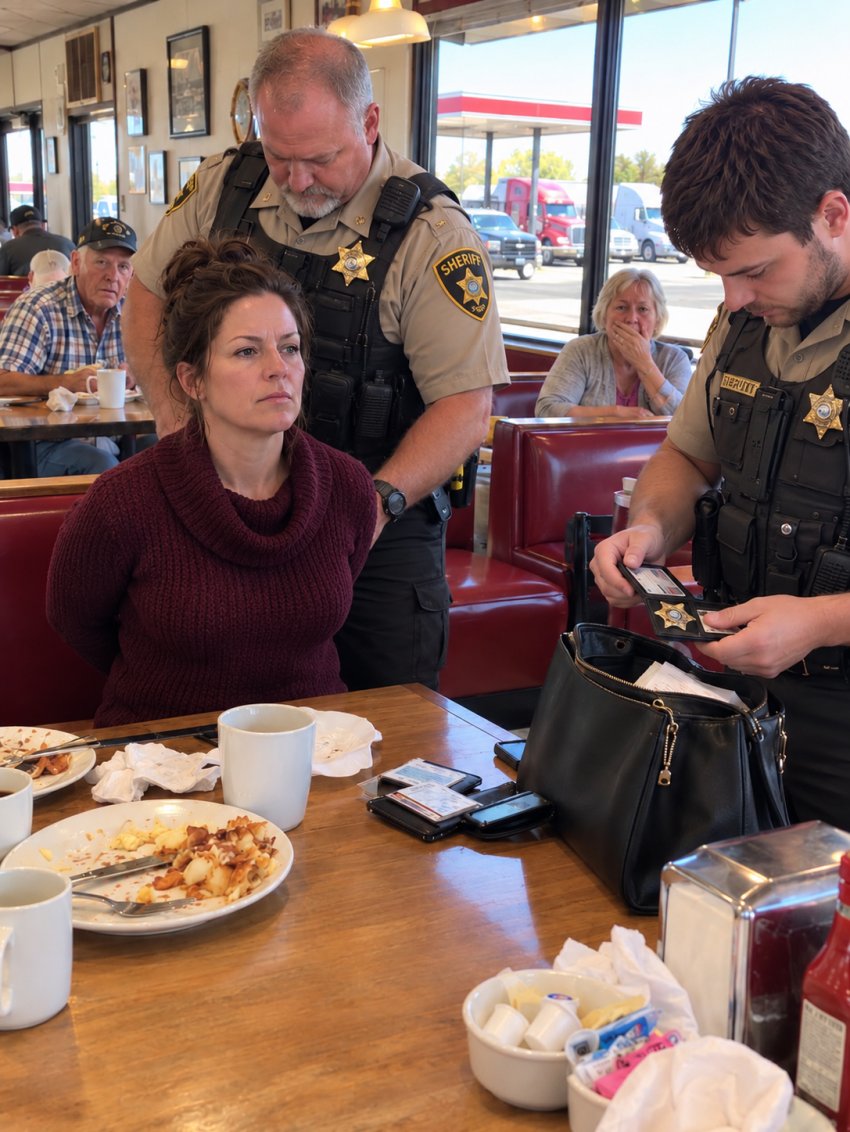
The metal handcuff closed around my left wrist with a hard click before I could lower my fork. One moment, I had been sitting in a red vinyl booth, trying to finish a quiet lunch. The next, a stranger with a badge had seized my arm and turned the entire diner into an audience. The sudden pressure of the steel against my skin was painful, but what struck me first was the speed with which an ordinary afternoon had changed.
“Hands behind your back. Right now!”
Sheriff Dalton Voss delivered the command so loudly that it seemed to strike every wall in the restaurant. The conversations stopped. Forks tapped against plates. A waitress stood motionless near the counter, a coffeepot still in her hand. People who had been talking a moment earlier now watched the sheriff pin my shoulder against the booth as though no one could quite believe what they were seeing.
I did not scream or struggle. I remained seated long enough to finish chewing my bite of fried catfish. That small act of calm seemed to irritate him more than an argument would have. I could feel the cuff pressing into my wrist, but I refused to give him the frightened reaction he appeared to want.
I kept returning to the same simple truth: I had been eating lunch, and I had done nothing to justify the violence used against me. The people in that diner had seen a sheriff take hold of a woman who had not threatened anyone, then accuse her of resisting when she stayed still. Every detail mattered—the fallen glass, the untouched plate, the silence, the fear on the faces of people who wanted to help but did not dare. The scene was ordinary enough to be recognizable and frightening enough to remain with anyone who witnessed it. I wondered how many people had experienced the same treatment without anyone recording their names, without anyone willing to repeat what had happened, and without anyone powerful enough to listen. My own position did not erase what had occurred. It only made the sheriff’s ignorance of my identity the most dangerous mistake he had made that afternoon.
The letters in my chambers had not been dramatic documents. They were the words of residents who wanted to be heard, people trying to explain what it felt like to live under a badge they no longer trusted. Some had written carefully, as though afraid that even the paper might betray them. Others had filled pages with the kind of frustration that comes after years of unanswered questions. I had read them more than once, not because I believed every allegation without examination, but because their persistence demanded attention. Now, in the back of a patrol car, I understood their descriptions of silence in a new way. A room full of witnesses could become quiet in an instant. A person could be accused of something that had not happened. And the man making the accusation could act as though his word was enough to settle every question.
I thought about the young deputy carrying my purse. His uncertainty was almost as revealing as the sheriff’s certainty. He had not shouted at me, and he had not been the one to force the cuffs onto my wrists, yet he had followed without protest. The difference between hesitation and action can seem small until someone needs help. I could not know what he believed or what he might later say. I could only remember the way he held my bag, careful not to drop it, while doing nothing to question why I was being taken away. It was a picture of a larger problem: authority can depend as much on the silence of those nearby as on the force of the person giving orders. That afternoon, everyone seemed to be waiting for someone else to speak first.
My name is Amara Whitlock. I am forty-four years old, born and raised in Georgia, and for six years I have served as a United States District Judge. I had come into the diner wearing a denim jacket, my hair braided, with no reason to announce my profession to anyone. To Sheriff Voss, however, I was simply a Black woman sitting alone, someone he believed he could intimidate without consequence.
My judicial identification was inside the zippered pocket of my handbag. My government-issued telephone was in that bag, too. Voss did not know either of those things. He also did not know why I had come to Pell County, or that a collection of letters from county residents had been kept in a locked drawer in my chambers in Atlanta for four months. The people who wrote those letters had described fear in different ways, but the feeling beneath their words was remarkably similar.
“Sheriff,” I said quietly, “you are making a serious mistake.”
I kept returning to the same simple truth: I had been eating lunch, and I had done nothing to justify the violence used against me. The people in that diner had seen a sheriff take hold of a woman who had not threatened anyone, then accuse her of resisting when she stayed still. Every detail mattered—the fallen glass, the untouched plate, the silence, the fear on the faces of people who wanted to help but did not dare. The scene was ordinary enough to be recognizable and frightening enough to remain with anyone who witnessed it. I wondered how many people had experienced the same treatment without anyone recording their names, without anyone willing to repeat what had happened, and without anyone powerful enough to listen. My own position did not erase what had occurred. It only made the sheriff’s ignorance of my identity the most dangerous mistake he had made that afternoon.
The letters in my chambers had not been dramatic documents. They were the words of residents who wanted to be heard, people trying to explain what it felt like to live under a badge they no longer trusted. Some had written carefully, as though afraid that even the paper might betray them. Others had filled pages with the kind of frustration that comes after years of unanswered questions. I had read them more than once, not because I believed every allegation without examination, but because their persistence demanded attention. Now, in the back of a patrol car, I understood their descriptions of silence in a new way. A room full of witnesses could become quiet in an instant. A person could be accused of something that had not happened. And the man making the accusation could act as though his word was enough to settle every question.
I thought about the young deputy carrying my purse. His uncertainty was almost as revealing as the sheriff’s certainty. He had not shouted at me, and he had not been the one to force the cuffs onto my wrists, yet he had followed without protest. The difference between hesitation and action can seem small until someone needs help. I could not know what he believed or what he might later say. I could only remember the way he held my bag, careful not to drop it, while doing nothing to question why I was being taken away. It was a picture of a larger problem: authority can depend as much on the silence of those nearby as on the force of the person giving orders. That afternoon, everyone seemed to be waiting for someone else to speak first.
“I don’t make mistakes in my county, lady.”
He leaned so close that I smelled stale coffee and cigar smoke. Then he twisted my right arm behind my back and locked the second cuff in place. He did it with the confidence of a man who expected obedience, not questions. I kept my breathing even and looked straight ahead. I knew how quickly a confrontation could become more dangerous when one person believed his authority was unlimited.
“You match the description of a suspect in an armed theft,” he announced. “And now you’re resisting arrest.”
I kept returning to the same simple truth: I had been eating lunch, and I had done nothing to justify the violence used against me. The people in that diner had seen a sheriff take hold of a woman who had not threatened anyone, then accuse her of resisting when she stayed still. Every detail mattered—the fallen glass, the untouched plate, the silence, the fear on the faces of people who wanted to help but did not dare. The scene was ordinary enough to be recognizable and frightening enough to remain with anyone who witnessed it. I wondered how many people had experienced the same treatment without anyone recording their names, without anyone willing to repeat what had happened, and without anyone powerful enough to listen. My own position did not erase what had occurred. It only made the sheriff’s ignorance of my identity the most dangerous mistake he had made that afternoon.
The letters in my chambers had not been dramatic documents. They were the words of residents who wanted to be heard, people trying to explain what it felt like to live under a badge they no longer trusted. Some had written carefully, as though afraid that even the paper might betray them. Others had filled pages with the kind of frustration that comes after years of unanswered questions. I had read them more than once, not because I believed every allegation without examination, but because their persistence demanded attention. Now, in the back of a patrol car, I understood their descriptions of silence in a new way. A room full of witnesses could become quiet in an instant. A person could be accused of something that had not happened. And the man making the accusation could act as though his word was enough to settle every question.
I thought about the young deputy carrying my purse. His uncertainty was almost as revealing as the sheriff’s certainty. He had not shouted at me, and he had not been the one to force the cuffs onto my wrists, yet he had followed without protest. The difference between hesitation and action can seem small until someone needs help. I could not know what he believed or what he might later say. I could only remember the way he held my bag, careful not to drop it, while doing nothing to question why I was being taken away. It was a picture of a larger problem: authority can depend as much on the silence of those nearby as on the force of the person giving orders. That afternoon, everyone seemed to be waiting for someone else to speak first.
I had not resisted. I had not moved toward him or raised my voice. The accusation was so detached from what had happened that for a moment I wondered whether anyone else in the diner would say so. Several people had seen the entire exchange. Their faces told me they knew what they had witnessed. Their silence told me something else.
Voss hauled me out of the booth. The table jolted, and my water glass toppled onto its side. Ice scattered across the Formica, and water streamed over the edge to the floor. A woman gasped. An older man at the counter began to rise, then caught the sheriff’s eye and settled back onto his stool. He looked down at his hands. No one challenged Voss.
I had heard that kind of silence described before. In Pell County, Georgia, people had lived with Sheriff Dalton Voss’s authority for twelve years. Whatever they thought privately, they had learned the cost of speaking publicly. In that diner, the lesson was visible in the way everyone looked away at the same time.
I kept returning to the same simple truth: I had been eating lunch, and I had done nothing to justify the violence used against me. The people in that diner had seen a sheriff take hold of a woman who had not threatened anyone, then accuse her of resisting when she stayed still. Every detail mattered—the fallen glass, the untouched plate, the silence, the fear on the faces of people who wanted to help but did not dare. The scene was ordinary enough to be recognizable and frightening enough to remain with anyone who witnessed it. I wondered how many people had experienced the same treatment without anyone recording their names, without anyone willing to repeat what had happened, and without anyone powerful enough to listen. My own position did not erase what had occurred. It only made the sheriff’s ignorance of my identity the most dangerous mistake he had made that afternoon.
The letters in my chambers had not been dramatic documents. They were the words of residents who wanted to be heard, people trying to explain what it felt like to live under a badge they no longer trusted. Some had written carefully, as though afraid that even the paper might betray them. Others had filled pages with the kind of frustration that comes after years of unanswered questions. I had read them more than once, not because I believed every allegation without examination, but because their persistence demanded attention. Now, in the back of a patrol car, I understood their descriptions of silence in a new way. A room full of witnesses could become quiet in an instant. A person could be accused of something that had not happened. And the man making the accusation could act as though his word was enough to settle every question.
I thought about the young deputy carrying my purse. His uncertainty was almost as revealing as the sheriff’s certainty. He had not shouted at me, and he had not been the one to force the cuffs onto my wrists, yet he had followed without protest. The difference between hesitation and action can seem small until someone needs help. I could not know what he believed or what he might later say. I could only remember the way he held my bag, careful not to drop it, while doing nothing to question why I was being taken away. It was a picture of a larger problem: authority can depend as much on the silence of those nearby as on the force of the person giving orders. That afternoon, everyone seemed to be waiting for someone else to speak first.
Voss bent close to my ear, lowering his voice so only I could hear. “You think you’re clever? In my town, nobody hears you scream. And nobody’s coming to save you.”
He pushed me through the glass doors toward the patrol cruiser waiting outside, its engine idling. Behind us, a young deputy followed with my purse hanging awkwardly from his shoulder. He looked uncertain, as though he understood that something was wrong but did not know what to do about it. The diner door swung shut, leaving the customers behind the glass, watching.
Inside my purse, my government-issued phone began to vibrate. The message was urgent, and it came from the Chief Judge of my district. I could not reach the phone with my hands cuffed behind me. Voss had no idea that the notification existed, much less who had sent it.
I kept returning to the same simple truth: I had been eating lunch, and I had done nothing to justify the violence used against me. The people in that diner had seen a sheriff take hold of a woman who had not threatened anyone, then accuse her of resisting when she stayed still. Every detail mattered—the fallen glass, the untouched plate, the silence, the fear on the faces of people who wanted to help but did not dare. The scene was ordinary enough to be recognizable and frightening enough to remain with anyone who witnessed it. I wondered how many people had experienced the same treatment without anyone recording their names, without anyone willing to repeat what had happened, and without anyone powerful enough to listen. My own position did not erase what had occurred. It only made the sheriff’s ignorance of my identity the most dangerous mistake he had made that afternoon.
The letters in my chambers had not been dramatic documents. They were the words of residents who wanted to be heard, people trying to explain what it felt like to live under a badge they no longer trusted. Some had written carefully, as though afraid that even the paper might betray them. Others had filled pages with the kind of frustration that comes after years of unanswered questions. I had read them more than once, not because I believed every allegation without examination, but because their persistence demanded attention. Now, in the back of a patrol car, I understood their descriptions of silence in a new way. A room full of witnesses could become quiet in an instant. A person could be accused of something that had not happened. And the man making the accusation could act as though his word was enough to settle every question.
I thought about the young deputy carrying my purse. His uncertainty was almost as revealing as the sheriff’s certainty. He had not shouted at me, and he had not been the one to force the cuffs onto my wrists, yet he had followed without protest. The difference between hesitation and action can seem small until someone needs help. I could not know what he believed or what he might later say. I could only remember the way he held my bag, careful not to drop it, while doing nothing to question why I was being taken away. It was a picture of a larger problem: authority can depend as much on the silence of those nearby as on the force of the person giving orders. That afternoon, everyone seemed to be waiting for someone else to speak first.
He opened the back door of the cruiser as though the matter were settled. To him, I was another outsider he had humiliated in public, another person whose objections could be ignored. He did not know whom he was placing in the back seat. And he had no idea that what awaited him at the station house would be far more complicated than the easy arrest he believed he had made.
I kept returning to the same simple truth: I had been eating lunch, and I had done nothing to justify the violence used against me. The people in that diner had seen a sheriff take hold of a woman who had not threatened anyone, then accuse her of resisting when she stayed still. Every detail mattered—the fallen glass, the untouched plate, the silence, the fear on the faces of people who wanted to help but did not dare. The scene was ordinary enough to be recognizable and frightening enough to remain with anyone who witnessed it. I wondered how many people had experienced the same treatment without anyone recording their names, without anyone willing to repeat what had happened, and without anyone powerful enough to listen. My own position did not erase what had occurred. It only made the sheriff’s ignorance of my identity the most dangerous mistake he had made that afternoon.
The letters in my chambers had not been dramatic documents. They were the words of residents who wanted to be heard, people trying to explain what it felt like to live under a badge they no longer trusted. Some had written carefully, as though afraid that even the paper might betray them. Others had filled pages with the kind of frustration that comes after years of unanswered questions. I had read them more than once, not because I believed every allegation without examination, but because their persistence demanded attention. Now, in the back of a patrol car, I understood their descriptions of silence in a new way. A room full of witnesses could become quiet in an instant. A person could be accused of something that had not happened. And the man making the accusation could act as though his word was enough to settle every question.
I thought about the young deputy carrying my purse. His uncertainty was almost as revealing as the sheriff’s certainty. He had not shouted at me, and he had not been the one to force the cuffs onto my wrists, yet he had followed without protest. The difference between hesitation and action can seem small until someone needs help. I could not know what he believed or what he might later say. I could only remember the way he held my bag, careful not to drop it, while doing nothing to question why I was being taken away. It was a picture of a larger problem: authority can depend as much on the silence of those nearby as on the force of the person giving orders. That afternoon, everyone seemed to be waiting for someone else to speak first.
I kept returning to the same simple truth: I had been eating lunch, and I had done nothing to justify the violence used against me. The people in that diner had seen a sheriff take hold of a woman who had not threatened anyone, then accuse her of resisting when she stayed still. Every detail mattered—the fallen glass, the untouched plate, the silence, the fear on the faces of people who wanted to help but did not dare. The scene was ordinary enough to be recognizable and frightening enough to remain with anyone who witnessed it. I wondered how many people had experienced the same treatment without anyone recording their names, without anyone willing to repeat what had happened, and without anyone powerful enough to listen. My own position did not erase what had occurred. It only made the sheriff’s ignorance of my identity the most dangerous mistake he had made that afternoon.
The letters in my chambers had not been dramatic documents. They were the words of residents who wanted to be heard, people trying to explain what it felt like to live under a badge they no longer trusted. Some had written carefully, as though afraid that even the paper might betray them. Others had filled pages with the kind of frustration that comes after years of unanswered questions. I had read them more than once, not because I believed every allegation without examination, but because their persistence demanded attention. Now, in the back of a patrol car, I understood their descriptions of silence in a new way. A room full of witnesses could become quiet in an instant. A person could be accused of something that had not happened. And the man making the accusation could act as though his word was enough to settle every question.