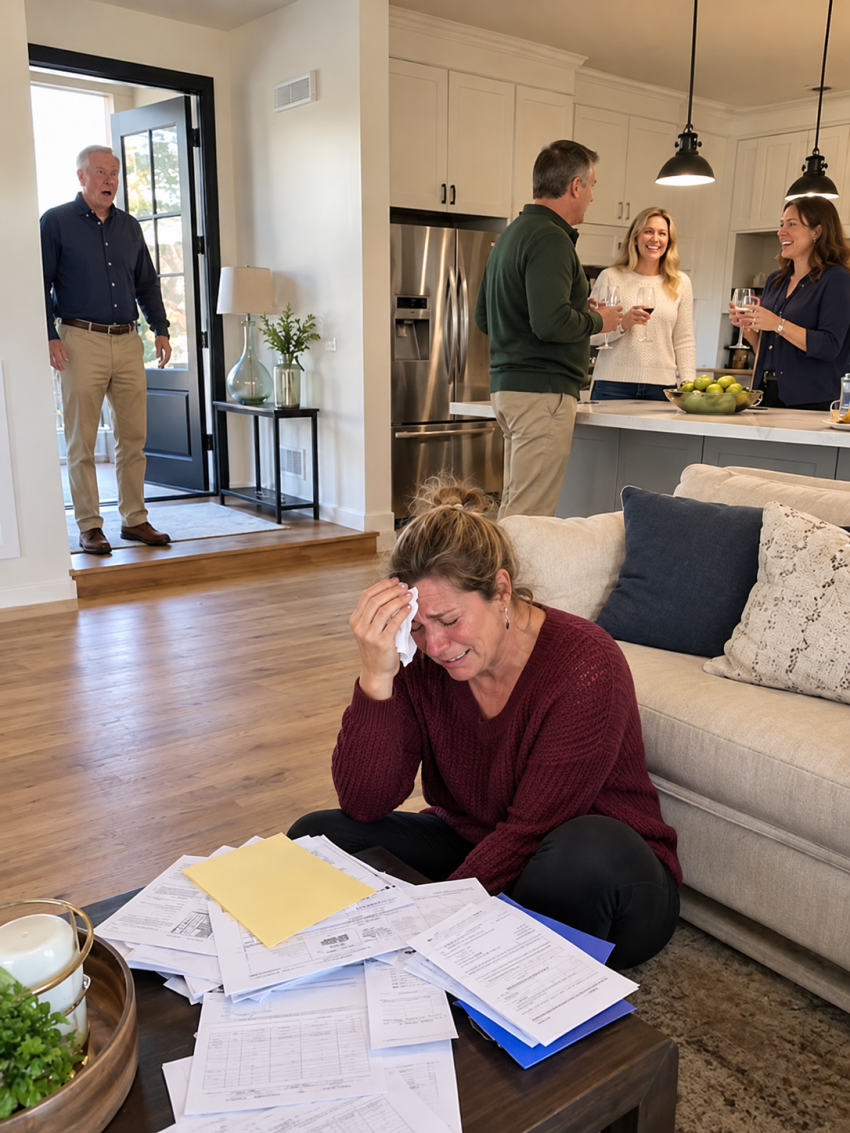
I got home two days earlier than anyone expected because the transportation conference ended ahead of schedule.
The house still held the late-afternoon warmth. The screen door gave that familiar little scrape when I pushed it open.
Then I smelled something sharp under the lemon cleaner.
The first thing I saw was a dark stain on our Persian-style rug—the one we’d bought the year we made it to twenty years married.
The second thing I saw was my wife.
Sarah was alone on the living room floor, her back pressed against the beige sofa, one trembling hand held over her right eyebrow. The stain marked her temple, touched the collar of her cream blouse, and dotted the rug we’d saved for months to buy. Her eyes were swollen. Her breath came in broken little pulls. She looked smaller than I had ever seen her look in our own home.
When she saw me, she did not smile.
She did not reach for me.
She only whispered my name like she was ashamed I had found her that way.
From the kitchen came laughter.
Not nervous laughter. Not the kind people make because they don’t understand what happened. Big, comfortable, ugly laughter. The laughter of people who were certain they had done nothing wrong.
I heard my son Michael.
I heard his wife, Olivia.
I heard Olivia’s parents, David and Jessica, laughing over the clink of glasses and the scrape of chairs against the tile floor.
Ten steps away from my injured wife, they sounded like people finishing dessert at a celebration.
I knelt beside Sarah.
“Who did this?”
She looked toward the kitchen first, as if she was still afraid of them.
Then she looked at me, and what I saw on her face made my stomach turn worse than the injury did.
It was not just pain.
It was humiliation.
“I tried to make them leave,” she whispered. “I wouldn’t sign.”
That was when I saw the folder on the coffee table.
A notary packet. County recorder transfer forms. A deed draft for the little beach house Sarah inherited from her mother two years ago. The same house Michael had been pushing us to sell for weeks so he could “invest” in David’s restaurant—the one that had been losing money long before my son decided his mother’s inheritance should save it.
I had already told Michael no.
Sarah had already told him no.
But greed rarely kicks down the front door. Most of the time, it comes in holding family history, smiling like it only wants what is fair.
Sarah swallowed hard.
“Michael grabbed my arm. I pulled away. I hit the table.”
The kitchen laughed again.
For one second, I saw the room go red in my head. I saw myself dragging my own son out by the collar. I saw David’s wineglass shattering against the wall. I saw every chair in that kitchen turned over before anyone could speak.
I did none of it.
Instead, I took Sarah’s hand away from her brow just long enough to see the cut properly. It was deep—not deep enough for stitches, but deep enough that she’d need to clean it, ice it, monitor it for infection. The kind of injury that comes from blunt force impact when someone is trying to escape.
I pulled out my phone and documented everything with the coldest hands I have ever had.
One photo of Sarah’s face, swollen and damaged.
One photo of the dark stain on the rug.
One photo of the open folder, the deed draft, the notary page, the pen lying on the coffee table like it had been waiting for her to give up.
At 5:21 p.m., I called 911.
I kept my voice low enough that the people in the kitchen would not hear me over their own laughter. I gave the dispatcher our address. I said my wife was injured. I said there had been pressure over property documents. I said there were four people in my kitchen and one of them was my adult son.
The dispatcher told me to stay on the line.
I did.
Then I stood up.
The living room and kitchen were only separated by a wide doorway, but walking through it felt like crossing into another universe. Behind me, Sarah was still on the floor, breathing through pain. In front of me, my son was leaning back in a chair with a grin on his face while Olivia’s father lifted a glass like he had just won something.
The whole kitchen froze when they saw me.
Michael’s smile died first. His chair came forward with a scrape. “Dad, you’re—”
Olivia’s fork stopped halfway to her mouth.
Jessica’s hand hovered over her wineglass.
David’s chair legs gave one last little sound against the floor, and then even that stopped.
A paper napkin slid off the edge of the table and landed near David’s shoe, but nobody bent to pick it up. Nobody moved.
I looked at my own son like he was a stranger standing in my kitchen. Not the boy I raised. Not the kid whose first car I helped fix in our garage. Not the man who had sat at this same table every Thanksgiving of his life.
Then I set my phone faceup on the counter, with 911 still listening, and said:
“My wife is on the living room floor bleeding because Michael grabbed her arm and she hit the table trying to escape. I have photographs of her injury, the rug, and the documents you’ve been pressuring her to sign. The police are on their way.”
The silence that followed was so complete it had a physical weight.
“Dad, you don’t understand—” Michael started.
“I understand perfectly,” I said. “I understand that my wife told you no. That Sarah told you no. That I told you no. And I understand that you decided your financial problems were more important than her bodily autonomy.”
David set down his wineglass very carefully.
“This is a family matter,” he said, and his voice carried the tone of someone used to talking his way out of difficult situations. “There’s no need to involve authorities. We were having a discussion about—”
“A discussion?” I moved further into the kitchen, and the space between David and me suddenly felt very small. “A discussion is when two people talk. A discussion is when one person says no and the other person accepts it. A discussion is not when you pressure someone repeatedly, when you bring notary forms to their house uninvited, and when you physically grab them when they refuse to comply.”
“Michael didn’t mean—” Olivia began, her voice high and uncertain.
“I don’t care what Michael meant,” I said. “Intent is irrelevant when the outcome is my wife injured on the floor of her own home.”
Michael’s face had gone pale. “I didn’t mean to hurt her. I just… I was frustrated. She kept saying no, and I just wanted her to understand that—”
“To understand what?” I asked. “That her inheritance should solve your money problems? That her no wasn’t actually no, it was just a starting negotiation point?”
“We needed that money,” David interjected. “The restaurant was in trouble. We were trying to help Michael and Olivia get ahead. Surely you understand family obligation—”
“I do understand family obligation,” I said. “And my family obligation is to my wife. Not to bail out my son’s poor financial decisions. Not to validate my son’s physical aggression. Not to sit quietly while he victimizes the woman he promised to protect.”
Sirens sounded in the distance.
The sound made everything real in a way that words hadn’t managed.
The officers arrived at 5:34 p.m.
Two of them came in through the front door, and two more came through the garage door that was still unlocked. They moved through our house with the practiced efficiency of people who had responded to hundreds of domestic violence calls. One of them went immediately to check on Sarah. The other three took positions that made it clear nobody was leaving.
I told them what had happened.
Michael kept saying “I didn’t mean to hurt her” over and over, like that was a defense. Like intent absolved him of responsibility for his actions. Like his frustration was somehow justifiable grounds for grabbing his mother.
David tried to minimize it. “She hit her head on a table. It was an accident. A regrettable accident, but—”
“An accident is when nobody intended harm,” one of the officers said flatly. “According to the victim and the witness, someone grabbed her and she was injured trying to escape. That’s not an accident. That’s assault.”
They took photographs of Sarah’s injury.
They documented the rug, the folder, the notary forms.
They asked Michael what had happened, and despite my telling him to say nothing until he had a lawyer, he tried to explain. He explained that he was frustrated. He explained that David’s restaurant was failing. He explained that Sarah’s inheritance seemed like the obvious solution. He explained that he just wanted to “convince” her that selling the beach house was the right choice.
He did not explain it in a way that made anything better.
One of the officers said, “So you came here with notary forms already prepared, hoping to pressure her into signing documents for property that isn’t yours. Is that accurate?”
Michael looked at me.
I looked away.
“I think I need a lawyer,” Michael finally said.
“That would be wise,” the officer agreed.
They didn’t arrest Michael that night.
It wasn’t because what he did wasn’t serious. It was because Sarah, when asked if she wanted to press charges, hesitated. I could see the conflict on her face—the part of her that still loved her son warring with the part of her that had just been assaulted by him.
“I need to think about it,” she said finally.
The officers explained that she could change her mind, that they had documentation, that she could file charges later if she wanted to. But they couldn’t force her to prosecute her own son.
They gave her the case number and victim support information and told her to seek medical attention if the headache worsened or if she started experiencing any symptoms of concussion.
Then they asked David and Jessica to leave.
David tried to argue that they hadn’t done anything wrong, that this was a family dispute, that the officers didn’t understand the context. But the officers were very clear: he and his wife needed to get out of my house, and they needed to do it now.
Olivia followed them, her face a mix of embarrassment and confusion. She didn’t try to defend Michael or minimize what had happened. She just followed her parents out of our house and into the evening, leaving her husband behind.
Michael stood in our kitchen with his hands at his sides, looking like someone had suddenly made him visible as he truly was. Not the successful son. Not the good husband. Not the man building a future. Just a man who had grabbed his mother and was now facing the consequences of that decision.
“I didn’t know you’d be home,” he said finally.
“Does that matter?” I asked him. “If I hadn’t come home early, would you have let her sign those documents? Would you have continued pressuring her until she agreed?”
Michael didn’t answer.
“I think you should leave,” I said. “And I think you should call a lawyer. I think you should understand that what you did tonight has consequences, and some of those consequences might not be forgivable.”
“Will you tell me if she presses charges?” he asked.
“No,” I said. “You’ll find out when the police contact you.”
He left through the garage door, and I locked it behind him.
Sarah and I sat on the porch as the light faded and the neighborhood settled into evening. She had changed clothes. She had cleaned the cut on her temple. But she was still trembling in a way that ice and time weren’t fixing.
“I feel like I failed him,” she said. “Like somewhere along the way, I failed to teach him that this wasn’t acceptable.”
“You didn’t fail,” I said. “Michael made a choice. That choice belongs to him, not to you.”
“But I’m his mother—”
“And you’re my wife,” I said. “And you’re a person with boundaries and autonomy that your son had no right to violate.”
She was quiet for a long time.
“Do you think she’ll leave him?” Sarah asked. “Olivia, I mean.”
I thought about the way Olivia had followed her parents out without trying to defend Michael or apologize for what he’d done. I thought about the kind of woman who would marry a man and then stand quietly while he pressured his mother over property and, when that failed, grabbed her.
“I don’t know,” I said. “That’s her choice to make.”
“It’s going to destroy him,” Sarah said. “The legal consequences, the family fallout, all of it.”
“I know,” I said. “And that’s unfortunate. But he destroyed it when he decided to grab you.”
Sarah leaned against me, and I put my arm around her. We sat there as the sun finished setting and the streetlights came on, and neither of us said anything for a long time.
Sarah pressed charges.
It took her three weeks to decide, and when she told me, her voice was steady. “If I don’t, he’ll think he can do this to someone else. He’ll think he got away with it. I can’t have that on my conscience.”
The district attorney’s office pursued the case.
Michael’s lawyer negotiated a plea deal: assault in the fourth degree, anger management classes, twelve months of probation, a restraining order keeping him at least two hundred yards from Sarah.
David’s restaurant closed six months later. Apparently, the financial problems were worse than anyone had realized, and without Sarah’s inheritance to bail them out, the place couldn’t sustain itself.
Olivia divorced Michael while he was in anger management classes.
In her statement to the court, she said she couldn’t be married to someone who was capable of that kind of violence, even if it was only directed at his mother. She said she’d seen red flags during their marriage that she’d ignored because she loved him, but that watching him assault Sarah had finally made her see what she’d been refusing to acknowledge.
Michael and I haven’t spoken in three years.
He tried to reach out once, about a year after the assault, saying he wanted to apologize. I told him that his apology wasn’t mine to accept—it belonged to Sarah. And I told him that until he understood why what he’d done was wrong beyond just the legal and social consequences, his apology wouldn’t be genuine anyway.
He hasn’t tried to contact me since.
Sarah and I are still here.
We redecorated the living room. Not because we were trying to forget what happened—you don’t forget something like that. But because sitting in that room had started to feel heavy. We needed to reclaim it as a space that belonged to us, not to trauma.
I think about that moment when I walked into the kitchen and saw my son leaning back in a chair like he had won something. I think about how easy it would have been to yell, to rage, to give into the red I felt. I think about how being calm and methodical—calling the police, documenting evidence, saying clearly what I saw—was actually more powerful than any anger would have been.
I think about what it means to love your children and still hold them accountable.
Michael is living in another state now. He remarried. I don’t know if he’s learned anything from what happened, if he’s understood that his mother’s body and her property and her choices were never his to control. I hope he has. But I can’t control that. I can only control my own choices.
And my choice is to protect my wife.
My choice is to stand up when someone—even someone I raised—violates her autonomy.
My choice is to understand that love and accountability aren’t opposites. They’re actually the same thing. You can’t truly love someone and let them destroy themselves through harmful behavior.
Sarah’s beach house is still in her name.
She visits it sometimes, and she’s peaceful there in a way she wasn’t for a few years after the assault. She’s reclaimed it as her own, not as a source of family conflict or financial pressure.
And I would do it again.
Because that’s what it means to stand beside someone.
Not just when things are easy.
But especially when standing beside them costs you something you thought you’d never have to give up.