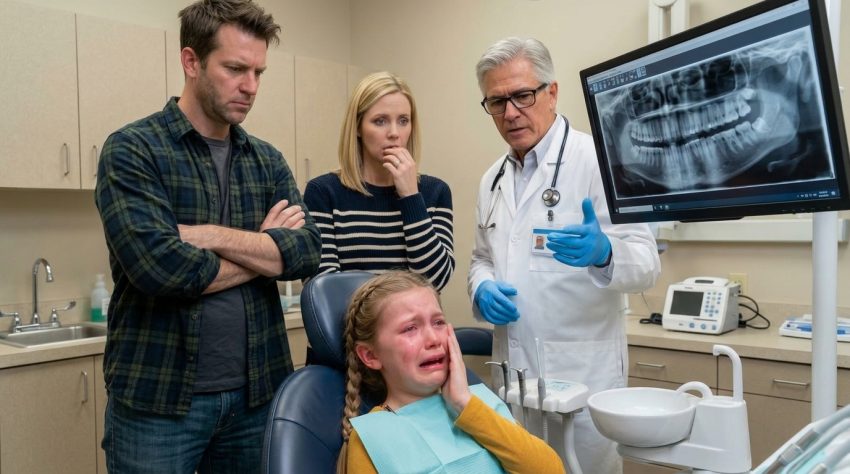
I took my ten-year-old daughter to the dentist after she had been complaining of persistent tooth pain, expecting nothing more than a routine checkup and perhaps a straightforward filling.
Then my husband unexpectedly insisted on coming with us, despite having spent years avoiding doctors’ appointments, school meetings, and almost every responsibility involving our daughter.
During the examination, I noticed the dentist repeatedly glancing in my husband’s direction.
He seemed increasingly uncomfortable, as though he recognized something about him.
Before we left the office, he discreetly slipped a folded piece of paper into my hand.
I opened it in the parking lot, and my hands immediately began to shake.
The note contained eleven words that changed everything: “Your daughter isn’t safe with him. Please don’t take her home.”
But the warning itself wasn’t the most disturbing part of what I discovered.
Beneath the message, the dentist had written a name, a date, and a police case number.
My name is Emily Carter. I’m thirty-seven years old, and until that Thursday morning, I believed my biggest family problem was the growing emotional distance between my husband and me.
My daughter, Sophie, had complained about a painful tooth for several days. She struggled to eat, avoided cold drinks, and occasionally woke during the night in tears.
Initially, I assumed she had developed a cavity.
Cavities are common among children, after all, and Sophie had always loved sweets, despite my repeated reminders to brush and floss regularly.
I called our usual dental practice in suburban Pennsylvania and arranged an appointment. I expected a short examination, perhaps a few X-rays, and recommendations about whatever treatment she needed.
When I mentioned the appointment over breakfast, my husband, Nathan, suddenly put down his coffee. “What time are you taking her?” he asked, staring directly at me.
“Ten-thirty,” I answered. “Why?” Nathan glanced at Sophie, who continued eating her oatmeal without saying anything. “I’m coming with you,” he announced. “I should be there.”
I almost laughed.
Over twelve years of marriage, Nathan had accompanied Sophie to fewer than five medical appointments, most of them when she was still a baby.
He regularly complained that appointments interfered with his work.
Even when Sophie broke her wrist at eight years old, he remained at work until late that evening.
“You honestly don’t have to come,” I told him. “It’s probably nothing serious.” Nathan shook his head. “She’s my daughter, Emily. I have a right to know what’s happening.”
Something about his tone unsettled me. He wasn’t simply offering to help. It felt as though he was determined to make sure I never spoke to the dentist without him present.
Sophie seemed uncomfortable with the idea, too. After Nathan left the kitchen to retrieve his car keys, she leaned closer and whispered, “Can we go without him, Mom?”
I gently brushed a strand of hair away from her forehead. “Daddy just wants you to feel better.” She lowered her gaze to her breakfast and said nothing more.
Looking back, I can recognize many small moments when Sophie seemed uneasy around her own father.
She had stopped asking him to read bedtime stories.
She avoided being alone with him in his office.
Sometimes, she would become noticeably quiet as soon as he entered a room.
I had assumed she was becoming more independent. Ten-year-olds develop their own habits and preferences, and Nathan had never been particularly affectionate. I failed to recognize the concerns my daughter was struggling to express.
We arrived at the dental office fifteen minutes before the scheduled appointment.
Sophie held my hand as we approached the reception desk, while Nathan walked ahead, occupied with a phone conversation.
Our dentist, Dr. Michael Reeves, had been treating Sophie since she started kindergarten.
He was gentle, patient, and especially good at helping nervous children feel comfortable, which was why I trusted him.
When he entered the examination room, he greeted Sophie warmly.
Then he noticed Nathan standing near the doorway, and his smile almost immediately disappeared.
For several seconds, the two men stared at each other without speaking.
Nathan clenched his jaw. Dr. Reeves glanced toward the hallway before turning his attention back to Sophie.
“Mr. Carter,” he said quietly. “I didn’t expect you to come with us today.” Nathan folded his arms. “Is something wrong?” The dentist shook his head.
“Of course not,” he replied, although his expression seemed to suggest otherwise. He asked Sophie to point out the painful area and began examining the back of her mouth.
Sophie indicated her lower right molars. Dr. Reeves examined the area carefully, then asked his assistant to take dental X-rays to help establish the cause of her discomfort and determine the appropriate treatment.
Nathan immediately objected. “Does she really need X-rays? She’s only ten.” Dr. Reeves explained that the images could help identify the problem and guide treatment decisions.
Nathan continued questioning him.
He asked how long the appointment would take, whether Sophie’s records were stored electronically, and precisely who was authorized to access her medical information.
His questions seemed unusually specific. Dr. Reeves answered professionally, but I noticed him watching Nathan whenever my husband looked away.
The atmosphere in the room became increasingly tense.
After reviewing the X-rays, Dr. Reeves explained that one of Sophie’s molars had substantial decay requiring treatment. He also noticed tenderness around her jaw that needed further assessment.
“Has she recently experienced any injuries to her face?” he asked. I shook my head. “Not that I know of.” Nathan answered before Sophie could respond.
“She fell off her bicycle last week,” he said. “Kids can be careless.” I turned toward him. Sophie had never told me about falling off her bicycle, and I hadn’t noticed anything unusual.
Dr. Reeves looked at Sophie. “Do you remember falling?” She hesitated, then glanced at Nathan. “I’m not sure,” she whispered, barely loud enough for us to hear.
A knot tightened in my stomach. Nathan let out an impatient sigh. “She’s embarrassed because she forgot her helmet. Can we please finish the appointment?”
The dentist didn’t challenge him. Instead, he politely suggested that Nathan accompany the assistant to reception to confirm the insurance information while we discussed Sophie’s treatment options.
Nathan refused. “I’m staying here.” Dr. Reeves paused briefly before nodding. He explained the recommended procedure and scheduled another appointment, remaining noticeably cautious throughout the conversation.
While Sophie rinsed her mouth, I saw Dr. Reeves quietly writing something on a small piece of paper. He slipped it beneath the appointment reminder card.
When we were ready to leave, he placed both papers in my hand, pressing them discreetly into my palm. His fingers lingered against mine for a moment as we made eye contact.
“Just aftercare instructions,” I replied. Dr. Reeves watched us leave, his expression still serious. As we crossed the parking lot, I noticed Sophie gripping my hand much more tightly than usual.
Nathan walked ahead of us to unlock the car.
During those few seconds, I unfolded the note, expecting instructions about pain relief, appropriate foods, and Sophie’s upcoming treatment.
Instead, I found the warning. “Your daughter isn’t safe with him. Please don’t take her home.” Beneath it was another sentence, written in hurried handwriting.
“Ask the police about the 2018 investigation involving Nathan Carter and a child named Lily Warren. Tell them Dr. Reeves recognized him.”
My vision blurred.
I read the message again and again, hoping I had somehow misunderstood its meaning.
Then I saw the case number written underneath, and my knees nearly gave way.
Nathan called out from the driver’s seat. “Emily, what’s taking you so long?” I folded the paper, forced myself to remain calm, and climbed into the passenger seat.
“We need to stop at the pharmacy,” I said. “Sophie needs something for her tooth.” Nathan frowned. “We already have medicine at home.” I shook my head.
“The dentist recommended a specific kind. I’ll pick it up.” Nathan looked irritated but eventually agreed. During the drive, I focused on breathing steadily and keeping my fear from showing.
Sophie sat quietly in the back seat, watching the houses pass outside her window.
When our eyes met in the rearview mirror, she looked worried, as though she sensed that something had changed.
At the pharmacy, I told Nathan I needed to speak privately with the pharmacist about Sophie’s medication.
He stayed outside in the car, complaining that I was taking unnecessarily long.
Once inside, I moved away from the counter and approached an employee.
My hands were trembling as I explained that I needed somewhere private and secure to contact the police.
The employee escorted me into a small office. I called 911, explained the dentist’s warning, and provided the case number.
I also told the dispatcher that my husband was waiting outside.
She instructed me to remain inside and avoid confronting him. Then she asked whether Sophie was with me.
My heart sank when I explained that my daughter was still in the car.
I told the dispatcher that Nathan had never physically threatened me, but I was no longer confident I could predict how he might react.
The dispatcher stayed on the line while officers made their way to the pharmacy.
A few minutes later, two police vehicles pulled into the parking lot.
One officer approached Nathan’s car while another entered the store to speak with me. I handed him the folded note.
After reading it carefully, the officer asked whether I knew anyone named Lily Warren. I shook my head. I had never heard the name, and Nathan had never mentioned her.
Through the office window, I watched an officer speaking to Nathan beside our vehicle.
His expression shifted from annoyance to anger. He gestured toward the store, apparently demanding to know why officers were questioning him during what he believed was an ordinary family outing.
Another officer brought Sophie inside.
The moment she saw me, she hurried into my arms. I held her tightly, struggling to contain the questions flooding my mind.
“Have we done something wrong?” she whispered. I kissed her forehead. “No, sweetheart. You’re safe here with me. The officers just need to understand something very important.”
We were taken to a nearby police station, where Detective Sarah Collins greeted us in a quiet interview room. She introduced herself to Sophie gently and tried to put her at ease.
The detective explained that a specialist trained to interview children needed to speak with Sophie separately. She reassured us that my daughter was not suspected of doing anything wrong.
I agreed, although watching Sophie walk into another room was almost unbearable.
Before leaving, she turned back and asked whether her father would be angry.
I told her that she was not responsible for managing anyone else’s anger. Detective Collins waited until Sophie had left before opening a folder on the table.
“Mrs. Carter,” she began, “the number your dentist provided relates to an investigation opened eight years ago. Your husband was interviewed following allegations involving a child.”
My stomach tightened. “What were the allegations?” The detective paused. “A nine-year-old girl reported feeling frightened and being physically intimidated while she was in his care.”
The child was Lily Warren. Nathan had previously lived with Lily’s mother before he met me. According to the investigative records, Lily had described several disturbing experiences at home.
Detective Collins explained that the original investigation had concluded without criminal charges. Investigators had been unable to obtain sufficient evidence, and the family eventually moved away from the area.
I stared at the documents. “How would our dentist know about this?” Collins explained that Dr. Reeves had previously treated Lily and documented concerns about her circumstances.
At the time, he had followed the appropriate reporting procedures. When Nathan arrived at the dental office with Sophie, Dr. Reeves recognized him from the earlier investigation.
The detective emphasized that recognizing someone from a previous investigation did not establish that the person had committed wrongdoing.
Nevertheless, Sophie’s hesitation, the unexplained discomfort around her jaw, and Nathan’s behavior had raised concerns that warranted further professional assessment.
I thought about Nathan’s explanation of the supposed bicycle accident. I remembered Sophie’s reluctance to spend time alone with him and the evenings when she begged to sleep beside me.
Then I recalled something that had happened three weeks earlier.
I had returned from work to find Sophie crying in the laundry room, pressing a cold pack against her cheek.
Nathan told me she had accidentally bumped into a cabinet while playing.
I described the incident to Detective Collins. She listened carefully, then asked whether Nathan had ever discouraged Sophie from speaking privately with doctors, teachers, or members of our extended family.
The question made me deeply uncomfortable.
Nathan had recently begun taking Sophie to school himself. He had also become irritated whenever she spent weekends visiting my sister.
He accused my sister of filling Sophie’s head with foolish ideas. He described school counselors as meddlesome and repeatedly insisted that family problems should never be discussed outside our home.
I had interpreted his controlling behavior as an excessive concern about our family’s reputation. Now, those same behaviors seemed much more troubling, and I regretted not recognizing the warning signs sooner.
Nearly an hour later, the specialist returned after speaking with Sophie.
She explained that my daughter had described experiences requiring additional investigation and an immediate plan to protect her safety.
The detective did not repeat every detail Sophie had shared.
Instead, she explained that trained professionals would carefully document my daughter’s account while avoiding repeated questioning that could cause further distress.
Even the limited information I received was devastating. Sophie had described being handled roughly during disagreements, being threatened with punishment if she spoke about what happened, and repeatedly being told that nobody would believe her.
She also disclosed that Nathan had struck her face during an argument about homework.
Her face continued to hurt afterward, but she had been too frightened to tell me what happened.
I covered my face and began to cry.
My little girl had been afraid in the very home where I had always promised she would be protected.
Detective Collins handed me tissues and reminded me that the investigation was still ongoing. Nathan’s conduct would be assessed using documented evidence, professional interviews, and established legal procedures.
To help protect Sophie immediately, officers assisted us in arranging a temporary safe place to stay. We would live at my sister’s home while investigators and child-protection professionals completed their assessments.
I called my sister, Lauren, from the police station.
Forty minutes later, she arrived carrying Sophie’s favorite blanket and the stuffed rabbit my daughter had treasured since preschool.
When Sophie saw her aunt, she began crying again. Lauren knelt beside her and reassured her that she could stay for as long as she needed.
That evening, I sat beside Sophie in Lauren’s spare bedroom. She looked exhausted but continued watching my face, as though she were afraid I might become upset with her.
“Mom,” she whispered, “are you mad at me for telling them?” My eyes filled with tears once more. “No, sweetheart. I’m proud of you for telling the truth.”
She looked uncertain. “Daddy said you’d be upset if I talked about what happened at home.” I gently took her hand, thinking carefully about how to respond.
Sophie leaned against my shoulder. A few minutes later, she asked the question I had been dreading. “Are we going to have to go back to Daddy’s house?”
“Not tonight,” I answered softly. “And we’ll make sure you’re protected before we make any more decisions.” She closed her eyes and slowly began to relax.
The following weeks brought numerous appointments, legal consultations, and emotionally difficult conversations. I began divorce proceedings and sought protective orders based on the circumstances documented by investigators.
Police continued investigating the allegations, reviewing earlier records and medical documentation. I gradually learned to distinguish between concerns that had been reported, facts supported by independent evidence, and questions that still required investigation.
I contacted Sophie’s school to arrange additional support. Her counselor helped develop a safety plan identifying trusted adults Sophie could approach whenever she felt frightened or unsafe.
Dr. Reeves later called to discuss Sophie’s dental treatment. I thanked him for recognizing the concerning signs and responding appropriately rather than dismissing his suspicions.
He explained that he could not discuss another patient’s confidential history, but he was pleased that Sophie was receiving professional support.
His intervention had prompted me to take steps to protect my daughter.
Slowly, Sophie began sleeping peacefully throughout the night. She laughed more often, returned to drawing, and became less startled when someone unexpectedly raised their voice.
Recovery did not happen immediately. Sometimes she became withdrawn, and certain memories continued to trouble her. A qualified therapist helped Sophie understand that keeping children safe is always an adult’s responsibility.
Several months later, Sophie asked if we could paint her bedroom yellow. She told me that the color reminded her of sunshine and made the room feel happier.
We spent an entire Saturday painting, listening to music, and laughing when she accidentally smeared yellow paint on the tip of my nose.
As we put away our supplies, Sophie looked around her newly painted room and smiled. “I really like living here, Mom,” she said. “It feels like nobody is going to shout.”
I wrapped my arms around her and promised to keep working toward a home where she could feel secure. I understood that rebuilding her confidence would require consistent actions, not merely reassuring words.
Eventually, investigators filed formal charges against Nathan concerning the reported mistreatment of Sophie. Court proceedings were still underway, and I trusted the appropriate professionals to evaluate the evidence and handle the case through the legal system.
Rather than making promises I could not guarantee, I offered her something meaningful: I would listen, stand beside her, and do everything within my power to protect her.
I still think about that Thursday morning, when I packed a children’s book and a bottle of water, expecting nothing more than an ordinary dental appointment.
I remember Nathan insisting on accompanying us. I remember the concern on Dr. Reeves’s face. Most vividly, I remember the folded note trembling in my hands.
I walked into the dental office believing my daughter needed nothing more than treatment for an aching tooth. I left understanding that she also needed protection from someone I had trusted completely.
The most important lesson I learned was that a quiet child is not necessarily a happy child.
Sometimes, silence is simply how children cope with fear until someone finally takes the time to listen.