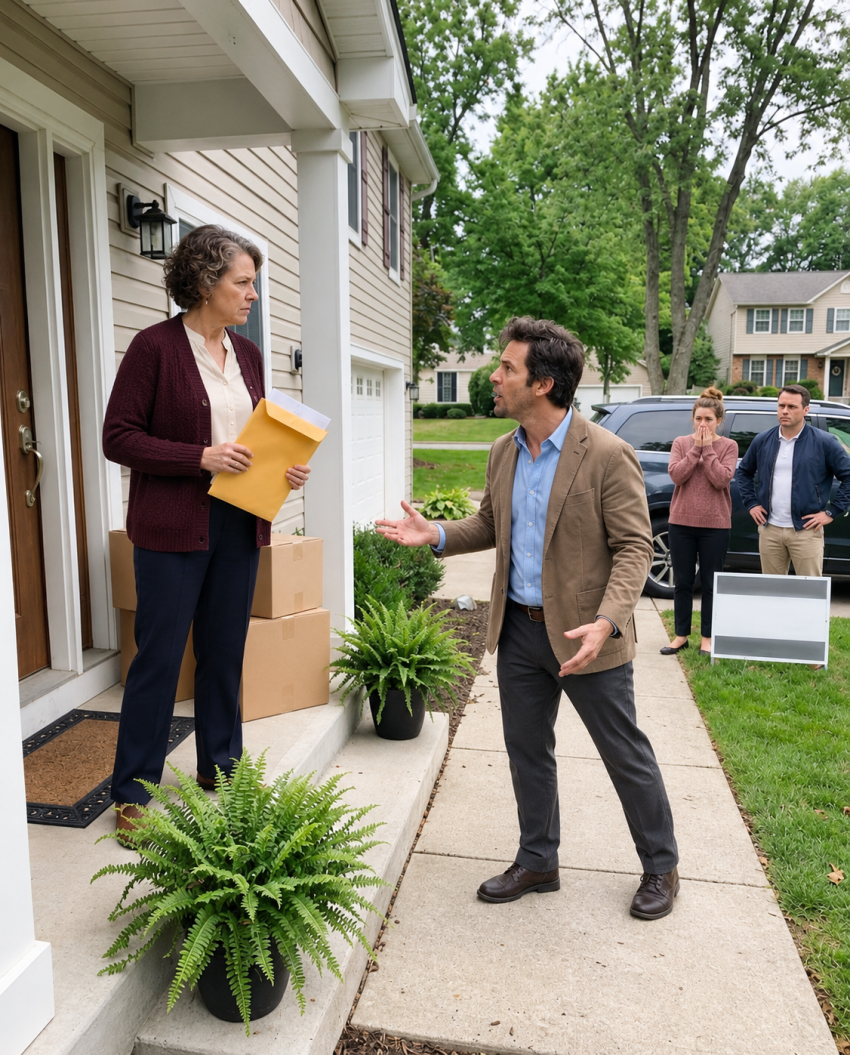
“Because this is our family home,” Caleb had said, standing in my front hall with the sale sign casting a long shadow through the door.
“No,” I said. “This is my home. And I’d like you to sit down while I tell you what that means.”
He didn’t sit. He stood among the boxes with his truck keys in his fist, and I watched him look at the stacked cartons, at the bare spot on the wall where his father’s fishing photograph had hung, and at the face of a mother he apparently hadn’t studied in years.
I should tell you who I am, because for five years my son and his wife had a version of me, and it had no deed in it.
My name is Eleanor Hayes. I’m sixty-four. I spent thirty-three years as a medical billing supervisor at a hospital in Dayton, Ohio, which taught me two things: every charge has a code, and every code has a person who ignored it until it was due.
My husband, Frank, was a high school shop teacher with sawdust in his eyebrows and a habit of humming Merle Haggard while he graded. He died five years ago in October, of a heart attack, in the garage, with a sanding block in his hand. I found him when the coffee went cold.
The house is a four-bedroom brick colonial on Linden Court, bought in 2002 for $214,000. We paid it off in 2017. It’s worth about $389,000 now. It has a dining room Frank refinished by hand, a staircase with a loose third step I never fixed because it sounded like him, and a kitchen window that looks onto a garden I planted, one tomato at a time.
We had one child. Caleb is thirty, an HVAC technician, with Frank’s shoulders and a talent for agreeing with whoever spoke last. I love him. I’ll say it plainly, because the rest of this story might make you doubt it.
Lauren came into our lives six years ago. She’s twenty-nine, a dental office manager, pretty, quick, with a laugh that turns on like a porch light. Her mother, Judith, is sixty-one, a retired real estate agent with silver hair, pearl studs, and a voice that could cut glass without leaving a mark.
I tried with Lauren. I want you to know that. I sent her flowers when she got her promotion. I made her grandmother’s pierogi recipe for her first Christmas. I paid $3,800 toward their wedding flowers because Caleb said they were “a little short.”
Somewhere in the second year, I noticed the arithmetic.
Their phone plan, four lines, had always been mine, a family plan I’d had since 2015. I kept Caleb and Lauren on it. $168 a month. Their car insurance, a joint policy through my carrier, for his truck and her sedan, $342 a month. I’d added them “temporarily” after Caleb’s credit dipped. Then there were the small things. A $1,200 dental bill. A $2,400 transmission. A new washing machine, $890, when theirs flooded the laundry room.
I kept a ledger. Of course I did. A billing supervisor can’t help it. By that October, it came to $41,600 over five years.
Nobody had thanked me in a long time.
The dinner was on a Saturday in November, at a seafood restaurant downtown called the Gilded Oyster, with white tablecloths, a wall of wine bottles, and a menu with no prices on the women’s copies.
Caleb had called on Thursday. “Mom, we’d like to have a family dinner. Lauren’s mother is in town. It’d mean a lot.”
I said yes. I always said yes.
I wore my good navy blouse, the one Frank bought me in 2016, with a little silver pin at the collar. I arrived at six-fifteen. Lauren’s mother was already in the booth.
Judith looked me up and down before I’d taken off my coat.
“That’s an interesting blouse,” she said.
“Thank you.”
She smiled. “I suppose comfort becomes more important at our age.”
Lauren laughed.
Caleb looked at his menu.
That should have told me how the evening would go.
I’ll give you the highlights, because the whole thing took two hours and I’d rather not live it twice.
Judith had mastered the art of insulting someone while pretending to make conversation. She did it with a tilt of the head and a sip of wine. When the waiter came, she ordered the lobster and said, “Eleanor, you’ll have the chicken, won’t you? Something light.”
“I’ll have the salmon.”
“Oh. Brave.”
When the bread came, she remarked that widows often “let themselves go.” When I mentioned my garden, she said, “How sweet. Something to do with your hands.” When I said I’d called Caleb that morning, she said, “Does he ever get a moment to himself?”
“I call him because he’s my son.”
“Mm. Lauren says you call twice a day.”
“It’s twice a week.”
“It feels like twice a day,” said Lauren, to her wine.
Then Judith leaned toward me.
“So, Eleanor. What do you actually do all day?”
“I keep busy.”
“Must be nice. No husband to look after. No children at home. No demanding career.” A small smile. “You probably have hours and hours to yourself.”
I knew exactly what she was doing.
“I enjoy the quiet.”
“Quiet?” She laughed. “That’s one way to describe being alone.”
Caleb finally spoke. “Mom’s doing fine, Judith.”
He said it so softly it barely counted.
It went on. I won’t give you all of it.
Judith mentioned that she “didn’t understand women who retire and then hover around their children.” Lauren stepped in to say I “worried too much.” When I put down my fork, and said I didn’t hover, Lauren shrugged.
“Sometimes you take things too personally.”
There it was. The sentence she always used. Judith could insult me. Lauren could laugh. Caleb could study his plate. But if I reacted, I was too sensitive.
Then Judith turned to my house.
“Well. At least you have that enormous place to keep you occupied.”
“Yes.”
“Four bedrooms, isn’t it?”
“Yes.”
“Seems excessive for one person.”
Lauren smiled. “I’ve told Eleanor the same thing.”
That smile bothered me.
Because in August, on a Sunday afternoon, I’d stood in my own kitchen, with a dish towel in my hand, and heard two voices on my back porch. Caleb and Lauren, thinking I was upstairs. They’d been talking about my house.
Not asking about it. Planning around it.
We could redo the kitchen, Lauren had said. Take out that wall. It’s so dated.
Dad’s workshop would make a good man cave, said Caleb. And we could finish the basement.
We’d save a fortune on rent.
She’s not going to live forever.
Caleb.
I’m just saying.
Lauren had laughed.
I’d stood very still, with the towel pressed to my chest, and I’d gone back to the sink and run the water, loud, so they’d think I hadn’t heard.
Judith delivered the final remark over dessert.
“Maybe,” she said, stirring her coffee, “you’re lonely because you haven’t learned how to let other people live their lives.”
I took a slow breath.
Lauren rolled her eyes. “Oh, come on. Mom’s joking.”
I looked at her. At this pretty, polished girl, in a green dress, whom I’d taught to make pierogi.
“Insults don’t become jokes,” I said, “just because everyone laughs afterward.”
Her face hardened.
“Honestly, Eleanor, you make everything so difficult.”
“Lauren,” Caleb murmured.
She ignored him. She leaned across the white cloth, and lowered her voice, and said, with perfect, glassy calm:
“If you don’t like my mother’s sense of humor, you can pay the bill and leave.”
The table went silent.
Judith looked pleased. Lauren looked certain I’d back down. And Caleb looked at me with the expression I’d seen on him a hundred times. The pleading, boyish, miserable look.
Please don’t make this worse.
Something inside me became completely still.
It’s difficult to describe. It wasn’t anger. Anger is hot, and I was cold. It was like the moment in an audit when the final column adds up, and you see, laid out in plain figures, exactly what you’ve been carrying.
I smiled.
“That’s an excellent idea.”
Lauren blinked.
I raised my hand. A young waiter, in a black apron, appeared at once.
“I’ll take care of the entire check,” I said.
“Mom, you don’t have to,” said Caleb.
“It’s fine.”
It came to $487. Lobster. Wine. Two appetizers. A dessert tray. A bottle of something Judith had ordered in French. I put down my card without looking at the total. The waiter, a boy of about twenty, glanced at me with an expression I’ll never forget. A flicker, quick and kind. He’d heard it all.
I stood. I put on my coat. I picked up my purse.
Lauren’s satisfied expression returned. She settled back against the leather, and took a sip of wine.
“Since Caleb and Lauren rode here with me,” I said, pleasantly, “you’ll need to arrange your own ride home.”
Caleb looked up sharply.
“Mom.”
“Good night.”
I walked out.
It was a cold, clear night, with a bright, thin moon over the river. The wind off the water smelled of salt and diesel. I stood on the sidewalk in my navy blouse, with my keys in my hand, and breathed.
I hadn’t planned it. I want you to understand that. I’d have told you, at the start of the evening, that I’d endure whatever came. I’d endured a great deal.
But somewhere between the lobster and the dessert tray, I’d understood a plain fact. That I’d spent five years paying to be insulted.
I drove home with the windows down. I didn’t turn on the radio. When I pulled into my driveway, the porch light glowed, and the house stood white against the dark, and I sat in the car for ten minutes, with my hands in my lap, and felt, to my astonishment, a strange, enormous relief.
It was the lightest I’d felt in years.
Caleb called at eight the next morning.
I was on the back porch in my robe, with a cup of coffee and a blanket across my knees. The garden was gray with frost. A cardinal flashed on the fence.
“Mom. What were you thinking?”
“Good morning to you, too.”
“You embarrassed us.”
“How?”
“Lauren’s furious. We had to take an Uber home. It was forty-two dollars.”
I almost laughed.
“Lauren told me to pay the bill and leave.”
“She didn’t mean literally.”
“Then she should choose her words more carefully.”
He sighed. I knew that sigh. It’s the one he’s made since he was twelve, caught between two women who wanted different things.
“Mom, you know how Lauren is.”
“Yes, Caleb. I do.”
“She says you owe her and Judith an apology.”
“No.”
A silence.
“What?”
“I’m not apologizing for leaving a table where I was being insulted.”