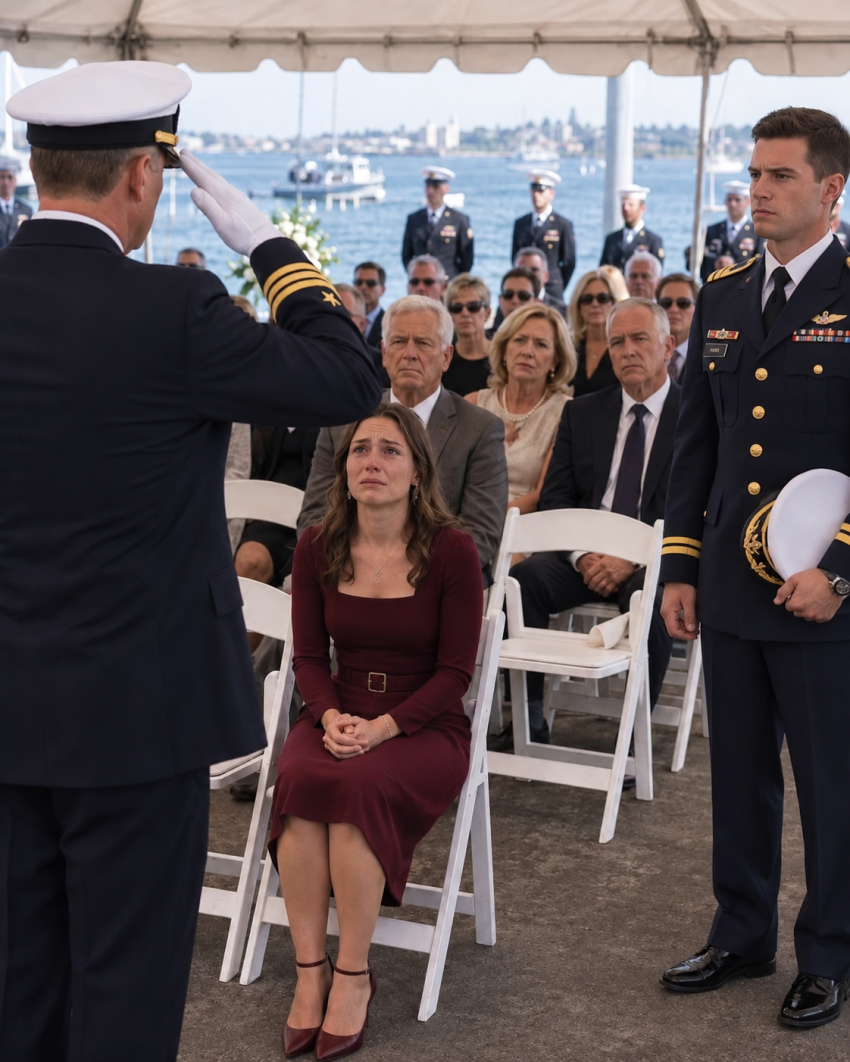
The salute hung in the air for a full two seconds before anyone under that tent understood what they were looking at.
I stood up. Old habits don’t ask permission.
“Commander,” I said.
“Ma’am.” His voice was pitched to carry — not loud, but the kind of trained clarity that reaches the back row of any formation. “We didn’t expect you until the reception. Sir asked me to bring you up whenever you arrived.”
Behind me, I heard my mother’s chair creak as she turned. I heard the specific silence of my father not knowing what to say, which was rarer than Christmas.
“I wanted to sit with my family first,” I said.
Commander Hayes’s eyes moved, just briefly, to the row behind me — to my father’s stiff shoulders, to Madison’s frozen half-smile, to Ryan standing in the candidate line with his jaw working like he was chewing on something bitter. Hayes had run enough workups and enough hell weeks to read a room of men trying not to look rattled. He read this one in about a second and a half.
“Of course, ma’am,” he said. “Whenever you’re ready. Master Chief Alvarez has your seat reserved at the front, next to Admiral Cho.”
The word Admiral did something to the air under that tent. I watched it move through the crowd like a current through water — a ripple of turned heads, of husbands elbowing wives, of the woman with the trembling program going very still.
“Thank you, Commander,” I said. “Give me one minute.”
“Take your time, ma’am.” He clicked his heels again, dropped the salute, and walked back toward the stage — but slower than he’d come, like he wanted everyone to get a good long look at exactly whose family section this had turned out to be.
I sat back down.
My mother had both hands pressed flat against her chest like she was checking to see if her heart was still beating correctly. “Emily.” Her voice came out thin. “What — why did he — ”
“I told you I had somewhere to be after this,” I said quietly. “I told you three weeks ago.”
“You said you had a work thing.”
“I said I had a work thing, Mom. I didn’t lie to you. I just didn’t fill in the parts you didn’t ask about.”
Madison had gone the color of old paper. She was still half-turned in her seat, red sundress catching the morning light, that sharpened smile of hers nowhere to be found now. “Emily, what — I don’t understand, why would a commander — ”
“Because I outrank him,” I said.
I didn’t say it cruelly. I didn’t say it the way I’d imagined saying it a hundred times on the drive down, windows cracked, radio off, rehearsing sentences I never thought I’d actually get to use. I said it the way you’d mention the weather. Flat. True. Unbothered.
My father’s mouth opened. Closed. Opened again.
“That’s not — ” he started.
“That’s not what?” I looked at him now, really looked, the way I hadn’t let myself in years, because looking at my father directly always cost something and I’d learned to ration it. “Not possible? Not true? Which one were you about to say, Dad?”
“You never told us you made — ” He stopped himself, recalibrating mid-sentence, the way he always did when he realized he was about to admit he didn’t actually know anything about my life. “You never told us anything.”
“I told you I was in the Navy,” I said. “You told everyone at Thanksgiving I did ‘paperwork somewhere overseas.’ I told you I’d made rank. You changed the subject to Ryan’s BUD/S class times. I told you I was coming to this ceremony because I had orders to be here. You told me not to embarrass you at the reception.”
Ryan’s head turned sharply. “Wait.” His voice cracked slightly, the practiced military bearing slipping for just a second. “Orders to be here? What does that mean?”
I looked at my brother. Twenty-four years old, about to receive a Trident he had worked four brutal years to earn, and I felt something complicated move through my chest — pride, real pride, tangled up with the specific hurt of watching someone you love decide, in front of an audience, that you were the embarrassing one.
“It means I’m not here as your sister today, Ryan,” I said. “I mean, I am. But I’m also here because Admiral Cho asked me to attend and say a few words before the pinning.”
The silence that followed had weight to it. I could feel Madison doing math behind me, recalculating something. I could feel my mother’s hand find my father’s sleeve and grip it.
“Say a few words,” my father repeated slowly, like the phrase itself might rearrange into something that made more sense if he said it again.
“Yes.”
“About what?”
“About Ryan,” I said. “About the program. About the four sailors from this class who didn’t make it to today, and the reasons this uniform means what it means. I was asked to speak because of my current billet, not because I inserted myself into anything.” I let that land for a second. “I didn’t ask for this seat, Dad. You put me in it when you told me to sit somewhere quiet and not ask questions.”
“Emily, I didn’t mean — ”
“You meant exactly what you said.” I kept my voice level, the way I’d learned to keep it level in rooms far more hostile than a Coronado ceremony tent. “You told me not to come to the reception unless Ryan invited me. You told me people would ask questions about what I do. You’ve spent six years assuming the answer was something you’d rather not know, and it was easier for you to guess ‘disappointing’ than to actually ask.”
My mother made a small sound, something between a gasp and a sob that she immediately swallowed. “We didn’t know,” she whispered. “How could we know if you never — ”
“I told you I’d made Commander eight months ago,” I said. “I sent a text. Do you remember what you said back?”
She didn’t answer. She knew. I watched it surface behind her eyes — the memory of glancing at her phone at a stoplight, typing back that’s nice honey, are you coming for Easter, and moving on with her day.
“You said ‘that’s nice, honey,’” I said, gently now, because there was no version of this that needed to be cruel to be true. “And then you asked about Easter.”
Up near the stage, I could see Admiral Cho — silver-haired, compact, the kind of quiet authority that didn’t need to raise its voice in forty years of service — glance toward our section with the mild, patient expression of a man who had all morning and had clearly done this dance before, watching families realign themselves around information they should have had years ago.
Commander Hayes was making his way back.
“Ma’am, they’re ready to begin whenever you are.”
I stood again. This time my mother reached up and grabbed my wrist.
“Emily. Wait. Please.”
I looked down at her hand on my arm — the same hand that had clutched pearls a few minutes earlier while her son publicly accused me of driving four hours for attention. “What, Mom?”
“I’m sorry,” she said, and her voice actually broke on it, which surprised me more than I expected it to. “I don’t — I don’t understand what’s happening right now, but I know I should have asked more questions. I know that. Please don’t — don’t let this be the last thing that happens today.”
I softened, because I am not made of stone, whatever my family occasionally needed to believe about me to feel better about themselves. “Nothing’s ending, Mom. I’m just going to go do my job. You can watch.”
I followed Commander Hayes down the center aisle, past a hundred folding chairs full of people who had spent the last ten minutes watching my family’s private humiliation unfold in real time and were now craning their necks to watch where it led. Somewhere behind me I heard Madison whisper something to Aunt Patricia, and I heard the word “commander” repeated back at a volume clearly meant for me to hear, edged with something that used to be condescension and had curdled fast into something closer to fear.
I didn’t look back at Ryan. I couldn’t yet. I didn’t trust what my face would do.
Admiral Cho stood as I approached the front row, extending his hand.
“Commander Whitfield.” His grip was firm, brief, professional. “Good to finally put a face to the file. Your CO speaks highly of you.”
“Thank you, sir.”
“That your family back there?” He nodded, not unkindly, toward the section I’d just left, where a hundred heads were still turned in our direction like sunflowers tracking something brighter than the sun.
“Yes, sir.”
“They didn’t know.”
It wasn’t a question, so I didn’t answer it like one. “No, sir. They didn’t know.”
Something moved behind his eyes — not pity, exactly. Recognition, maybe. The particular recognition of a man who’d worn a uniform for four decades and had seen every possible configuration of family pride and family blindness that came wrapped around it.
“Well,” he said. “They’re about to.”
He gestured me toward the folding chair beside his own, front row, close enough to the podium that I could see the velvet cases laid out on the table, could see the individual Tridents catching morning light exactly the way they had from fifty feet back, except now I could see the engraving on the plaque beside them too — the names of four sailors from Ryan’s BUD/S class who hadn’t made it to this morning, who’d washed out not from failure but from injuries that ended careers, or in one case, from something far more permanent that the whole class had worn like a quiet weight for the last eighteen months.
I sat. I did not look back at my family’s row. I focused instead on straightening the small stack of index cards in my jacket pocket, cards I’d written on the drive down at a rest stop outside Yuma, never imagining the exact configuration of faces that would be watching me read them.
Commander Hayes returned to the podium first, welcoming everyone back from the brief recess, running through the remaining program with the crisp efficiency of a man used to keeping ceremonies on schedule regardless of what family drama had briefly threatened to derail them.
“Before we proceed to the pinning ceremony,” he said, “we’re honored to have a few words from Commander Emily Whitfield, currently serving as Operations Officer for Naval Special Warfare Group Three, and — for those of you in the family section who may not know this yet — Petty Officer First Class Ryan Whitfield’s older sister.”
A murmur went through the crowd. I could feel it reach my family’s row like a wave hitting a seawall.
I stood, walked to the podium, and looked out at a hundred and fifty faces I’d never met, and one row of faces I’d known my entire life, now looking back at me like they were seeing me for the first time.
Maybe they were.
“Thank you, Commander Hayes.” I set my index cards on the podium and didn’t look at them once.
“I want to start by saying something that might surprise some of you.” I found my mother’s eyes in the crowd, then my father’s, then Ryan’s, standing rigid in his white uniform among the other candidates, his jaw tight enough that I could see the muscle working from here. “I almost didn’t come today as anything other than a sister.”
I let that sit for a second.
“I’ve spent six years in this community not talking much about what I do. Partly that’s the job — some of it, I genuinely can’t talk about, and some of you in this tent understand exactly what I mean by that. But partly, if I’m honest, it’s because it was easier. Easier to let my family think I did something vague and unremarkable somewhere overseas. Easier than explaining what it actually costs to earn the kind of trust that lets you sit in rooms where decisions get made about where sailors like the ones up here today get sent, and what comes home with them, and what doesn’t.”
I glanced, just once, toward the plaque with four names engraved beside the Tridents.
“Ryan’s class started BUD/S with a hundred and eighty-four candidates eighteen months ago. Twenty-two of them are getting pinned today. That’s not a coincidence of toughness. It’s not luck, and it’s not just physical capability, though God knows you need plenty of that. It’s something harder to explain to people who’ve never watched it happen up close. It’s the specific, stubborn refusal to let the person next to you fail alone. I’ve watched that refusal cost people everything. I’ve watched it save lives. Sometimes both, in the same operation, on the same night.”
I looked at the four names again.
“Petty Officer Daniel Cho — no relation to the Admiral, before anyone asks, though he’d have appreciated the joke — Petty Officer Marcus Delgado, Petty Officer Trevor Ames, and Ensign Wyatt Brennan started this pipeline with the sailors sitting in front of you today. Three of them didn’t finish because their bodies gave out before their will did, which happens more than people outside this community understand, and which is its own kind of sacrifice that doesn’t come with a Trident at the end of it. And Wyatt Brennan isn’t here today because eleven months ago, during an evolution I’m not going to describe in detail in front of families, he made a choice that kept two of his classmates alive and didn’t keep himself alive doing it.”
The tent had gone completely silent. Even the little boy who’d asked his grandfather why I looked sad had stopped fidgeting.
“I didn’t know Wyatt personally. But I know men like him. I’ve served with men like him for six years, and I want every family in this tent to understand something before your sailor gets that Trident pinned on his chest in the next ten minutes: what he’s carrying now isn’t just an anchor and an eagle and a trident and a flintlock pistol stamped onto a piece of metal. He’s carrying the specific, permanent responsibility of being the kind of person other people’s lives depend on, in moments when there’s no time to think it through, when instinct has to already be trained into character. That’s what those four names on that plaque bought, for everyone else standing in this class today. That’s not something you get to be casual about. And it’s not something the people who love these sailors get to be casual about either.”
I found Ryan’s eyes across the tent. He wasn’t looking tight-jawed anymore. He was looking at me like he was seeing someone he didn’t fully recognize — which, I realized, standing there, was probably fair. He’d grown up with a version of me that existed mostly in the gaps between holiday visits and rare phone calls, a sister who was “in the Navy” the way some vague uncle was “in insurance.” He’d never had the chance to see this part.
“My brother is about to become one of the people who carries that weight,” I said. “And I want to say, publicly, in front of everyone who loves him and everyone who’s about to watch him earn this — I am unbelievably proud of him. Not because he’s my brother, though obviously that’s part of it. I’m proud of him because I’ve read his instructor evaluations. I’ve talked to his cadre. I know exactly what it took for him to get to this morning, and I know he did it the right way — by carrying people, not stepping over them.”
I paused, and let myself say the next part slower.
“There’s a version of this community that gets misunderstood by people outside it. People think it’s about being the toughest person in the room. It’s not. The toughest person in the room usually washes out around week three of Hell Week, because toughness alone doesn’t teach you how to trust the guy next to you enough to let him carry part of the load when your body is done. What gets you through is something closer to humility. The willingness to be the weakest link sometimes, and trust the team to cover you, and then flip that and cover someone else when it’s their turn to be weak. That’s not a soft skill. That’s the entire skill.”
I looked directly at my family’s row now. At my mother, both hands pressed to her mouth. At my father, sitting very still, staring at me like I was a stranger wearing his daughter’s face. At Madison, who had gone quiet in a way I don’t think anyone in our family had witnessed before.
“I think sometimes the families of people in this line of work forget that the same humility gets asked of us too,” I said, and my voice caught, just slightly, on the word us, but I let it catch, because pretending otherwise would have been its own kind of lie. “It’s easy to be proud of the uniform. It’s harder to be curious about the person wearing it. It’s harder to ask questions instead of making assumptions, and to actually sit with answers you weren’t expecting.”
I let that hang for a moment longer than was strictly comfortable.
“I drove four hours to be here today. Not for a job. For my brother. I want that on the record, in front of everyone, because it’s the truest thing I’ve said all morning.”
I picked my index cards back up, though I hadn’t looked at a single one of them.
“Petty Officer Ryan Whitfield — and the twenty-one other sailors about to be pinned — everyone under this tent is proud of you. But more than that, we trust you now. That’s what this Trident means. Somewhere down the line, someone’s life is going to depend on the character you built to earn it. Don’t ever let anyone — including yourselves, on the hard days — convince you that character was an accident.”
I stepped back from the podium.
The applause started slow — the confused, uncertain applause of a crowd that had just witnessed something more personal than they’d expected at a military pinning ceremony — and then built, the way it does, until it was the kind of applause with weight behind it, the kind that comes from people who’d just recalculated something about what they were watching.
I sat back down next to Admiral Cho. He leaned toward me slightly.
“Well,” he said, quiet enough that only I could hear it. “That wasn’t in the program.”
“No, sir.”
“Was it true?”
“Every word.”
He nodded once, satisfied, and gestured toward Commander Hayes to proceed with the pinning.
The ceremony itself moved fast after that — the way ceremonies do, all that buildup collapsing into ten efficient minutes of names called, Tridents pinned, hands shaken, photographs snapped. I watched Ryan’s name get called third. I watched him walk up to the stage in that stiff, careful way you walk when your body is holding itself at attention out of habit built over eighteen months of not being allowed to slouch. I watched Master Chief Alvarez pin the Trident to his chest, watched Ryan’s hand come up in a salute that held for a beat longer than protocol strictly required.
Then Ryan did something that wasn’t in the program either.
He turned, in front of the whole tent, and looked directly at me.
“Ma’am,” he said — not sister, not Emily, but the honorific, delivered with a formality that made half the crowd realize something had shifted between us in real time — “permission to step out of line.”
Commander Hayes, standing beside him, glanced toward Admiral Cho with the faintest raised eyebrow. The Admiral, to his credit, just gave a small nod and a smaller smile, the universal signal of a man who’d decided this particular breach of ceremony protocol was worth allowing.
“Granted,” Hayes said.
Ryan walked down off the stage, still in formation-perfect posture, Trident gleaming on his chest, and came to stand in front of my chair.
Up close, I could see he was fighting something in his face — the same something I’d been fighting behind the podium a few minutes earlier.
“I said something ugly to you this morning,” he said. His voice wasn’t pitched for the crowd this time; it was pitched just for me, though of course everyone within twenty feet heard every word anyway. “In front of everyone. I told you that you drove here so people would notice you.”
“I remember.”
“I was wrong.” He swallowed. “I’ve spent eighteen months proving to myself that I could handle anything this pipeline threw at me, and somewhere in there I think I decided that meant I didn’t need anyone else’s shadow standing near mine on the day it finally paid off. Especially not my sister’s, since I never really understood what that shadow actually was.”
“Ryan — ”
“Let me finish. Please.” His jaw was tight again, but different this time — tight with effort, not with contempt. “I’ve been telling people for months that my sister does something boring in an office somewhere. I told my instructors that. I told the guys in my class that. I think some small, ugly part of me needed you to be boring, because if you weren’t boring — if you were actually further along in this exact world I was breaking myself trying to enter — then I couldn’t just be the first Whitfield to do something extraordinary. I’d just be following you.”
The tent had gone quiet around us again, a hundred and fifty strangers pretending to check their programs while listening to every word.
“I don’t need to be first at anything, Ryan,” I said quietly. “I never needed that from you either.”
“I know that now. I think I always kind of knew it, and just didn’t want to.” He looked down at the Trident on his chest, then back up at me. “Would you—” He stopped, started again. “Would you pin the collar device? The junior one. It’s tradition, family gets to do it if they’re present. I didn’t think you’d be here to ask.”
I stood up. My hands were steadier than I expected them to be.
“I’d be honored.”
He handed me the small insignia from the velvet box Master Chief Alvarez had passed him, and I pinned it to his collar with the careful precision of someone who’d done this exact motion for other sailors a dozen times before, though never once for someone who shared my blood.
“There,” I said, stepping back. “Now it’s official.”
Ryan didn’t say anything right away. He just looked at me — really looked, the way he hadn’t in years, maybe the way he never had — and then, in front of the entire tent, in front of Admirals and Commanders and Master Chiefs and a hundred and fifty strangers, my little brother hugged me.
It wasn’t a formal, careful, camera-ready hug. It was the kind of hug that happens when eighteen months of exhaustion and eight years of quiet family distance both come loose in the same second.
“I’m sorry,” he said into my shoulder, quiet enough now that maybe only I heard it. “I’m really sorry, Em.”
“I know,” I said. “Me too.”
The reception happened in a banquet room overlooking the water, white tablecloths and a buffet line and a slideshow of BUD/S class photos looping on a screen near the bar. My father found me near the dessert table forty minutes in, holding a plate he clearly wasn’t going to eat from, using it as a prop to justify standing near me without immediately having to say something.
“I owe you an apology,” he said finally.
“Yes,” I said. “You do.”
He almost smiled at that — the bluntness of it, maybe, or the fact that I wasn’t going to make this easy for him, the way I might have five years ago, back when smoothing things over for my father’s comfort was still a reflex I hadn’t fully broken.
“I told you not to come to this reception unless Ryan invited you,” he said. “In front of half the family.”
“You did.”
“I said it because — ” He stopped, recalibrated, the way he had under the tent. I watched him actually try, for maybe the first time in my adult life, to say something true instead of something convenient. “I said it because I didn’t understand what you’d become, and not understanding you made me uncomfortable, and it was easier to be embarrassed by the mystery of it than to admit I never bothered solving it.”
It wasn’t a perfect apology. There was no explicit I’m sorry buried in that sentence, no clean admission of cruelty. But it was more honesty than my father had offered me in a decade, and I decided, standing there with a slice of cake going soft in my hand, that I could work with honesty. I’d built a career out of working with less.
“You could have just asked me, Dad,” I said. “Any time in the last six years. ‘What do you actually do, Emily?’ That’s it. That’s the whole question.”
“I know.”
“Why didn’t you?”
He was quiet for a long moment, looking out the window at the water, at sailboats moving lazily across a bay that had no idea what kind of morning had just happened on the lawn behind it.
“Because I think some part of me already suspected the answer would make me feel small,” he said finally. “And I didn’t know how to feel small next to my own daughter. So I decided not to find out.”
I didn’t have a clean response to that. I’m not sure one existed. Some truths don’t come with tidy resolutions attached; they just sit there, heavy and real, and you decide what to do with the weight of them going forward.
“I’m not interested in you feeling small, Dad,” I said eventually. “I never was. I just wanted you to be curious.”
“I’ll work on that.”
“Okay.”
It wasn’t everything. It wasn’t the speech I’d once imagined giving him in the car on some other, angrier drive down the coast, the one where I laid out every slight in chronological order and made him answer for each one individually. But it was a start, offered without me having to force it out of him with a folded invitation and a protocol stamp, and after six years of nothing, a start counted for more than I expected it to.
My mother found me later, near the end of the reception, when the crowd had thinned and Ryan was off somewhere getting his photo taken with his instructors, Trident gleaming under the banquet lights.
“I looked you up,” she said, without preamble, holding her phone slightly toward me like evidence. “After the ceremony. There’s a public bio on the base website. Operations officer. Commander. It says you did two deployments I’ve never heard you mention.”
“I don’t talk about deployments much, Mom. Most of what happens on them, I legally can’t.”
“I know that now.” She set the phone down on the table between us. “I think I always told myself that if it were something worth knowing, you’d have made more noise about it. That silence meant nothing was there. I never once considered that silence might mean the opposite — that it was actually the biggest thing in your life, and you just didn’t know how to hand it to people who’d stopped asking.”
“That’s exactly what it meant,” I said quietly.
She reached out and took my hand across the table, the way she used to when I was small and scraped a knee, an old, muscle-memory gesture of comfort neither of us had used on each other in years.
“I’m proud of you,” she said. “I should have said that a long time before some commander saluted you in front of two hundred strangers made it impossible to ignore.”
“You could say it now.”
“I’m saying it now.” Her eyes were wet. “I’m so proud of you, Emily. And I’m sorry it took me this long to actually see it.”
I squeezed her hand back.
“It’s okay, Mom. We’ve got time to fix it.”
“Do we?”
“I think so,” I said. “I’m not going anywhere. I never was. You all just needed to actually look.”
Madison never did apologize, not directly, not in so many words — some people’s pride doesn’t bend that way, even when the ground has clearly shifted beneath them. But I noticed, on my way out of the banquet hall that evening, that she’d quietly moved my name placard from the far end of the family table — where she’d originally seated me, tucked in beside a second cousin nobody talked to — up to the seat directly across from Admiral Cho, who’d apparently decided the reception was worth staying for after all.
Some corrections don’t come with words attached. Some just come as small, silent rearrangements, made by people too proud to admit out loud that they’d been wrong, but not so proud that they couldn’t quietly fix the seating chart.
I sat down in that new seat anyway. I didn’t need the apology. I’d already gotten what actually mattered — my brother’s hand in mine on that stage, my mother’s hand across a table an hour later, my father’s rough, unfinished attempt at honesty by the dessert table.
Dignity, I’d learned a long time ago, was never about the speech you gave in the moment someone tried to make you small. It was about what you did after — whether you let their smallness shrink you down to match it, or whether you simply kept your hands folded, waited for the truth to arrive on its own schedule, and let it do the talking you’d been too patient to do yourself.
That morning, dignity had looked like silence.
By evening, it looked like a Trident pinned to my brother’s collar by my own hand, and a table full of people finally, finally asking the right questions.
It only took them six years. But some doors, once they’re open, don’t need slamming to prove they mattered. They just need to stay open.
And for the first time in a long time, walking out of that banquet hall into the cool evening air off the water, I believed mine finally would.