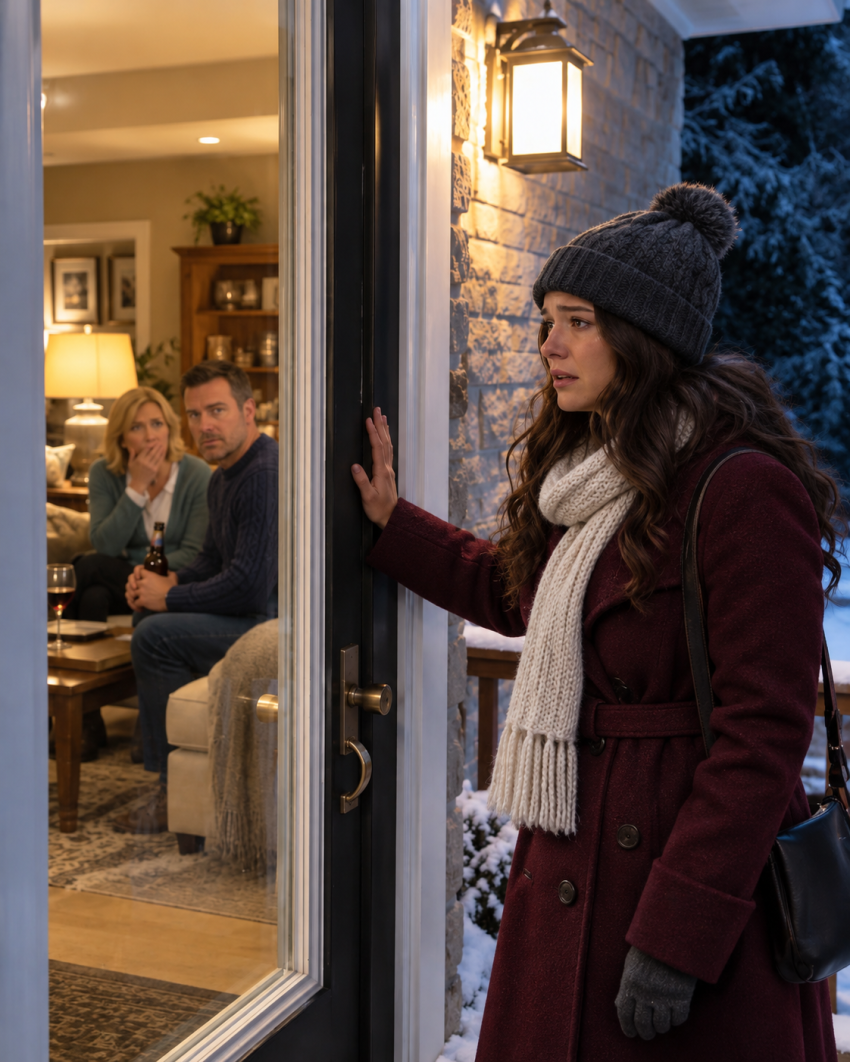
The morning after my older brother locked me outside our grandmother’s farmhouse during a Montana blizzard, my phone wouldn’t stop ringing.
He wasn’t calling because he was worried about me.
He was calling because a legal notice had appeared on the farmhouse door, threatening to expose everything he’d been doing behind my back.
Eleven vacation bookings. More than $41,000 in deposits. A forged property deed.
And a business he had secretly created on land that didn’t belong to him.
But to understand how my brother ended up begging me to answer his calls, I need to explain what happened to our family after Grandma Rose died.
My name is Haley Morgan. I’m twenty-nine years old, and I work as a veterinary technician in Bozeman, Montana.
My older brother, Brandon, is thirty-four.
Growing up, Brandon was always the child everyone expected to accomplish something extraordinary. He was popular, athletic, confident, and capable of convincing almost anyone to believe in his latest idea.
Our mother, Diane, adored him.
When Brandon abandoned college to pursue a business opportunity, she praised his ambition.
When I finished my veterinary technology program and found steady employment, she barely acknowledged it.
I learned early that being responsible didn’t necessarily earn attention in our family.
Grandma Rose was different.
She owned a beautiful forty-acre property along Gallatin Creek Road. The farmhouse had white siding, green shutters, an old red barn, and a kitchen that always smelled faintly of cinnamon.
Grandma had lived there for more than four decades.
After Grandpa Walter died, she refused to leave the place they had built together.
In the winter of 2022, Grandma slipped on an icy step and fractured her hip.
Her doctors warned that living alone would no longer be safe.
Mom immediately suggested assisted living.
Brandon recommended selling the farm, arguing that the property could bring in more than a million dollars.
Neither seemed particularly interested in what Grandma wanted.
So I asked her myself.
She looked at me from her hospital bed and quietly said she wanted to go home.
That was enough for me.
I rearranged my work schedule and began visiting the farmhouse five evenings each week.
I cooked her meals, organized medications, cleaned the house, drove her to appointments, and helped her recover.
We spent countless evenings together at the kitchen table.
She told me stories about the thirty-one years she had worked as a school bus driver. I listened while we drank coffee and shared cinnamon rolls.
Mom called occasionally.
Brandon visited perhaps twice a year.
I never expected anything in return for helping Grandma. Being with her was something I genuinely enjoyed.
But she noticed how differently our family treated me.
One freezing December evening, the furnace stopped working.
While we waited for a repairman, Grandma and I wrapped ourselves in blankets and sat together in the living room.
She suddenly took my hand.
“Haley, promise me you won’t waste your life trying to earn love from people who keep shutting you out.”
I tried to laugh it off.
She wouldn’t let me.
She reminded me how often I overlooked insults, accepted unfair treatment, and pretended everything was fine.
I told her I wasn’t expecting anything from anyone.
She gave me a sad smile.
“That’s exactly why they take advantage of you.”
I didn’t fully understand her warning until much later.
Several weeks afterward, Grandma asked me to drive her to attorney Nathan Foster’s office.
She spent nearly three hours inside.
When she returned, she carried a sealed envelope.
I asked whether something was wrong.
She simply said she was making sure everything ended up where it belonged.
Grandma died peacefully that March.
I found her sitting in her favorite armchair beside the window.
For a long time, I sat on the floor next to her, holding her hand and wishing we could have one more conversation.
Two weeks after her funeral, our family gathered at Nathan’s office for the reading of her will.
Mom received $60,000 and several treasured household belongings.
Brandon inherited $85,000.
Grandma also left $10,000 to a local animal welfare organization.
Then Nathan announced that the farmhouse, barn, and entire forty-acre property belonged to me.
I couldn’t speak.
Brandon immediately demanded an explanation.
Mom suggested Grandma had been confused when she made the decision.
Nathan calmly explained that Grandma had been mentally competent and had independently arranged everything.
She had also made it clear that I knew nothing about her plans.
Brandon was furious.
Mom looked at me as though I had somehow stolen something.
But Grandma had made her wishes legally clear.
By June, the property deed was officially recorded in my name.
Nathan later warned me that Brandon had contacted his office repeatedly, asking whether ownership could be transferred to him through some informal family agreement.
Nathan had refused.
He sent Brandon a certified letter confirming that the farm belonged exclusively to me and that he had no authority to rent, advertise, renovate, or otherwise use the property without permission.
Brandon signed the delivery receipt.
I assumed that would settle the matter.
I was wrong.
In October, Mom invited me to spend a weekend at the farmhouse.
She said it would be nice for the three of us to spend time together and remember Grandma.
I wanted to believe we could finally become a closer family.
So I agreed.
When I arrived that Friday evening, snow was already falling heavily.
Mom’s car was parked beside Brandon’s pickup.
Inside, I found them sitting with a woman named Lauren, whom Brandon introduced as his girlfriend.
Architectural drawings covered the dining table.
There were plans for guest suites, a hot tub, outdoor fire pits, and luxury accommodations.
A glossy brochure displayed the name Gallatin Creek Retreat.
Underneath was an advertised nightly rate of $850.
I stared at the documents.
Brandon enthusiastically explained his plan to transform Grandma’s property into an upscale vacation destination.
He believed the business could generate more than $200,000 annually.
When I asked whether he’d already contacted contractors, he brushed off my question.
I reminded him that the property belonged to me.
His expression immediately hardened.
He insisted it was family property.
Mom stepped in, accusing me of being difficult.
She said Brandon was trying to create something valuable for everyone.
I asked how he could make plans for land he didn’t own.
Neither gave me a reasonable answer.
Dinner was uncomfortable.
Later, while I washed dishes, Brandon approached me and quietly suggested I might not be welcome at the farmhouse much longer if I refused to cooperate.
I should have left immediately.
Instead, I stayed because some part of me still wanted to believe my family could treat me fairly.
Around nine that evening, Brandon proposed a challenge.
He offered me fifty dollars if I could remain on the enclosed porch for ten minutes in the freezing weather.
It sounded childish.
But he reminded me of similar games we had played growing up.
I reluctantly agreed.
I was already wearing my winter coat, boots, and gloves.
Besides, the kitchen door was only a few feet away.
I stepped outside.
The wind was brutal.
Snow swept across the yard, and the temperature had dropped well below zero.
I waited near the porch swing.
Through the glass, I could see Brandon watching me.
After approximately three minutes, I heard the deadbolt click.
I turned around.
Brandon stood inside, smiling.
I knocked and told him to open the door.
He shook his head.
At first, I thought he was teasing.
Then he mouthed something through the glass.
He wanted me to find somewhere else to sleep.
I knocked harder.
The temperature was dangerously low, and the storm was getting worse.
Brandon laughed.
Lauren appeared behind him, but she no longer looked amused.
Then Mom entered the kitchen.
I called out to her.
She looked directly at me.
For one brief moment, I expected her to tell Brandon to stop.
Instead, she smiled, raised her fingers in a small wave, and walked away.
I immediately called her phone.
I watched it light up on the kitchen counter.
She saw my name and declined the call.
Then Brandon switched off the porch light.
I stood in the darkness, realizing that this had never been a harmless joke.
They had deliberately shut me out of my own home during a blizzard.
I could have continued pounding on the glass.
Instead, I remembered Grandma’s warning.
I turned away from the house and started walking.
Our neighbor, Arthur Pruett, lived about half a mile down the road.
He was seventy-nine and had known Grandma for decades.
I hoped I could reach his home before the cold overwhelmed me.
Snow filled my boots.
The wind made it difficult to see.
My fingers were becoming painfully numb.
I had walked roughly a quarter mile when headlights appeared through the storm.
A truck stopped beside me.
Arthur opened the passenger door and told me to get inside.
He had noticed the farmhouse porch light suddenly go dark.
Grandma had always kept that light on, and he thought something was wrong.
He drove me to his house, gave me dry socks, warm tea, and a place beside the wood stove.
His collie, Biscuit, rested her head on my knee while I struggled to stop shaking.
When Arthur asked what had happened, I finally broke down.
I told him about Brandon, Mom, and the locked door.
He listened quietly.
Then he revealed something that changed everything.
He had seen Brandon meeting with a contractor at the farm the previous week.
The contractor had been measuring the garage.
Arthur also heard that Brandon had ordered construction materials using my name.
And there was something even worse.
Brandon had apparently been collecting advance payments from people planning to stay at the farmhouse.
I immediately checked my phone.
There were messages from Mom asking where I had gone.
Brandon had apparently told her he was sorry.
But I also found an urgent email from Nathan.
A vacation rental management company had contacted him because Brandon was claiming to own the farmhouse.
He had submitted a property deed showing himself as the owner.
Nathan believed the document was fraudulent.
My stomach dropped.
Brandon hadn’t simply made plans without asking me.
He had apparently forged legal paperwork to convince strangers that he owned Grandma’s farm.
I wanted to call Nathan immediately, but Arthur persuaded me to wait until morning.
I barely slept.
At 6:55 a.m., I called Nathan and explained everything.
He was horrified by what my family had done.
He asked me to come to his office at nine and warned me not to return to the farmhouse alone.
When I arrived, he had several documents waiting.
The first was the genuine recorded deed confirming my ownership.
The second was the document Brandon had submitted to the rental company.
It looked official, complete with a notary stamp.
But the name of the supposed notary was false, and the commission information didn’t match.
Nathan also showed me the certified letter he had sent Brandon months earlier.
The letter explicitly prohibited him from renting, advertising, renovating, or making financial commitments involving the farm.
Brandon had signed for it.
He knew exactly what he was doing.
Nathan explained that Brandon had apparently believed the property should have been his inheritance.
He had spent years telling people he would eventually take over Grandma’s farm.
When she left it to me, he treated her decision as an injustice.
Nathan prepared a formal cease-and-desist notice demanding that Brandon stop all unauthorized activity, cancel the listings, return every deposit, and provide a complete accounting.
I authorized him to proceed.
The notice was delivered to the farmhouse at 9:17 that morning.
Almost immediately, my phone started ringing.
Brandon called repeatedly.
Then Mom called.
Then Brandon again.
I sat in Arthur’s truck near the property and watched the calls arrive.
The first voicemail was furious.
Brandon demanded that I make Nathan withdraw the notice.
He claimed I was destroying his business.
He said eleven families had booked stays and that he was responsible for more than $40,000.
A later voicemail sounded different.
He apologized for the porch incident, calling it a joke that had gone too far.
Then he begged me to call him.
I didn’t.
When Mom finally reached me, she expressed concern about where I’d spent the night.
But her real reason for calling soon became obvious.
She wanted me to let Brandon operate the vacation rental business for at least one season.
She argued that he had already invested too much effort to abandon it.
I waited for her to apologize for leaving me outside in the freezing weather.
She didn’t.
When I reminded her that she had waved at me through the glass, she dismissed the entire incident as teasing.
That was when something inside me changed.
I sent both of them a message explaining that I owned the farmhouse and had never authorized Brandon’s business.
I told them Nathan would handle all further discussions.
For the first time, I refused to negotiate my rights simply to keep the peace.
Three days later, I returned to the property with Arthur.
Brandon was waiting on the porch.
He looked exhausted and angry.
He immediately accused me of ruining eight months of work.
I asked him why he had taken bookings for property he didn’t own.
He insisted he had intended to give me a percentage of the profits.
I reminded him that offering me fifteen percent of revenue from my own land wasn’t generosity.
Then I confronted him about the forged deed.
He tried to call it a temporary document.
Nathan had already established otherwise.
When I mentioned the certified letter he had signed in August, Brandon finally stopped arguing.
His expression collapsed.
He began crying.
He admitted that he had spent his entire life trying to impress Grandma.
He had always been the charming, successful child everyone praised, but he never felt she truly respected him.
He believed that turning the farm into a profitable business would finally prove his worth.
When Grandma left the property to me, he felt rejected.
He admitted that seeing how warmly she treated me had made him jealous for years.
Then he confessed something I wasn’t prepared to hear.
He had locked me outside because he wanted me to experience the same rejection he believed he had suffered.
He wanted me to feel excluded.
Hearing that didn’t excuse what he had done.
But it helped me understand how deeply our family had damaged both of us in different ways.
I asked him to come down from the porch.
When he approached, I hugged him.
He began sobbing and apologized repeatedly.
I told him I wasn’t surrendering the farm.
I wasn’t giving him a share of a business he had created without permission.
And every family who had paid him needed to receive a refund.
He agreed.
Then he admitted that most of the $41,200 was already gone.
He had spent it on construction materials, equipment deposits, a hot tub, and even a down payment on a bulldozer.
For a moment, I couldn’t believe what I was hearing.
The sheer absurdity of it made us both laugh through our tears.
But the consequences were serious.
With Nathan’s assistance, Brandon agreed to a written repayment plan.
He canceled every listing and personally contacted all eleven families.
He sold his pickup and an expensive watch, then arranged additional financing.
By the end of November, every customer had been repaid in full, including interest.
Brandon also found a job driving for a feed distributor.
The work was physically demanding and far less glamorous than the life he had imagined.
But he gradually began taking pride in earning money through honest labor.
He started attending counseling.
For the first time, he seemed interested in becoming someone he respected rather than someone other people admired.
In December, Nathan asked me to visit his office again.
He had another envelope from Grandma.
She had instructed him to give it to me if the family conflict unfolded as she feared.
Inside was a handwritten letter.
Grandma explained that she knew Brandon would be angry about the inheritance.
She also knew Mom would probably defend him.
But she wanted me to stop sacrificing my own happiness for their approval.
She had left me the farm because I genuinely loved it.
Not because she wanted me to punish anyone.
Then she asked me to do something difficult.
She wanted me to keep the possibility of reconciliation open, but only when my family was ready to treat me differently.
She explained that Brandon had grown up being praised for his image rather than loved for his true personality.
Mom had unintentionally encouraged that insecurity by constantly expecting him to become someone extraordinary.
Grandma believed he was frightened, not beyond redemption.
At the bottom of the letter, she had written a simple request.
She wanted me to leave the porch light on.
And in a final note, she revealed the secret to her cinnamon rolls.
The butter had to be cold.
I cried for a long time after reading that letter.
In January, I moved permanently into the farmhouse.
Arthur helped prepare the house, and I gradually made it my own.
One evening, I noticed the porch light was still switched off.
I reached for the cord and turned it on.
The soft yellow glow spread across the steps where I had once stood begging my family to let me inside.
I decided to leave it burning every night.
Not because I had forgotten what happened.
But because I no longer wanted that darkness to define my life.
My relationship with Mom took longer to repair.
For months, we barely spoke.
Then, one Sunday in March, her car appeared in the driveway.
She approached the house slowly and asked whether she could come inside.
I invited her into the kitchen.
Over tea, she told me she had started seeing a counselor.
Brandon had encouraged her to seek help.
She admitted that she had spent years protecting him from disappointment while assuming I could handle everything alone.
Then she finally spoke about the night of the blizzard.
She remembered my face through the glass.
She remembered waving.
And she admitted that she had chosen to protect Brandon’s feelings instead of my safety.
She began crying.
For the first time in my life, Mom acknowledged that her favoritism had hurt me.
I didn’t immediately forgive everything.
Twenty-nine years of disappointment couldn’t disappear during one conversation.
But I was willing to see whether things could change.
Before she left, I gave her a key to the kitchen door.
I told her she could visit on Sundays.
She held the key tightly and cried again.
Two years have passed since that terrible night.
I still live at Grandma’s farmhouse.
I’ve planted a garden, repainted the shutters, and finally learned to make her cinnamon rolls properly.
Mom visits most Sundays.
She brings dessert, drinks coffee in Grandma’s old chair, and asks about my work.
Our relationship isn’t perfect, but it’s more genuine than it used to be.
Brandon comes on Wednesdays.
He still works for the feed distributor.
Sometimes we play cards at the kitchen table.
He also asked permission to rent part of the eastern field so he could grow hay.
This time, he offered to pay a fair price and put everything in writing.
I agreed.
Watching him work the land honestly has been surprisingly meaningful.
He no longer talks constantly about getting rich.
He talks about soil, equipment, weather, and how satisfying it feels to create something real.
And every evening, I turn on the porch light.
Last January, another blizzard swept across the valley.
I was drinking tea in the kitchen when headlights appeared outside.
Brandon’s truck had become stuck in a snowdrift.
He walked toward the farmhouse wearing his brown work uniform, snow gathering on his shoulders.
He stopped at the bottom of the porch steps.
For a moment, he seemed uncertain whether he should approach.
I opened the door.
He explained that the road was blocked and apologized for arriving unexpectedly.
I looked at him standing in the bitter cold.
Then I stepped aside and invited him in.
He glanced up at the glowing porch light.
His voice grew quiet.
He told me he’d noticed I still kept it on.
I smiled and said I always would.
He entered the warm kitchen, and I offered him soup.
That night, I finally understood what Grandma had been trying to teach me.
Forgiveness doesn’t mean surrendering your home, your dignity, or your boundaries.
It means allowing people the opportunity to change without pretending their past actions never happened.
My brother once locked me outside in a blizzard because he wanted me to feel powerless.
The next morning, he desperately called because his deception had been exposed.
But the greatest change wasn’t the legal notice, the refunded money, or even the apology.
It was what happened afterward.
He learned to take responsibility.
Mom learned to acknowledge the harm she had caused.
And I learned that I could protect myself without closing my heart forever.
Grandma left me forty acres and an old farmhouse.
But the most valuable thing she gave me was the courage to decide who could come through my door.
And now, whenever darkness falls over the Montana fields, one small yellow light shines above the porch.
A reminder that nobody in our family needs to stand outside forever—but everyone who enters must respect the home and the person who owns it.