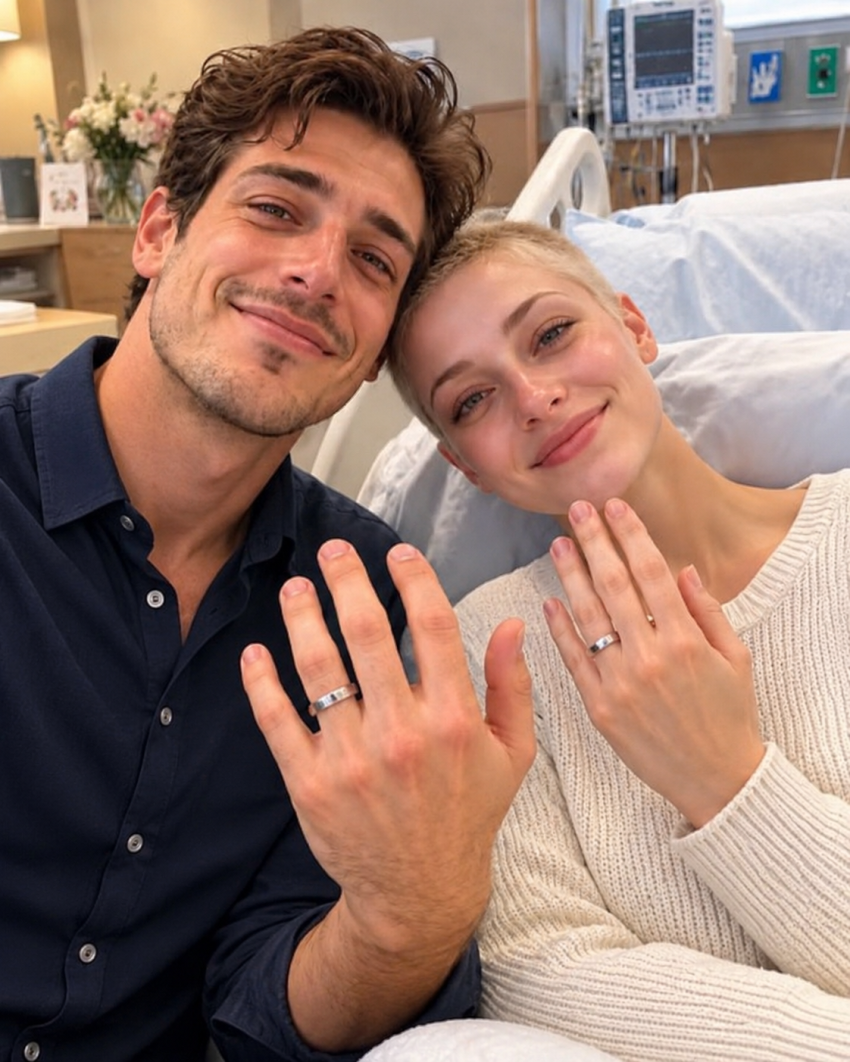
I thought marrying my dying patient was an act of kindness. After her funeral, her sister handed me a box with my name on it — and before I had finished reading what was inside, I was forced to defend myself against an accusation that could end my career.
My name is Luke Harrison. I was thirty years old, with a medical degree, a white coat, and student loan payments that still made my stomach tighten every month.
Becoming a doctor was all I had ever wanted.
My parents couldn’t help much with tuition, so I had studied all week and worked weekends, all the way through medical school. By the time I met Alyssa, I thought the hardest part was finally behind me.
She was eighteen, and she was the funniest person on the oncology floor.
Even exhausted from treatment, she could make a nurse laugh while changing her bedding.
“Doctor Luke, you know smiling is free, right?” she would say.
In six weeks, she had become the patient every nurse asked about on their break. She remembered the names of their children. She rated the hospital food out of ten and announced the scores like a judge on a cooking show. She once made the night nurse laugh so hard during a bed change that they had to stop, set everything down, and start over.
She did all of this while her own body was failing her, treatment by treatment.
I had known her for six weeks when she caught me checking a loan reminder on my phone.
“I worked weekends through medical school,” I admitted. “I’m still paying for it.”
“They should give you a refund for that handwriting,” she said.
It was a small conversation. She asked about my life the way she asked about everyone’s — like she intended to use every day she had left collecting people.
Neither of us knew, that afternoon, that she had just learned something about me she would carry into the decision she made at the end of her life.
I wish, sometimes, that I could go back and be more careful with that moment. Not because of what she did with it. Because of how much of my future she was quietly able to build out of one honest answer.
On a Tuesday, the attending physician told her family that she likely had about three days left.
I had no new treatment to offer her, and I dreaded seeing her look to me for one.
That was when Alyssa made her request.
She wanted to get married.
I thought she was joking. She smiled weakly.
“Come on. I don’t want to show up in heaven as an unmarried woman.”
“You’re not who I’d choose if I were marrying for love, doc,” she added, glancing at a nurse walking past and blushing, then turning back to me. “But I have my reasons.”
“Which are?”
“Because you listen. Even when what I want sounds silly. I want one big thing that I get to choose.”
Then she asked the question I could not answer.
“Why does having less time make my wish less worth thinking about?”
I couldn’t find a way to refuse without watching her face fall.
Instead, I pictured giving her one happy afternoon after weeks of disappointing news.
I arranged for another physician to take over her care, so that I would no longer be her doctor.
But I never asked Dr. Simmons, my supervisor, whether I should go ahead.
That failure — the question I never asked — would follow me for a long time.
We married the next day in her hospital room.
A nurse braided thin strips of clean bandage into two rings.
Alyssa wore a white scarf over her bald head, like a veil.
She smiled through the entire ceremony.
Her sister Megan fixed the scarf twice, then squeezed my hand.
“Thank you,” she said. “You gave her something. I mean it.”
The next morning I did my rounds on another floor, with another doctor’s patients, and tried not to count the hours. Alyssa asked after me once, the nurse told me later, and accepted the explanation with a grace I had not earned.
“This is what I wanted,” she said. “Let him be a doctor again.”
Alyssa passed away days later, peacefully, with her family around her — exactly as herself, on her own terms, a married woman by her own choice.
At the funeral, I stood behind the people who had loved her for her whole life, unsure where I belonged.
Afterward, I was beside my car when Megan hurried over carrying a small sealed box.
“She asked me to give you this only after she was gone,” she said.
My name was written across the lid in Alyssa’s handwriting.
PART 2
I opened the box with Megan standing beside me.
The first thing inside was a letter from a lawyer.
Alyssa had left me her share of an inheritance from her grandmother.
The amount would clear every loan I owed. Every single one.
I checked the figure against my name again and again, certain that one of them had to be wrong.
“I didn’t know,” I said. “I swear to you, I had no idea.”
“I did,” Megan said, and her voice cracked. She had known about the inheritance. She had known what Alyssa intended.
Then she leaned over my shoulder, looked at the letter again, and her face turned red.
“And now I can see what you got out of it,” she said sharply.
Megan backed away and pointed at me. “I’m reporting you to the hospital.”
I stayed beside the car with the box open in my hands.
If the hospital believed I had married a patient for her money, I could lose my job, my license, everything I had worked for since I was a teenager.
I put the lid back on before I did anything else.
That night, alone at home, I entered the amount into my loan calculator.
I sat looking at the zero it produced, imagining taking my parents out to dinner without checking what I would have left afterward. Imagining a life without that monthly weight.
Then I closed the laptop.
I needed to refuse the money while I could still make myself do it.
The next morning, I called the lawyer and told him I wanted to formally refuse the inheritance.
“Yes,” I said, looking at the loan reminder still sitting on my screen. “Send me whatever I need to sign.”
Saying no meant years more of those payments. But my dream job was at risk now, and I needed to save it — and more than that, I needed to be able to say that I had never taken a cent.
I went to Megan and told her I had refused the money, that she did not need to file a complaint.
“Refusing it now proves nothing,” she said. “You got caught.”
“Grandma talked about that money like it was our whole future,” she said. “I buried my sister on Saturday. And now there’s a letter naming you.”
I could not make her believe I had known nothing about it.
I dressed for my shift and drove to the hospital.
Dr. Simmons was waiting outside the ward when I arrived.
“Your patients have been reassigned,” she said. “I need your badge.”
I handed it over.
“You married an eighteen-year-old patient, and now you stand to inherit her money,” she said, clenching her jaw. “What on earth were you thinking?”
“Marrying a patient crosses a professional boundary,” she continued. “Transferring her care didn’t erase that.”
“That’s what the review will have to determine.”
At home that evening, I finally unfolded Alyssa’s own note, the one she had placed beneath the lawyer’s letter.
Grandma had left each sister money for school and a fresh start, she wrote.
You told me you worked your way through school. Everyone calls you lucky to be a doctor. I don’t think they know what it cost.
I felt seen in a way I had not felt in a very long time.
Megan still has her half, Alyssa wrote. I can’t use mine for the life Grandma wanted me to have. Maybe it can give you some of yours back.
The wedding was something I wanted. This is something I want to give you. You deserve to have a good life, doc.
I read that note three times.
Then I folded it carefully and put it somewhere safe — where it would stay private, whatever happened to me.
PART 3
My parents invited me to dinner that night.
Mom put rice on my plate, and for a few minutes I let myself feel looked after, the way I had as a boy.
Then Mom set down her fork. “Who was this girl, Luke? Why risk everything for her?”
I told them about Alyssa. But when I mentioned her age, their faces dropped.
“Eighteen!?” Dad shouted. “Why would you marry an eighteen-year-old patient?”
I explained the prognosis, her wish, the complete absence of romance.
Dad waited until I stopped. “But why did you say yes?”
“Don’t make it sound weird,” I said. “It wasn’t like that.”
“That doesn’t answer the question,” Mom said quietly.
“Because there wasn’t anything else I could do for her.”
“Oh, Luke.” Mom’s voice softened. “That doesn’t mean marrying her was the solution.”
They knew me. Neither of them believed I had chased her money.
But neither of them believed that made the marriage right.
Dad finally asked, “Do you need money while this plays out?”
I held on to the table, relieved that their love hadn’t changed.
At home, I began writing the account the hospital had requested.
I typed that Alyssa had insisted, then stopped. Explaining my decision without hiding behind her wish took most of the night.
I sent it before I could soften it again.
Later that week, Megan posted the wedding photograph online.
There I was in my tie, beside Alyssa in her white scarf.
“This doctor exploited my dying sister to obtain an inheritance,” she wrote.
The post began to spread.
“Why would you do this?” I asked her. “The review isn’t finished.”
“Because I think the hospital will protect you,” she said. “They’ll quietly bury it.”
At home, I started typing everything I could remember that might make them understand.
I opened the box. I picked up Alyssa’s note. I nearly photographed it to attach to my reply.
Then I stopped.
She had trusted me to listen. Now I was searching her private words for something that would make people stop judging me.
And besides, the note couldn’t establish what I had known before the wedding.
I put the note away. Whatever it cost me, her words were hers.
A former professor who had once written me a recommendation asked whether the accusation was true. I drafted an answer, deleted it, and started again. There was no short version that was honest.
Dad offered me work at his shop. “The shop could use a hand,” he said. “If you want some work.”
He did not pretend it was charity, and I did not pretend I didn’t need it.
“I know what you are,” he told me. “I’m offering you a way to pay your bills. That’s all.”
On Monday, I unpacked stock behind his counter.
When a customer asked if I was his son, I braced for a question about the photograph.
She asked where we kept the lightbulbs. I was relieved enough to almost laugh.
At lunch, Dad handed me a sandwich and left me alone with my phone.
The weeks of the review were the longest of my life. I had spent ten years building one single thing — the right to walk onto that ward and be trusted with sick people — and now I waited in my father’s shop, pricing batteries and lightbulbs, while strangers on the internet decided what kind of man I was from one photograph.
Some nights I rehearsed quitting before they could fire me. It would have been a cleaner story, at least: the doctor who fell on his sword. But my written account was already sent, and it was honest, and some stubborn part of me believed an honest account deserved to be waited out.
Other nights I thought about Alyssa’s empty bed on the oncology floor, already given to someone new, and I understood something uncomfortable: the review was never really about whether I was a good person. It was about whether a hospital could trust my judgment at the exact moment my feelings were loudest.
That was the question I had failed to ask Dr. Simmons, the morning of the wedding. It turned out to be the only question that mattered.
I had signed the refusal papers. I had sent my account of the marriage to the hospital.
But Megan’s public accusation was still spreading, and the people sharing it didn’t know she had helped with the wedding. They didn’t know she had never once said she could prove I had expected money.
Then Megan contacted me again.
She said she wanted Alyssa’s scarf and the bandage ring returned. She had put them in the box herself after the funeral, and now she wanted them back with the family’s things.
“I’ll bring them,” I said. “I also need you to tell the hospital what you actually witnessed.”
I gathered the keepsakes, and copies of the lawyer’s notice and my signed refusal.
In her kitchen, I placed the small box between us and opened it so she could see the scarf and the ring.
She touched the white fabric, then closed the lid.
“I’m not apologizing,” she said. “I had every right to complain.”
“You did,” I said. “I was her doctor. I was responsible for my decision. Her asking didn’t change that.”
“So you admit it. You took advantage of her.”
“I should have refused the marriage,” I said. “But I didn’t marry her for money.”
She read the lawyer’s notice, then the refusal, checking the dates.
“This doesn’t prove you didn’t know.”
“No,” I said. “It shows when I was formally notified, and what I did afterward. You can tell them that. You can also tell them what you knew about the wedding when you helped with it. You knew it wasn’t a romance. You helped with the ceremony. And you don’t know that I expected money.”
“People will think I’m taking your side.”
“You can keep your concerns in the statement.”
“And you can get out.” Her voice broke. “I thought I was giving her something good. But you…”
I looked at the box beneath her hand. I remembered how carefully she had fixed the scarf, twice.
For a moment, I wanted to tell her we had both done the right thing. It would have been easier. And then I could ask for her help afterward.
But I had spent too many nights trying to make that answer fit.
“I thought I was helping too,” I said. “I still made a decision I shouldn’t have made.”
“And if they let you go back?” Megan asked. “What happens when someone else asks you for something you shouldn’t give?”
I started to promise I would never make that mistake again — another reassurance, offered because I wanted her to feel better.
Instead, I told her the truth.
“I’ll ask for help before I answer.”
Megan picked up her phone, then put it down again.
“What you did was wrong,” she said. “And I’m not deleting the complaint.”
Then she opened an email to the person handling the review, and began typing.
She could send it, and I could still lose my job. She knew that. I knew that.
She described helping with a wedding she had understood to be nonromantic. She said she had no direct knowledge that I had expected an inheritance. And she kept her concerns about the marriage, all of them.
When she showed me the screen, I read it twice.
It wasn’t an endorsement. I thanked her, and she sent it.
Then she added a correction to her public post. Her thumb hovered for a long moment before she published it.
At the door, she was already opening the box again, touching the scarf.
The review took time.
Megan’s statement was considered alongside my account and the other evidence.
In the end, they found no evidence of calculated financial exploitation.
They also found that I had exercised poor professional judgment.
I could return to work — but with a formal reprimand on my record, mandatory training on professional boundaries, and a period of supervised clinical work.
I read the conditions at my parents’ table.
The refusal paperwork was complete, too. No inheritance money for me. Alyssa may have gifted it with the best of intentions, but I couldn’t keep it.
I still owed my loans, and I would be working Saturdays at Dad’s shop until I caught up.
On my first morning back, I waited outside the ward while Dr. Simmons confirmed the new arrangements.
My hand shook as I held my new badge to the reader.
She looked at me for a moment, and her frown softened by half a degree.
“No more weddings, Luke,” she said.
“No more weddings,” I agreed.
I thought marrying my dying patient was a kindness I could give her, the one big thing she got to choose.
What I learned is that a kind intention does not erase a boundary — and that the most dangerous decisions of my life will not arrive looking dangerous. They will arrive looking like compassion.
Alyssa got her one happy afternoon. I will carry the lesson for the rest of my career.
And on the hard Saturdays, stacking shelves in my father’s shop, I pay my loans the slow way — the same way I earned the degree in the first place.
That, I have decided, is not a punishment.
That is the price of a good life, paid honestly.