I slept in my father’s old room that night, on the narrow bed with the plaid blanket, and I did not sleep at all.
Ethan had gone home to our house across town. “You should be with family,” he’d said, in the voice he used when he wanted something to sound generous. I let him believe it was grief that wanted me there. It was arithmetic. Dad’s old blue truck was in the driveway, and in the glove compartment, wrapped in a shop rag, lay the phone I had carried since the day he handed it to me.
I took it out around two in the morning. It was a battered gray flip phone, the kind with buttons worn smooth. The battery light blinked red. I plugged it into the charger Dad kept on his workbench, and I sat on the shop stool, in the smell of motor oil and cold metal, and waited for it to wake.
It didn’t need to. I knew what was on it. I had never listened to it. He’d asked me not to.
“Not yet, Lydia,” he’d said. “Let Martin play it when it’s time. You’ll want to hear it with people in the room.”
I hadn’t understood what he meant. I understood now.
I should tell you who I am, because for three years I’d been mostly a pair of hands in a blue truck.
My name is Lydia Brandt, though on paper I’ve been Lydia Whitaker since I married Ethan. I’m thirty-six. My father, George Brandt, ran Brandt Auto & Diesel on Route 9 for forty-one years. Two bays, a gravel lot, a hand-painted sign. He fixed school buses for the county, delivery vans for the bakery, and, on slow days, the neighbors’ lawn mowers for free. My mother died when I was eleven, and from then on it was the two of us, and the shop.
I did his books at the kitchen table from the age of fifteen. By twenty-five I understood depreciation, liens, and tax deferral better than most accountants in town. Dad used to say, “Numbers don’t lie, Lydia. People do. So watch the numbers.”
I met Ethan at a friend’s wedding. He was handsome in the polished way of men who sell things, a regional manager at a financial services firm, all easy laughter and expensive loafers. He asked about my work and actually listened. I was thirty-two, and tired of being the girl who smelled like the shop.
Dad shook his hand at our first dinner, held it a beat too long, and said nothing. Afterward, washing dishes, he said only, “He looks at the walls.”
“What?”
“When he comes into a room. He looks at the walls. The ceiling. What it’s worth.” He shrugged. “Probably nothing. Old mechanic’s habit.”
I laughed. I married Ethan eight months later.
Three years is long enough to learn a family.
Marjorie Whitaker was a widow of sixty-eight with silver hair set weekly and a gift for the small cruelty. “Lydia, dear, you work so hard. It’s a shame it shows.” At Thanksgiving, she introduced me as “Ethan’s wife, the one with the garage.” She had never once visited the shop. She called it “that place.”
Ethan’s younger brother, Dean, owned a restaurant downtown called Harvest Table, which had been failing in slow motion since before I met them. A loan of three hundred and forty thousand dollars hung over it. Marjorie’s own credit cards carried another hundred and ten. None of it was ever spoken of directly. It floated through conversations like smoke, a sigh at dinner, a pointed remark about “families helping families.”
Ethan changed gradually. He started asking questions. How was the shop doing? Did Dad own the land outright? What was it worth, roughly? I answered, because I didn’t know any better, because I was his wife, because he said, “I’m just trying to understand your world, babe.”
In the second year, he suggested I put his name on the shop’s business account “to simplify things.”
I said I’d think about it.
I told Dad that night. He set down his coffee and said, very quietly, “Don’t.”
“Dad, he’s my husband.”
“He’s a man who looks at walls.” He rubbed his eyes. “Lydia. Promise me. Nothing in your name goes into his without Martin Shaw looking at it first.”
I promised. It was the easiest promise I ever kept, and the most important.
Dad got sick in the spring. Cardiac, and then, as these things go, everything else. Fourteen weeks from diagnosis to the hospice bed in the front room of his own house.
Two months before the end, on a good afternoon, he asked me to sit at the kitchen table.
“I need every statement,” he said. “Bank, brokerage, deeds, the shop’s lease, the security files from the safe. Everything with a number on it. Put it in a box.”
“Dad, what’s this for?”
“Sorting things out.” He smiled the crooked smile I loved. “You’ll see.”
I gathered it all. It took me a week. When I brought him the box, he went through it slowly, sheet by sheet, with his reading glasses sliding down his nose. Some pages made him nod. Some made him sigh.
Then he reached into the pocket of his flannel shirt and took out the gray phone. He folded my fingers around it.
“If I’m gone before I finish,” he said, “give this to Martin Shaw. Not your husband. Not his mother. Martin.”
“What’s on it?”
“The truth, said out loud.” He patted my hand. “Don’t listen to it alone. It’ll only make you sad. Wait until the right room.”
I didn’t ask what he meant. I think I was afraid of the answer.
He died on a Thursday in October, at dawn, with the window open and a mockingbird going in the yard. I was holding his hand. It was warm for a long time after.
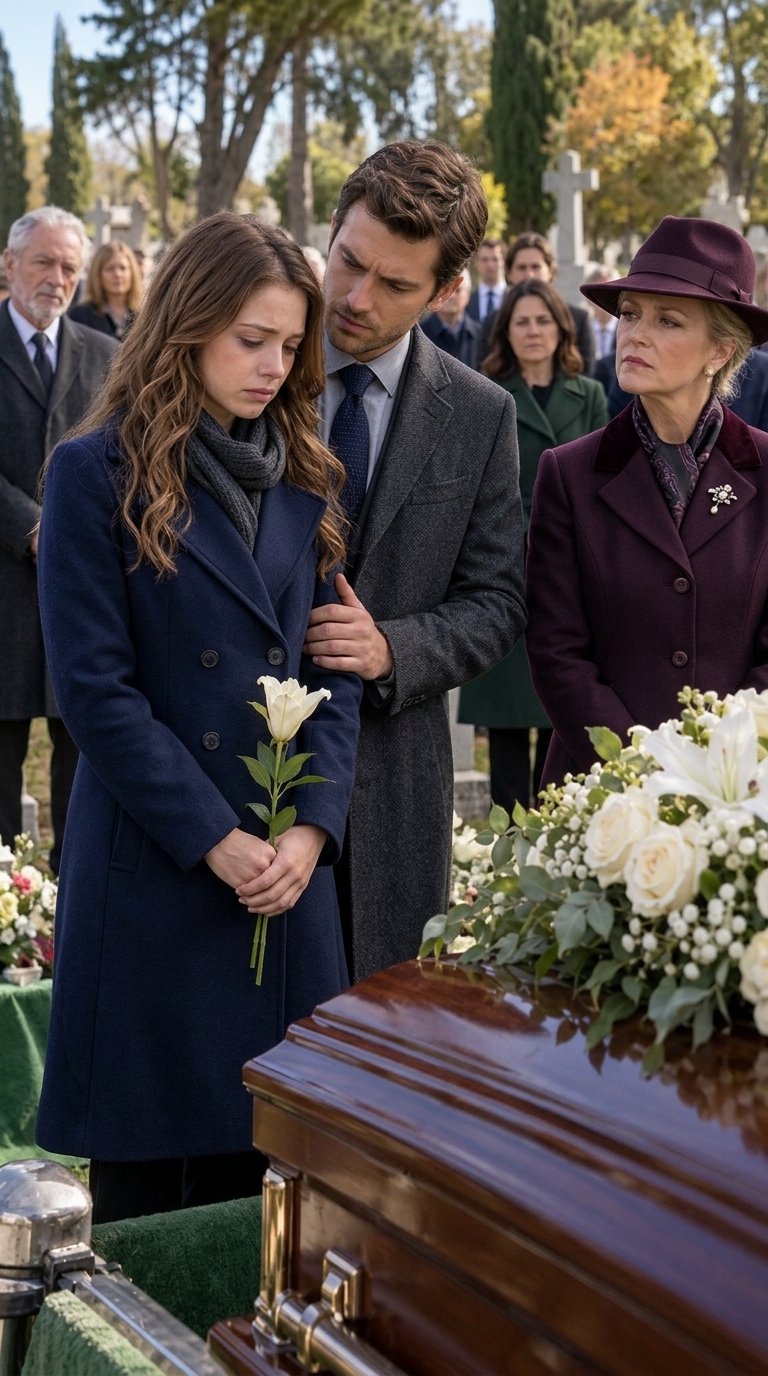
You know the funeral. The cold gray sky. The casket, plain oak, which Dad had picked out himself. Ethan’s whisper at the graveside: At least your inheritance can finally solve some of this family’s problems.
Something in me went still. Not numb. Still, the way a lake goes still before the ice forms.
And you know Marjorie, with her dry-eyed sobbing and her bracelet, accepting condolences like a bride at a reception. I heard her tell Pastor Reyes, in a low confiding tone, that “George would have wanted the estate put to good use.” I heard her tell a neighbor about the colonial on Linden Drive. White columns. Black shutters. A sunroom, “perfect for healing.”
I’d seen the listing on Ethan’s laptop the night before, open on the kitchen table. Six hundred thousand, four bedrooms, a three-car garage. A note beside it in his handwriting: M. wants by Dec. Closing cost est. 18k.
He hadn’t even closed the tab.
At the luncheon, Ethan’s hand clamped my wrist under the table. “Whatever comes to you comes to us,” he murmured, still smiling for the room.
And Marjorie, from behind my shoulder, in her cloud of roses: “Let Ethan handle the financial matters until you’re feeling more like yourself.”
I looked at the hand on my wrist. I looked at the pearl earrings on his mother. I thought of Dad on his stool, saying He looks at the walls.
I pulled my wrist free. I folded my napkin. I said, “I’ll be there at ten.”
Ethan smiled. He thought I’d surrendered.
That was his first mistake.
I called Martin Shaw at six in the morning, from the shop, with the phone in my other hand.
He answered on the second ring. “Lydia.”
“I have Dad’s phone.”
A long breath. “Good. Bring it to the office at nine-thirty. Come to the back door. I’ll have Denise let you in.”
“What’s on it?”
“I haven’t heard it.” His voice was gentle. “He recorded it himself, over three weeks, with my guidance on what to say. He wouldn’t let me listen. He wanted it fresh when the time came.”
“Martin, am I going to regret this?”
He considered. Martin Shaw is seventy, with a courtly manner and a bow tie for every day of the week, and in thirty years of practice, he has never once given an easy answer.
“I think you’re going to feel a great many things,” he said. “Regret may be among them. But I don’t believe it will be the largest.”
The law office occupied the second floor of an old brick building on Main Street, above a florist. Dark wood, green leather chairs, the smell of lemon polish and paper. A long conference table, with a pitcher of water and a box of tissues placed, I noticed, at each seat.
I arrived at 9:35 and sat in Martin’s private office while the others gathered. Through the glass, I watched them come in.
Ethan, in the charcoal suit he wore to closings. Marjorie, in navy, with a fresh blowout and a leather portfolio she clearly believed made her look official. Dean, Ethan’s brother, rumpled, unshaven, with the haunted eyes of a man whose restaurant had missed another payment. And, to my surprise, a woman I didn’t know, in a gray pantsuit, with a briefcase.
“Who’s that?” I asked.
“Ms. Pruitt. Mrs. Whitaker’s attorney.” Martin straightened his bow tie. “She called last night. She was most insistent on attending.”
“Marjorie hired a lawyer?”
“To protect her interests.”
“What interests?”
Martin’s mouth twitched. “That,” he said, “is rather the point.”
He called the meeting to order at ten.
I sat at the end of the table, across from Ethan, with Martin at the head. Ethan reached over, as if for a handshake, and squeezed my hand. “You okay, babe?”
“I’m fine.”
“Just let Martin read it. Don’t say anything. It’ll go faster.”
“Of course.”
He smiled. He thought he was shepherding me.
Martin cleared his throat. He opened a thick folder and, with the precision of a man laying a table, set out three items: a sealed will, a stack of financial statements, and, beside them, a small gray flip phone, which he placed squarely in the center of the polished wood.
Marjorie’s eyes flicked to it. “What’s that?”
“A supplementary item, Mrs. Whitaker. Mr. Brandt’s instruction was that it be played after the formal reading of the will. However.” He glanced at me. I nodded, very slightly. “He also instructed that it be played before any party signed any document or made any claim. So I’ll begin with it.”
“Now, wait,” said Ms. Pruitt, half-rising. “My client wasn’t informed of any, ”
“Your client is not a beneficiary under the will,” Martin said pleasantly. “She is present as a courtesy. I’m quite willing to ask her to wait in the hall.”
Marjorie put a hand on Ms. Pruitt’s sleeve. “Let him play it. It’s an old man’s ramblings. It can’t hurt.”
Dean, at the far end, rubbed his face. Ethan leaned back in his chair, one ankle across his knee, the picture of ease.
Martin pressed a button.
Static first. A faint hiss, the sound of a room with a window open.
Then a cough. A chair creaking. And my father’s voice, thin and rasping, but unmistakable, with that dry humor under it like a stone beneath a stream.
“Well. If you’re hearing this, I’m dead, and Lydia finally listened to her old man. Good girl.”
I put my hand over my mouth.
I hadn’t known how much I’d needed to hear him say it.
“I’m going to say some things. I’d like everyone to stay seated.”
Ethan’s smile held.
“First: Lydia, I love you. You’ve been the best part of my life since the day your mother put you in my arms. Everything I’m about to say, I’m saying to protect you. Not to punish anyone.”
Marjorie shifted. Ms. Pruitt took out a pen.
“Now. Ethan.”
Ethan’s ankle stopped swinging.
“I want you to know that I’ve been watching you for three years. I’m a mechanic. I notice when something’s making a noise it shouldn’t.”
A pause. A cough. A long, slow breath.
“On March the ninth, in my own shop, I heard you on the phone with your mother. You didn’t know I was in the back office. I’ll repeat what you said, since I wrote it down.”
Six seconds. That’s how long it took.
“You said, ‘Mom, I’m working on it. The old man’s land is worth at least eight hundred, and Lydia doesn’t know a thing about it. Once he’s gone, I’ll get her to sign it over. She’s too soft to say no.’”
Ethan was on his feet.
His chair crashed back against the wall. His face had gone the color of old paper. “Turn that off!”
Nobody moved.
Martin, very calmly, did not touch the phone. He folded his hands.
“Mr. Whitaker. Please sit down.”
“This is, this is a violation, this is an illegal recording, he, he can’t, ”
“It’s a recording made by the speaker of his own words, regarding a conversation he overheard on his own property.” Martin’s voice was soft. “I think you’ll find the law has a good deal to say about that. But I’d invite you to let it finish.”
“Ethan,” said Marjorie sharply. “Sit.”
“Mom, he’s, ”
“I said sit.”
He sat. His hands were shaking. I’d never seen them shake.
Dad’s voice resumed, patient, unhurried, as if nothing had happened.
“I also heard what your mother said back. ‘Good. And don’t let her near a lawyer. Those people put ideas in their heads.’”
Marjorie’s face did something complicated. Her mouth opened, shut. Ms. Pruitt lifted her eyes from her notepad, slowly, and looked at her client.
“I’m not a vindictive man. I want that on the record. But I’m a careful one. So I did what a careful man does. I went to Martin. And I made some arrangements.”
I want to tell you what those arrangements were, because they’re the heart of it, and because I didn’t know them myself until that morning.
Martin turned the pages of the folder as the recording played, laying out documents in a neat row.
The first was a deed.
Dad owned the land under Brandt Auto & Diesel, two and a half acres on Route 9, outright, no mortgage. Ethan had guessed eight hundred thousand. The truth was higher. A commercial developer had made Dad an offer in 2022 for one point four million, which he’d refused.
But in the last year of his life, Dad had transferred the land, and the building, and the business, into an irrevocable trust. The trustee was Martin Shaw. The sole beneficiary was Lydia Brandt, not Lydia Whitaker, specifically, by maiden name, with a provision that the property was to be held “for her sole and separate benefit, free of any claim by any spouse, present or future.”
“It’s called a spendthrift trust,” Dad’s voice explained, with evident satisfaction. “Lawyer words. What it means is, nobody can touch it unless Lydia says so, and even then, only a little at a time. Not a husband. Not a husband’s mother. Not a husband’s brother’s restaurant.”
At the far end of the table, Dean made a small, strangled sound.
“Now, the money,” said Dad.
Martin laid out a second set of papers. Brokerage statements. A savings account. A life insurance policy, which Dad had carried quietly for thirty years.
Total liquid assets: just over nine hundred thousand dollars.
“It’s all in the same trust. Lydia will receive it in installments. A third at thirty-seven, which is next year. A third at forty. The rest at forty-five. Martin will manage it until then. If she wants to buy a house, or start a business, or travel to Portugal, she can ask, and Martin will say yes.”
A dry chuckle.
“I’m not tying her hands. I’m just putting a lock on the door. She holds the key.”
Marjorie’s face had gone slack.
“That’s, that’s absurd,” she whispered. “Ethan, tell him, ”
“I’m not finished,”* Dad’s voice said, as if he’d heard her.
I felt the hair rise on my arms.
“There’s one more thing. I don’t like to say it. But I’d be a poor father if I didn’t.”
The recording paused. In the silence, I could hear a clock ticking in the background, and the distant, gentle sound of the mockingbird.
“Lydia. Honey. If you’re sitting in that room, and your husband is jumping out of his chair, I’m sorry. I really am. I hoped I was wrong about him. I wanted so badly to be wrong.”
My eyes filled.
“But I’d rather you hear it from me, from the grave, than find out in two years when the money’s gone.”
Then Martin did something I hadn’t expected. He took a second device from his folder, a small digital recorder, and set it beside the phone.
“Mr. Brandt left this as well,” he said. “He instructed me to play it only if the first recording produced, quote, ‘a certain kind of reaction.’”
“What does that mean?” Ethan’s voice cracked.
“I believe,” said Martin, “he anticipated that you might try to stop it.”
He pressed play.
Another voice this time. A man’s. Young, confident, unmistakable.
“Mom. Mom, listen. I’ve got it handled. I just need her to sign a quitclaim before the will’s read. If I get the deed in my name, or at least a joint tenancy, the trust can’t touch it.”
Ethan’s voice.
My husband’s voice, recorded, I realized with a cold sinking, not by Dad, but through a phone left on in the back office of the shop.
“And if she refuses?” Marjorie’s voice, smooth as silk.
“She won’t. She’s grieving. She’ll do anything I ask. I just need to keep her emotional until it’s done.”
“What about the will?”
“I’ll have Pruitt look at it. We’ll contest it, if we have to. Undue influence. The old man was medicated at the end, right? Heart drugs, pain meds? It’s practically textbook.”
“And the house on Linden?”
“Closing’s in December. Don’t worry. By then, it’ll be ours.”
The recording ended.
The silence in the room was so complete I could hear Dean breathing.
Ms. Pruitt closed her notepad.
She did it slowly, deliberately, the way a woman closes a door behind her. Then she turned to Marjorie, and in a voice stripped of all courtesy, she said:
“Mrs. Whitaker. I was told this was a straightforward estate matter.”
“It is, it’s, ”
“I was not told you’d discussed contesting the will on grounds of undue influence on a recording.” She stood. She took up her briefcase. “I represent clients, not conspiracies. I’ll be withdrawing from this matter. You may expect a letter.”
“You can’t just, ”
“I can. I have.” She nodded at Martin. “Mr. Shaw. My apologies for the intrusion.”
“Not at all, Ms. Pruitt.”
She walked out. The door closed. A faint scent of lavender lingered where she’d stood.
Marjorie sat very straight in her navy suit, hands clutching the leather portfolio, her lips pressed so tightly they’d gone white. For the first time in the three years I’d known her, she had nothing to say.
Ethan turned to me.
I’d been waiting for it. I’d been watching his face since the first recording, watching it move through the stages, rage, panic, calculation, and now, finally, the last one. The one I’d seen only once, years ago, when he’d lost a promotion and thought no one was looking.
Pleading.
“Lydia.” His voice was low, urgent, tender, the voice of a man holding a very fragile thing. “Babe. Listen to me. You know I love you. This is all, he, your father, he was sick. He was confused. He misunderstood.”
“Did he?”
“I never said, I was just, I was venting. To my mother. It was stress, we have so much debt, and I was just, I was thinking out loud.”
“On March the ninth.”
“I don’t remember.”
“You said I was too soft to say no.”
“I, ”
“You said I didn’t know a thing.”
He swallowed. His eyes darted to Martin, to the phone, to the door. A cornered animal looks for exits. I had never seen it so clearly.
“Lydia, please. We can talk about this at home. Without everyone, ”
“I’ve heard enough talk,” I said.
My voice was quiet. It surprised me. It was my father’s voice, level and dry, like a stone under a stream.
“Ethan. I’m going to ask you one question. And I’d like you to answer it honestly, for once.”
He said nothing.
“The morning of the funeral. At the graveside. You leaned over and whispered, ‘At least your inheritance can finally solve some of this family’s problems.’ Do you remember?”
His mouth opened. Closed.
“I stood there,” I said, “next to my father’s coffin. And I thought, he doesn’t even wait. He doesn’t even wait until the dirt’s on.”
“Lydia, ”
“Did you love me? At all? In three years?”
He looked at me for a long moment. I watched the lie rise and fall behind his eyes.
“Of course I did,” he said.
But he said it a half-second too late. And I’d spent my whole life reading numbers.
I stood.
My legs felt strange, like they belonged to someone braver. I pushed back my chair and walked to the head of the table. Martin handed me a folder without a word.
“Thank you, Martin.”
“Of course.”
I turned to my husband, to his mother, to his brother, who was weeping quietly into his hand.
“I’m going to say this once. And then I’m going to leave.”
They watched me. Ethan’s face had gone gray.
“I’m filing for divorce. Martin has the papers. I’d have preferred to do this gently. But I think you’ve made gentleness impossible.”
“Lydia, please, ”
“The house we live in is in my name. I put the down payment in myself, from my savings, before we married. Martin has the records. You have thirty days to move out.”
Marjorie sucked in a breath. “You can’t throw my son out, ”
“Marjorie.” I looked at her. I did not raise my voice. “On the day of my father’s funeral, you told his friends that George would’ve wanted his estate put to good use. You’ve never once set foot in his shop. You called it ‘that place.’”
She went red.
“I’d like you to know that ‘that place’ fed a town. It fixed school buses, so children could get to class. It fixed ambulances, so people could get to the hospital. My father worked eighty hours a week for forty-one years. He never took a vacation. He never owned a boat.”
My voice cracked, finally, on the last word.
“You’ll never understand what that was worth. And I’m not going to spend my life explaining it.”
Marjorie said nothing. For once in her life, she looked her age.
I picked up Dad’s phone.
It felt warm in my hand, as if it had held its own small heartbeat. I looked at it for a long moment. The worn buttons. The cracked screen. A smear of grease on the casing, in the shape of a thumb.
“Dad,” I whispered. “Thank you.”
Then I put it in my coat pocket, and I walked out of the room.
Behind me, I heard Dean call, hoarsely, “Lydia, wait.”
I stopped in the doorway.
He’d stood up. His face was blotchy, his eyes red. He looked like a man who’d been hit by a truck and was still, somehow, on his feet.
“I didn’t know,” he said. “About, any of it. I swear. I knew Ethan wanted help with the restaurant. I didn’t know he was, that he’d, ”
“I believe you.”
“I’m so sorry about your dad.”
“Thank you.”
“The restaurant’s going to close.” He laughed shakily. “It was always going to. I think I knew. I was just, I was hoping someone would, that it would be fixed.”
I looked at him. A tired, rumpled, decent man, who’d walked into a nightmare he didn’t build.
“Dean,” I said. “Come see me in a month. After the dust settles. I’d like to talk about it.”
“About what?”
“About what a good bookkeeper can do for a restaurant. Before it’s too late.”
His mouth fell open.
“No promises,” I said. “But I know a little about numbers.”
The aftermath was not neat. They never are.
Ethan fought it for six weeks. He hired a new attorney, a slick man in a tailored suit, who filed a motion contesting the trust on grounds of undue influence. Martin responded with a thick binder of medical records, a letter from Dad’s physician certifying his clarity, and a transcript of both recordings, authenticated by a forensic audio specialist.
The motion was withdrawn eleven days later.
The divorce took four months. Ethan left the house on the twenty-ninth day, with two suitcases and a look of baffled rage. He didn’t say goodbye. I watched from the window as his car pulled out of the driveway, and I felt, to my surprise, nothing. Not triumph. Not grief. Just a vast, clean quiet, like a room after the furniture’s been moved out.
The colonial on Linden Drive sold to a young couple with twins. I heard they love the sunroom.
Marjorie sent me one letter, in January. Two lines on cream stationery. I hope you’re satisfied. I didn’t answer. I put it in the drawer where I keep the things I don’t need.
I kept the shop.
I hadn’t planned to. Martin had suggested, gently, that I might prefer to sell. The developer’s offer was still open, and I’d never have to work again.
I drove out to Route 9 on a Saturday in February, alone. The gravel lot was empty. The sign, BRANDT AUTO & DIESEL, hand-lettered by my father in 1983, hung crooked on its post. I unlocked the bay door, and the smell hit me, motor oil, cold metal, a ghost of Dad’s cigar, and I sat down on the stool and cried until I couldn’t see.
When I could breathe again, I looked around.
The tools still hung on their pegboard in the order he’d kept them. The calendar on the wall still showed March, torn off at the ninth. A coffee mug sat on the workbench, with a ring of dried residue at the bottom.
And I thought: I could sell this. I could walk away with a million and four.
Then I thought of the school buses. The ambulances. The neighbors’ lawn mowers, fixed for free.
I called Teddy Marsh, Dad’s longtime mechanic, who’d been keeping the lights on for six weeks out of loyalty and love.
“Teddy. How would you feel about running the place?”
A long pause. “Lydia, I’m not a manager.”
“I know. I’ll do the books. You do the wrenches. We’ll hire two more people. A kid from the vo-tech, maybe.”
“Are you sure?”
“I’ve never been surer.”
Teddy cleared his throat, thickly. “George would’ve loved that.”
“I know.”
“He’d have said you should paint the sign.”
“Over my dead body.”
We both laughed. And the shop, for the first time in months, felt warm.
It’s been two years.
Brandt Auto & Diesel is open six days a week. We’ve got four mechanics and two apprentices, one of whom, a nineteen-year-old named Marisol, is better with a diesel engine than anyone I’ve ever met. I do the books on Tuesdays and Thursdays, at Dad’s old desk, with his reading glasses still in the drawer. We’ve kept the hand-painted sign. I touch up the lettering every spring.
I got the first installment of the trust in November. I didn’t spend a cent of it on myself. I put a third into the shop, a new lift, a modern diagnostic scanner, a proper break room with a coffee machine that doesn’t taste like motor oil. I put another third into a scholarship at the vo-tech, in my father’s name, for kids who’d rather fix an engine than sit in a lecture hall.
The rest I left alone. I’m saving it, for what, I’m not sure. A house, maybe. A trip to Portugal. A child, someday, though I’m in no hurry.
Dean closed Harvest Table in March of that first year. He came to my office, as I’d asked, and we sat with a legal pad and a pot of terrible coffee. I helped him negotiate with the bank, restructure what was salvageable, and settle what wasn’t. It took eight months. He’s working as a line cook now, at a place downtown, and he’s good at it. He sends me a Christmas card every year, with a single line: Thank you for the numbers.
I’m told Ethan moved to Phoenix. I’m told he’s engaged. I hope, genuinely, that she reads the walls.
Last week, I went out to Dad’s grave.
It was a bright, cold afternoon, with a high wind. The stone is plain gray granite. George Brandt. 1951–2025. He fixed what was broken. I’d chosen the words myself.
I sat on the grass beside it with a thermos of coffee, and poured two cups, and set one on the stone.
“I listened to it again,” I said. “The recording. I play it sometimes, in the shop, when nobody’s around.”
The wind moved through the pines.
“I wasn’t sure, at first. I thought you’d been harsh. I thought maybe you’d been wrong about him. But you weren’t. You were right about everything.” I rubbed my eyes. “You always were.”
A sparrow hopped onto the granite and looked at me, head cocked.
“I want to ask you something. I’ve wanted to for two years.” I took a sip of coffee. “Why a recording? Why not just tell me? You could’ve sat me down at the kitchen table, and, ”
I stopped.
I knew the answer. I’d always known it.
Because you’d have defended him, I heard my father say, in the dry, gentle voice I’d never stop hearing. You’d have said, ‘Dad, you’re sick, you don’t understand.’ And I’d have lost, because you love people, Lydia. It’s your best quality, and it’s the one they’d use against you.
“I’d have defended him,” I said, aloud.
The wind stirred the grass.
“I was so afraid of being alone. So I let him put his hand on my wrist.” I laughed, shakily. “And you knew. You knew, and you didn’t say it, because you knew I couldn’t hear it. So you waited. And you made it so I could hear it from someone else. From him.”
A long silence. The sparrow flew off.
“That was the most loving thing anyone’s ever done for me,” I said.
I finished my coffee. I screwed the lid back on the thermos. And I laid my palm flat against the cold stone.
“The shop’s doing great, Dad. We landed the county bus contract again. Teddy says to tell you the Peterbilt’s finally running.”
I stood, and brushed off my knees.
“I’ve got your phone, you know. In my pocket. I still carry it.”
The wind carried my words across the quiet, windswept field.
“I never press play, though. I don’t need to. I know what it says.”
I smiled, and wiped my eyes, and walked back to the old blue truck. The engine caught on the first turn. It always does.
And as I pulled onto Route 9, headed for the shop, headed for a long afternoon of invoices and oil and honest work, I turned the radio up, and I sang along, badly, with the windows down, to a song my father used to hum.
Six seconds, that’s all it took. Six seconds of a dead man’s voice, to rearrange my whole life.
I’d spend the rest of it keeping the promise inside.