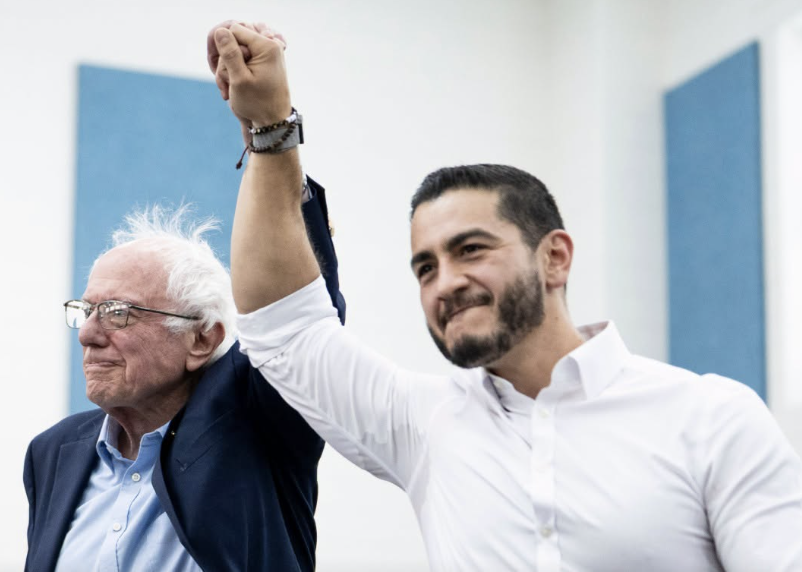
The financial contribution followed reports a day earlier that a leading pro-Israel lobbying organization intended to spend up to $9 million to prevent the Democratic Senate nominee from winning.
Senator Bernie Sanders responded swiftly on Wednesday after discovering that the American Israel Public Affairs Committee, the country’s most prominent pro-Israel lobbying group, was preparing to spend as much as $9 million against Dr. Abdul El-Sayed, the Democratic candidate in Michigan’s U.S. Senate contest. Frustrated by the development, Sanders immediately directed $1 million to El-Sayed’s campaign.
The Vermont senator and his political team then began contacting other potential contributors.
Their outreach targeted fellow progressives, whom they encouraged to provide financial support to offset AIPAC’s planned spending and strengthen El-Sayed’s campaign. A victory for El-Sayed would make him the first Muslim to serve in the United States Senate.
“What I have done today was not only put a million into Abdul’s campaign, but we are also reaching out to other individuals to try to raise money because this is just outrageous,” Sanders, an 85-year-old independent representing Vermont, explained during an interview.
By Wednesday evening, Sanders and his associates had secured commitments and pledges amounting to $300,000 from 12 other Democrats. Among those contributing were Senators Martin Heinrich of New Mexico, Tina Smith of Minnesota, Chris Van Hollen of Maryland and Jeff Merkley of Oregon, according to information shared by Sanders’ team.
“That’s nowhere near what AIPAC is doing,” Sanders acknowledged. “It’s nowhere near what other super PACs — billionaire-funded super PACs — are doing. But it is a way to stand with democracy and with Abdul’s campaign.”
Earlier in October, Sanders had already contributed $250,000 to the Abdul for Michigan Victory Fund, a joint fundraising initiative involving El-Sayed’s campaign, the Democratic Senatorial Campaign Committee and the Michigan Democratic State Central Committee. The longtime progressive entered October with approximately $22.4 million available in his campaign account, placing him among the best-funded sitting senators.

On Wednesday, The New York Times reported that AIPAC was taking the uncommon step of financially supporting a Republican candidate in a general election. The organization reportedly planned to direct as much as $9 million toward a super PAC backing former Representative Mike Rogers, the Republican nominee for Michigan’s Senate seat.
Rogers had indicated his willingness to accept the organization’s assistance during an Oct. 8 debate, declaring that he would “take all of that help.” AIPAC has not publicly addressed the reported financial commitment.
Sanders is not the only nationally recognized progressive politician to provide substantial financial assistance to El-Sayed this month. Representative Alexandria Ocasio-Cortez of New York also contributed $1 million while joining him on the campaign trail in Michigan last week, further increasing his campaign’s resources in a closely watched Senate contest.
The disagreement between Sanders and AIPAC is part of a longstanding dispute over the Democratic Party’s political direction. During the 2022 midterm election cycle, Sanders characterized the confrontation in an interview with The Times as “a war for the future of the Democratic Party.”
The organization’s public responses suggest that the antagonism extends in both directions.
On Thursday, Sanders published a social media message asserting that “AIPAC is why we’re at war in Iran.” The organization responded with a series of sarcastic remarks challenging his accusation.
“AIPAC is why your fantasy football team stinks,” the organization’s official account posted on X. “AIPAC is why the weather is bad. AIPAC is why you need an app to park. Say NO to Bernie’s obsessive scapegoating.”
Sanders objected to the organization’s characterization of his criticism.
“No, this is not Bernie Sanders’s obsessive scapegoating,” he responded. “This is a fact.”
Turning his attention to Israeli Prime Minister Benjamin Netanyahu, Sanders continued, “The fact is, the American people do not want to continue spending billions of dollars on Netanyahu’s extremist government.”
Meanwhile, El-Sayed sought additional assistance from progressive Democratic leaders after Wednesday’s report about AIPAC’s planned spending. He contacted Representative Pramila Jayapal of Washington, who chairs the Congressional Progressive Caucus, to discuss the financial challenges facing his campaign.
“Can you help?” El-Sayed asked during their conversation, according to Jayapal.
Jayapal said her leadership political action committee had previously provided $350,000 to support El-Sayed during the Democratic primary. She was now considering whether further contributions would be possible. She also urged retiring Democratic Senator Gary Peters, whose Michigan seat El-Sayed hopes to fill, to contribute financially to the party’s nominee.
“I think he’s got $7 or 8 million in his bank account — I’d love to see him come in with $1 million as well,” Jayapal said. “I think we need to see moderate and establishment Democrats be as committed to the party rallying around the nominee as they are when we get flak for progressives not rallying around a nominee.”
Peters’ office did not immediately provide a response when contacted for comment.