
During an address to an audience of Marines in September, Defense Secretary Pete Hegseth used a derogatory term while declaring that he was removing all transgender personnel from the United States military.
To carry out the policy, the Pentagon established review panels at military installations worldwide. These boards, composed of regular uniformed service members, received tightly defined instructions that appeared designed to make the discharge of transgender personnel appearing before them almost inevitable.
Yet at Marine Corps Base Quantico, only a short distance from the auditorium where Hegseth delivered his remarks, the panels responsible for implementing the policy were reaching different conclusions. Rather than recommending the removal of transgender Marines, they were voting to allow them to continue serving.
A similar development was unfolding within the Navy, where review boards operating under restrictive guidelines intended to facilitate dismissals were instead recommending that transgender sailors remain in uniform.
These outcomes were not isolated decisions by a handful of individuals. Across the Navy and Marine Corps, review panels have recommended retaining transgender service members in nine of the 12 cases considered.
The Pentagon has maintained strict confidentiality around the proceedings. Individuals outside the process, including the spouses of those appearing before the boards, cannot attend. Military officials have declined to disclose comprehensive statistics, while senior leaders have avoided discussing individual outcomes. The New York Times established the figures through conversations with service members and attorneys directly involved in the hearings.
The relatively small number of cases considered by Navy and Marine Corps panels means the figures could change significantly as additional hearings take place. Similar results have not emerged in the Army or Air Force, where review boards have recommended discharging transgender personnel in an overwhelming majority of cases.
Nevertheless, the decisions represent an unusual challenge within an institution built on obedience to orders and established chains of command. They also suggest that some of the military personnel whom the administration says its transgender service ban is intended to benefit are unwilling to support its implementation.
“These boards are being told to do something that they know is wrong — to rubber-stamp a non-choice given to them by the administration,” said Rachel VanLandingham, a former Air Force attorney and Southwestern Law School professor who has been monitoring the proceedings. “We are seeing them say they’re not going to play that game. We are seeing them nullify a process they see as unjust.”
The panels’ findings are recommendations rather than final determinations. Political appointees serving as secretaries of the individual military branches retain the authority to overturn them. Meanwhile, ongoing legal challenges could temporarily suspend the transgender service prohibition or result in its complete elimination.
The Trump administration maintains that transgender personnel, estimated to number approximately 4,250 and account for roughly 0.1 percent of the armed forces, impose financial and operational burdens that undermine military readiness. That position conflicts with findings from military assessments. During his first week in office, President Donald Trump signed an executive order barring transgender troops, arguing that the measure was necessary to remove individuals he characterized as dishonorable radicals who damage morale and consume military resources.
“For the sake of our Nation and the patriotic Americans who volunteer to serve it, military service must be reserved for those mentally and physically fit for duty,” the executive order stated.
The Defense Department subsequently introduced a policy offering financial incentives for transgender personnel who agreed to leave voluntarily. Hundreds of experienced and highly trained service members accepted the offer, including physicians, attorneys, aviators and nuclear specialists. Those who remained to contest their removal were left in prolonged uncertainty, in some instances for more than a year.
During that period, the administration created three-member separation panels to evaluate the remaining cases under a narrowly prescribed framework. The rules require discharge whenever evidence indicates that a service member has transgender feelings or tendencies, regardless of whether the individual has undergone a formal gender transition.
Each panel consists of three officers or enlisted service members temporarily assigned from their regular duties to consider an individual case, functioning in a manner comparable to jurors in a civilian proceeding. Under the established guidelines, they are not permitted to weigh an individual’s outstanding job performance, expertise in an essential military specialty or distinguished record of combat service.
Panel members receive a single-page findings form requiring them to select predetermined language indicating whether the individual shows evidence of being transgender. An affirmative determination is intended to establish that the person no longer meets military service requirements and should therefore be discharged.
That, however, is not always how the proceedings have unfolded.
Transgender sailors and Marines who appeared before the boards described experiences markedly different from what they had anticipated. After spending months hearing senior administration officials criticize transgender personnel, many expected their hearings to conclude with swift recommendations for dismissal. Instead, they encountered fellow service members who treated their cases seriously and respectfully before voting to preserve their military careers.
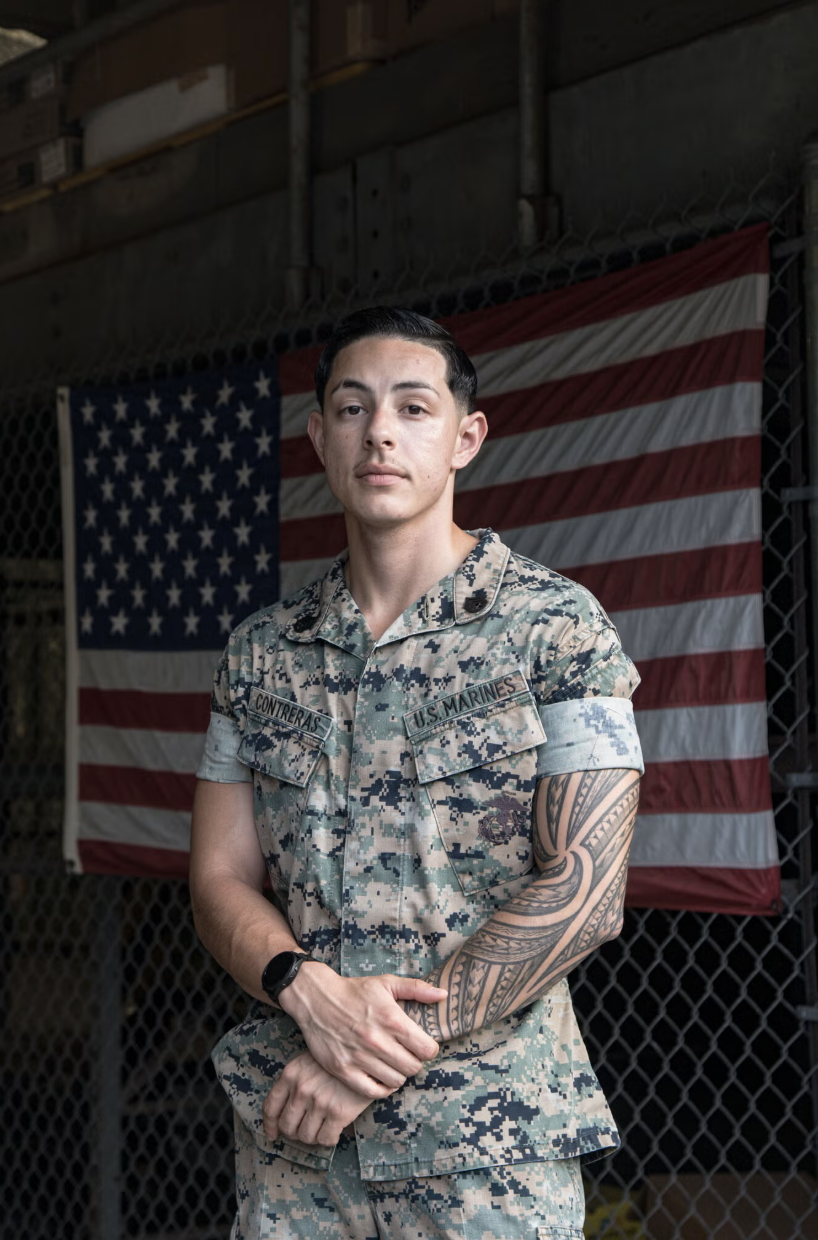
Marine Staff Sgt. Damien Contreras was among those who received an unexpected outcome. In April, the Marine Corps removed him from his regular assignment and placed him on paid leave while his discharge was pending. Toward the end of August, he was flown from his station in Hawaii to Marine Corps Base Quantico in Virginia to appear before a separation board.
Contreras entered the hearing looking downward, convinced that his years in uniform were about to end.
An attorney representing the government submitted records dating to 2017 that documented his gender transition.
The three panel members then examined his record as a supply and logistics specialist, which included a decade of service without disciplinary problems, three overseas deployments and consistently favorable performance evaluations.
After reviewing the material, the panel crossed out language on its findings form referring to “a history of cross sex hormone therapy.” Members instead selected “remains qualified” and recommended that Contreras continue serving in the Marine Corps.
“I was shocked at first, but when you come down to it, it makes sense,” Sergeant Contreras said during an interview from Hawaii, where he remains stationed. “You have war fighters looking at war fighters,” he explained. “They see I’ve always done my job, I’ve deployed, I’ve mentored other Marines, followed the rules. They say, ‘Hey, this is a good Marine, why wouldn’t we retain him?’”
Contreras is represented by Priya Rashid, an attorney who has handled dozens of cases involving transgender military personnel and has extensive firsthand knowledge of the review process. Although nearly all of her earliest cases ended in recommendations for discharge, she observed a pronounced change in outcomes during the summer. She has been unable to identify what caused the shift.
The Army began conducting separation hearings in February, making it the first military branch to implement the process. According to Rashid, approximately 50 cases have been reviewed, with panels recommending that soldiers be discharged in all but roughly five proceedings.
Air Force hearings began during the summer. Approximately six cases have been considered, and every outcome known so far has resulted in a recommendation for separation.
In contrast, the Navy and Marine Corps, which introduced their hearings in July, have recommended retaining transgender personnel in most of the cases brought before their panels.
“I don’t understand why this pattern is occurring,” Rashid said in an interview. “And I’m worried that if the pattern becomes too apparent, the government will just change the processes and procedures again so that the pattern can be extinguished.”
Rashid secured another favorable decision last week, this time involving an Army service member.
The hearings generally follow a similar procedure throughout the armed forces. Government attorneys first present medical information and supporting records indicating that the person under review is transgender. Defense attorneys then frequently spend several hours documenting their clients’ military careers, offering extensive collections of awards, evaluations and other records while calling witnesses to testify about their professionalism, achievements and character.
“It all made no difference,” said Maj. Kara Corcoran, an infantry officer with 18 years of military service and two deployments to Afghanistan. An Army panel recommended her discharge in May following proceedings she characterized as a “kangaroo court.”
“They cut off my character witnesses halfway through and said, ‘We get it, your service is commendable, that’s not what we’re here to decide,’” recalled Major Corcoran, who now leads the transgender advocacy organization SPARTA Pride. “The government lawyer, the board, they thought it was ridiculous, but I think they felt they had no choice.”
The Navy and Marine Corps have used largely identical hearing procedures, but the recommendations produced by their panels have differed considerably from those issued by the other branches.

Since Navy proceedings began in July, nine panels have considered cases involving transgender sailors. Seven recommended retaining the individuals under review, according to attorneys who participated in the hearings.
Marine Corps boards began convening in August and have examined three cases, recommending continued service in two. Although the third panel voted to discharge the Marine involved, its members included a written statement explaining that they unanimously believed he should “be retained based on his commendable service record and unique skills.”
The reasons behind these contrasting outcomes remain uncertain. Citing continuing litigation, representatives of the military branches declined to explain the decisions or arrange interviews with panel members. The Defense Department likewise refused to comment.
VanLandingham, the former military attorney, suggested that the recommendations might reflect increasing unease among service members who believe the Pentagon’s current leadership is concentrating on politically divisive cultural issues instead of the needs and welfare of military personnel.
She pointed to Hegseth’s September address to the Marines, during which he demanded “No fatties. No trannies. No beardos. No weirdos. No wimps. No radicals,” while making no reference to American service members who had been killed or injured during the conflict with Iran.
“There’s been a chipping away at any kind of confidence that Hegseth actually cares about service members,” VanLandingham said. “I think that’s given the boards license.”
Differences in institutional culture between military branches may also be influencing the results, she suggested. Although the instructions provided to the panels are nearly the same across the armed forces, the branches operate according to distinct traditions and organizational values. The Army is commonly viewed as the most bureaucratic branch and therefore less inclined to depart from established directives. The Navy has a reputation for greater diversity, while the Marine Corps places exceptional importance on loyalty among its members.
According to a 2015 study by the RAND Corporation, approximately 9 percent of Navy personnel identified as gay, bisexual or transgender, a proportion nearly twice as high as that reported in other military branches.
The significance of those personal connections became apparent during a Navy paramedic’s hearing in July, when his panel recommended allowing him to remain in service. The paramedic requested anonymity because he feared potential retaliation. He recalled being surprised when his attorney questioned the panel’s three members — a chief, a lieutenant commander and a commander — about whether they personally knew transgender sailors.
“They all said yes,” the paramedic recalled. “The chief said his liberty buddy in Thailand was transgender and was a phenomenal sailor. The lieutenant commander said her first work center supervisor was transgender, and she learned a lot from her. The commander said he’d worked with several transgender sailors, and he barbecues with his next-door neighbor, who’s trans.”
The paramedic also possessed a strong record of professional achievement. He had received two merit-based promotions recognizing outstanding performance, remained eligible for deployment throughout his five years in the Navy and helped save several patients’ lives while serving in emergency departments.
His most recent assignment placed him alongside Marines deployed to the southern U.S. border. Reflecting on his service, he said, “I never ran into people who cared if I was trans. They just cared that I did my job well.”
His attorney, Steph Kral, a former Air Force officer, subsequently represented another sailor before a separate review panel. Unlike the members of the first board, those hearing the second case reportedly had no personal relationships with transgender sailors. Nevertheless, they also recommended that the service member be retained.
“I don’t think they are trying to make any grand policy statement,” Kral explained. “I think they’re just trying to do what’s best for the Navy.”
The Marine Corps reports the smallest proportions of women, gay personnel and transgender service members among the military branches. Its identity is also closely connected to longstanding traditions emphasizing toughness and masculinity. At the same time, the organization is known for an exceptionally strong sense of solidarity among Marines, embodied in its motto, Semper Fidelis, meaning Always Faithful.
“The questions from the Marine boards have focused in on how the policies of higher-ups may have changed, but the Marines in question never did anything wrong,” Rashid explained. “I think they are looking for a way to give a fellow Marine the benefit of the doubt.”
When Contreras appeared before his Marine Corps panel, he submitted years of favorable performance reports along with letters from commanding officers and supervisors attesting to his abilities and dedication. Some of those officers had written their recommendations without knowing that he was transgender.
Following approximately three hours of deliberation, the panel members struck through the language concerning evidence of transgender status on the official findings form and recommended that Contreras remain in military service.
“It was very humbling to see the things that they had to say about me,” the sergeant reflected. “It had nothing to do with being transgender. I honestly don’t think they care about that. It was about how I was a great Marine.”