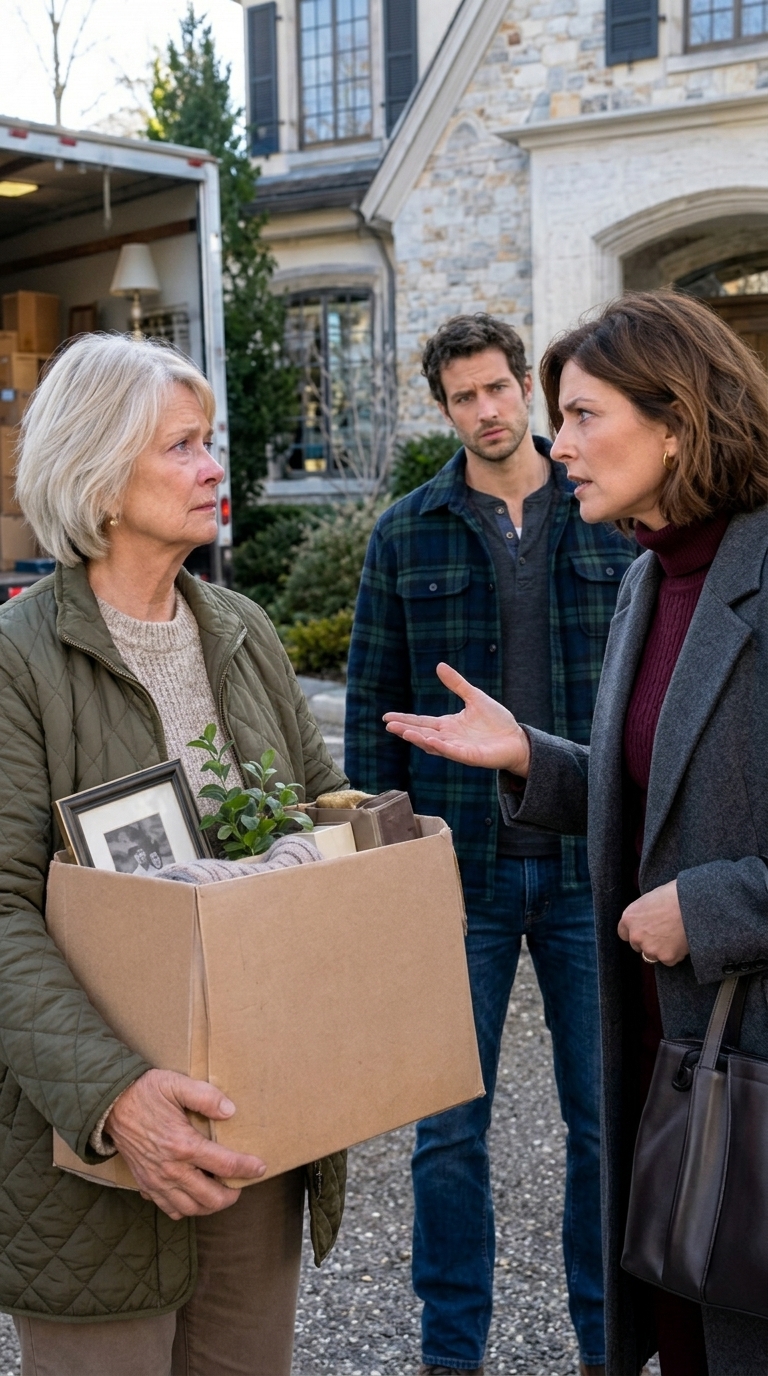
“I’m not putting things in storage, Catherine,” I said. “I’m moving.”
She stood on my driveway in her good quilted vest, one hand still on the door of the Highlander, and looked at the moving truck as if it had grown there overnight. In the back seat, Maddie, who was nine, pressed her face to the glass. Josie, six, was still coloring.
“Moving where?”
“To the cabin.”
Her whole face changed. Relief first, then confusion, then something sharper. “But Hal and Connie, ”
“Are not moving into the cabin. I am.”
“Mom, you can’t just, ”
“I sold the house.”
The words hung in the autumn air. A leaf drifted down onto the hood of her car. Catherine’s mouth opened, and for once in her life, she had nothing ready.
I should tell you who I am, because for sixty-four years I let other people answer that for me.
My name is Eleanor Voss. I taught fourth grade in Asheville for thirty-one years. I married Frederick Voss when I was twenty-six, a gentle, stubborn surveyor who measured the world in tenths of an inch and could never be hurried. We had one child, Catherine, born in 1988, after three losses I rarely mention. When she finally arrived, red-faced and furious, Frederick wept in the hallway.
In 1992, we bought the cabin in Asheford for forty-one thousand dollars. It sat on two acres of hardwood above a creek, one story, cedar siding, a stone chimney, a screened porch that caught the evening light. The roof leaked and the well was temperamental. Frederick fell in love with it in nine minutes. I fell in love watching him.
We spent thirty-two summers there. We built the deck ourselves. We learned the names of the birds. Every August, the three of us sat on that porch with a bowl of peaches and Frederick would say, “One day we’ll just stay.” We paid it off two years before he died, of a stroke, in the garden, on a Sunday in April.
I haven’t sold it. I haven’t changed a thing. It was the one place where his voice still lived.
Catherine grew into a capable, polished woman. A pharmaceutical sales manager, tall, quick, impatient with inefficiency. She married Brendan Hale at twenty-eight, a pleasant, vague man in commercial insurance who agreed with whoever spoke last. They had Maddie, then Josie, and for a long time I thought we were close.
What I realized, only later, was that our closeness had a direction. It flowed one way, like water downhill.
I did Tuesdays and Thursdays, school pickup. I kept their sports equipment in my mudroom because their garage was “full.” Catherine’s winter clothes occupied my guest room closet. When Brendan’s father, Hal, had a heart procedure, I drove to Raleigh three weeks running with casseroles, because Connie couldn’t manage alone. Nobody asked. Everyone assumed.
I told myself that’s what family is. I told myself that for years.
On the night of my birthday, Catherine took me to dinner at a restaurant I’d chosen. Brendan talked football. The girls colored on paper placemats. I’d ordered the trout and was three bites in when Catherine leaned forward and said, “Mom, we’ve been wanting to talk to you.”
You know the proposal. Hal and Connie, the townhouse stairs, the HOA fees. A single-story cabin with a garage, “that you hardly use.” They’d pay the electric and water. “It wouldn’t cost you a thing.”
I explained what the cabin was. Frederick. Thirty-two summers. The retirement we’d planned.
“But you have a perfectly good house,” Catherine said. “And your pension. You’re not exactly struggling.”
“It isn’t about struggling.”
“Then what is it about?”
“It’s about it being mine.”
She sat back. Her voice cooled. “You won’t be around forever, Mom. At some point, it’s going to be ours anyway. We’re just talking about using it now.”
Ours anyway. I looked at my daughter, whom I’d carried and nursed and taught to read, and understood that somewhere along the way she’d stopped seeing me as someone who owned things and started seeing me as someone who was holding them.
“Catherine,” I said. “This conversation is over. Not because I’m angry. Because I’m not doing it.”
“You’re being selfish.”
I set down my fork. “Happy birthday to me,” I said quietly.
I paid the check. I drove home with the radio off.
I want to describe what I saw when I walked into my house that night, because it was the real beginning.
The mudroom, with Maddie’s soccer bag, Josie’s cleats, a hockey stick nobody had touched in a year. The guest room, with Catherine’s coats, three boxes of her old files, a treadmill Brendan had never used. The refrigerator, stocked with the yogurt tubes I bought weekly for the girls. My calendar on the wall, with Tuesdays and Thursdays inked in my own handwriting.
I stood in the kitchen and counted. Not money. Hours. The pickups, the dinners, the Raleigh drives, the sick days. I’m a teacher; I grade things. I added it up and gave the total a mark.
It wasn’t a good mark.
Nobody had asked what I wanted for my birthday. Nobody had ever asked what I wanted at all.
Two days later, I drove to the cabin. I needed quiet.
The road climbs for forty minutes through hardwoods going gold. I parked at the carport, and breathed, and for the first time in a week, my shoulders came down. The creek was loud with early rain. A pileated woodpecker hammered somewhere above me.
I went to the tool shed to get the rake.
The door was ajar. Inside, stacked neatly against the back wall, sat four large moving boxes. Two were labeled in black marker: HAL & CONNIE, KITCHEN. One said BOOKS. The fourth, WINTER. Beside them stood a set of golf clubs in a battered bag, and a brand-new shower chair, still in plastic, with a price tag.
I stood very still.
Brendan had a spare key, for emergencies. I’d given it to him two years earlier, when I had pneumonia and was afraid of being found too late. Someone had used it. Someone had driven four boxes up this mountain, opened my shed, and arranged them like a quiet claim.
They hadn’t been asking. They’d been preparing.
I took photographs, every box, every label, the date on my phone. Then I walked up to the cabin and let myself in. Everything was as I’d left it. Frederick’s reading glasses on the mantel. His green mug in the drying rack. The afghan on the sofa.
I sat down on the couch and cried for ten minutes. Then I wiped my face and called a locksmith.
My second call was to Gloria Chen.
Gloria had sold Frederick and me the cabin in 1992, a brisk young agent with a blazer two sizes too big and a laugh you could hear across a parking lot. She was sixty now, silver-haired, still brisk, and she’d sold half of Buncombe County.
“Eleanor! Tell me you’re ready to list that mountain.”
“No,” I said. “It’s another property.”
A pause. “Which?”
“My house. The one on Willow Lane.”
Gloria was quiet for a long breath. “Honey. Are you sure?”
“I’ve never been surer.”
“What’s happened?”
I told her. Briefly. The dinner, the shed, the key. She listened, and when I finished she said, in her gentlest voice, “I’ll come by tomorrow. We’ll walk through it. And Eleanor?”
“Yes?”
“I think Frederick would be proud.”
I laughed, damply. “He’d say it was a sensible plan.”
“He’d say you should have done it ten years ago.”
She came on a Friday, in the same oversized blazer, with a folder under her arm. We walked through the rooms I’d lived in for twenty-nine years, the kitchen where Catherine learned to bake, the den where Frederick read the newspaper aloud. Gloria made notes. She didn’t rush. At the end, we sat at my dining table with tea.
“Market’s strong,” she said. “Willow Lane’s a good school district. I’d list at four hundred and eighty.”
“That seems high.”
“It’s right. I’ve already had two calls.” She smiled. “Do you want to sell quickly?”
“I’d like it done before winter.”
“That’s doable. Cash buyers, maybe. A young couple from Charlotte’s been looking.”
I turned my cup in its saucer. “And the contents?”
“Estate company, or you can sell it yourself. Or donate.” She studied me. “Eleanor, what are you actually going to do?”
“I’m going to live at the cabin. Year-round. I’ve wanted to since Frederick died. I just never believed I was allowed.”
“Who told you you weren’t?”
“Nobody.” I shook my head slowly. “That was the trouble. Nobody ever had to.”
I told no one.
Catherine stopped calling. For eleven days, silence, the kind she’d used on me since she was fourteen. Her theory, I think, was that I’d crack. That I’d phone, contrite, and say, “Fine, fine, tell Hal and Connie to come.”
I didn’t crack. I packed.
I’d forgotten how much a life contains. Thirty years of recipe cards. Catherine’s third-grade drawings. Frederick’s field notebooks, in his tiny, exact script, which I handled like holy things. I wrapped my mother’s blue-and-white dishes in newspaper. I sorted the books, the quilts, the winter coats. I gave away the treadmill. I mailed Catherine a box of her old files with a note: Please come get your things. She didn’t respond.
Day nineteen, she called. Not to apologize.
“Mom, I need you to take the girls Thursday. Brendan has a work thing, and I’ve got a client dinner.”
“I’m busy Thursday.”
“Busy with what?”
“Things.”
A silence. “Things more important than your granddaughters?”
“Different things.”
She exhaled, a long, brittle sound. “Fine. I’ll figure it out.”
I hung up. My heart was pounding. I sat for a long time, with my hand on the phone. Then I picked up the next box, labeled it, and kept going.
It was the hardest thing I’ve ever done. Not the selling. The not-answering. Twenty-nine years of a daughter’s emergencies had taught my body to flinch at the ringtone.
The sale closed on the thirty-ninth day.
I signed at Gloria’s office, with a young couple named Theo and Anya Park, who’d driven up from Charlotte with a toddler and an enormous enthusiasm for the pantry. Anya cried a little at the kitchen. Theo shook my hand with both of his.
“We’ll take good care of it,” he said.
“I know you will.”
“We’ll keep the maple.”
“Frederick planted that.”
His eyes went wide. “We’ll keep it forever.”
The movers came on the forty-fifth day. A big crew, quick and gentle, with a foreman named Luis who wrapped Frederick’s desk in three quilts. I’d given Catherine, Brendan, and the girls no warning. On the forty-seventh day, at two in the afternoon, I was carrying a box marked KITCHEN, FRAGILE down my front steps when a gray Highlander pulled into the drive.
You know the rest. Maddie’s face against the window. Catherine’s hand on the door.
“What happened?” she said, hollowly. “Where is everything?”
“I told you. I sold the house.”
“You sold it?”
“On the twelfth. It closed Thursday.”
“Without telling me?”
“Yes.”
She stared at the bare windows, the emptied porch, the spot on the lawn where Frederick’s bird feeder used to hang. Her face went through three colors.
“Mom, that’s, that’s insane. That was our, that’s where the girls, where I grew up, ”
“It was my home. Now it’s someone else’s.”
“You can’t just, ” She stopped. Her voice dropped. “Where will you live?”
“I told you. The cabin.”
Something flickered across her face. Not hurt. Calculation. I watched her work it out: the cabin is hers now, entirely. There’s no spare house, no fallback, no Hal and Connie.
“Mom,” she said, very carefully. “Let’s not do anything we’ll regret.”
“I’ve done nothing I regret.”
Brendan had gotten out of the passenger side. He stood on the lawn with his hands in his pockets, looking at the ground, and when I met his eyes, he flushed to the roots of his hair.
“Brendan,” I said. “I found the boxes.”
He closed his eyes.
“In the shed. Your parents’ kitchen things. Your father’s golf clubs. A shower chair with the tag still on.”
“Eleanor, ”
“You used the key I gave you for emergencies.”
“It wasn’t, ” He rubbed his neck. “Catherine said it was basically settled. That you were just, that you’d come around. She said it’d be easier to have things in place.”
“Catherine said.”
“Yes.”
“And you agreed.”
“I, ” He glanced at his wife. She was staring straight ahead. “I thought it’d work out. I didn’t want to, I should have called. I’m sorry.”
It was a pale, honest sentence. I’d heard it from him before, in other contexts, and each time it was true and each time it changed nothing.
“I’d like the key back,” I said.
He fished it out of his pocket. His fingers trembled. He set it in my palm.
“Thank you.”
“I’m so sorry, Eleanor.”
“I know you are. It’s your habit.”
He flinched. But he didn’t argue.
“Mom.” Catherine’s voice had gone thin. “Can we talk? Not here. Inside.”
“There’s no inside.”
“Then in the car.”
“No.”
“Mom, please.”
I set down my box on the porch steps. I looked at the two girls in the back seat, Maddie, with Frederick’s gray eyes, and Josie, pressed against the glass with a crayon in her fist.
“Girls,” I called. “Come here.”
They tumbled out. Josie hit me at the waist, nearly knocking the wind out. Maddie hung back a moment, then walked slowly into my arms.
“Grandma,” she whispered. “Is it true? You’re moving?”
“To the mountains.”
“Where the creek is?”
“The very same.”
“Can we come?”
“Any time. Every weekend, if your mother says yes.”
Josie looked up. “Will there be peaches?”
I laughed, in spite of myself. “In August. There’s a tree.”
“I want to be there for the peaches.”
“You’ll be there for the peaches.”
I kissed their heads. Over them, I looked at Catherine, who stood by the car with her arms wrapped around herself, in her expensive vest, looking, for the first time in years, like a frightened child.
“I’d like to have lunch with you,” I said. “Next week. Just us. At the cabin. If you’ll come.”
“Just us?”
“Just us.”
“And Hal and Connie?”
“Not this time.”
She blinked rapidly. “Okay,” she said. “Okay.”
The cabin in October is a different place.
The leaves had turned, a long drift of crimson and gold down the hillside. The creek ran high. Smoke curled from the stone chimney, because I’d lit a fire that morning, the first of the season. On the porch, I’d set out two chairs and a small table with a pot of coffee and a plate of lemon bars.
Catherine arrived at noon. She parked beside my car, sat for a long while behind the wheel, and finally got out. She wore jeans and a plain sweater, her hair unpinned. She looked smaller than I remembered.
She climbed the porch steps slowly. She stopped at the top.
“It smells like Dad.”
“It’s the wood smoke. And his pipe tobacco. It’s soaked into the beams.”
“I’d forgotten.”
“I haven’t.”
She sat. I poured coffee. For a while, neither of us spoke. A woodpecker started up on the hillside. The creek ran. A single leaf floated down onto the table, and she picked it up and turned it over.
“I’m so angry at you,” she said finally.
“I know.”
“You sold the house. You didn’t tell me. You, you left.”
“Yes.”
“I didn’t know where to put that. I’ve been furious for a week. I’ve been rehearsing things to say.” She laughed, shakily. “I had a speech.”
“What was in it?”
“That you’d humiliated me. That you’d made me look like a fool in front of Brendan. That I’d done nothing but ask for help.” Her chin trembled. “And then I drove up here. And I saw Dad’s rocking chair on the porch. And I couldn’t remember the speech.”
I waited.
“I think I owe you an apology,” she said.
“I’d like to hear it.”
She set down the leaf. She folded her hands. They were shaking.
“I’ve been treating you like a resource,” she said. “For years. And I called it closeness. You did everything, Tuesdays and Thursdays, the girls, Hal’s surgery. And I never once said thank you. Not really. I thought, it’s what mothers do.”
“It is what mothers do. But it’s not all we are.”
“I know that now.” She wiped her eyes. “When you said no, about the cabin, I felt, I don’t know. Rejected. As though you’d chosen a building over us. And I lashed out.”
“You said I wouldn’t be around forever.”
She winced. “God. I did.”
“You meant that the cabin would be yours.”
“I meant, ” She stopped. “I meant I was afraid of losing you. And it came out wrong. It came out as greed.”
I looked at her. At her father’s long fingers, her mother’s stubborn jaw.
“Catherine,” I said. “Do you know why I wouldn’t give it to Hal and Connie?”
“Because it’s yours.”
“Because it’s your father’s. It’s the last place he’s in.” My voice shook. “I couldn’t hand it to strangers. I couldn’t let a shower chair stand where he used to sit.”
She was crying openly now, silently, her shoulders heaving.
“I’m so sorry,” she whispered.
“I know.”
“Can you forgive me?”
“I forgave you in the driveway,” I said. “I just needed you to find your own way here.”
We stayed on the porch until dusk.
She told me about Brendan’s parents, who were, it turned out, in genuine trouble, not a crisis, but a slow squeeze. A pension that didn’t stretch. A townhouse they’d been trying to sell for a year. They’d never actually asked for the cabin. Catherine had offered it, in a burst of competitive generosity, because she wanted to be the daughter-in-law who solved things.
“I wanted them to like me,” she said. “I wanted to fix it. And I thought, Mom has a spare house. It’s not even used.”
“It’s used.”
“I know. By you.” She smiled ruefully. “I was wrong.”
“What will they do?”
“I don’t know. Brendan and I talked. We’re going to help them downsize. A one-bedroom near us, with an elevator. We’ll cover the difference for a year, until Hal’s pension kicks in.”
“That’s generous.”
“It’s what I should have done first.” She laughed. “Instead of raiding my mother’s shed.”
I laughed too. It was the first real laughter in months, a warm, startled thing, rising off the porch into the cooling air.
It’s been two years since the forty-seventh day.
I live at the cabin year-round now. I’ve added a woodstove and a proper insulated door. I put in a small garden, tomatoes, beans, a row of zinnias for the bees. I walk the creek trail every morning with a thermos and a field guide, and I’m up to sixty-one species of birds. Frederick, I think, would be insufferably proud.
I kept the afghan on the couch. I kept his green mug, which I use every morning. I kept the rocking chair, though I’ve learned to sit in it.
Catherine and the girls come on alternate weekends. They call first. They bring groceries, not the yogurt tubes, but bread and cheese and a good bottle of wine. Maddie, who is eleven, has taken up birdwatching, and keeps a notebook in her father’s old handwriting. Josie, eight, has appointed herself keeper of the peach tree, and checks the fruit with grave suspicion every July.
Brendan visits, too, though he’s quieter than he used to be. Last spring he drove up alone, with a toolbox, and replaced the rotted boards on the deck without being asked. He worked all afternoon in the sun, shirtless and sunburned and a little clumsy. At dusk, I brought him iced tea.
“I’m sorry about the key,” he said.
“You’ve said.”
“I know. I just, I need to keep saying it.” He took a long drink. “I’m learning that I don’t get to decide what’s easier. Not for other people.”
“That’s a good lesson.”
“It’s taken me thirty-seven years.”
“Better late than never.”
He grinned. It was the first time I’d seen him look at me directly in a long while.
Hal and Connie came in August.
Catherine arranged it, and I agreed, with some trepidation. They arrived in a rented sedan, a pair of white-haired, anxious people in their late sixties, clutching a pie. Connie, a small round woman in a sun hat, stood at the foot of my porch steps and said, in a quavering voice, “Eleanor, I want to apologize.”
“For what?”
“For not saying anything. When Catherine told us about the cabin. I knew it wasn’t right.” She wrung her hands. “Hal said, ‘Let the kids handle it,’ and I let him. But I should have called you.”
“You didn’t know what was in the shed?”
“We didn’t know about the shed. Not until later.” Her eyes filled. “Brendan told us. We were mortified.”
I looked at her, this gentle, flustered woman who’d once wept with gratitude over a casserole. I thought of her knees on the townhouse stairs.
“Come up,” I said. “Sit down. It’s a long climb.”
They sat on the porch, in the afternoon light, with pie and coffee. Hal, a lanky man with a quiet, dry humor, admired the creek. Connie asked about the birds. Within an hour, they were arguing amiably about whether a wren was a wren.
At dusk, as they were leaving, Hal paused at the bottom of the steps.
“Eleanor,” he said. “I’d like to say something.”
“Go ahead.”
“It’s a beautiful place.” He cleared his throat. “I understand why you couldn’t share it. I wouldn’t have either.”
“Thank you.”
“I just wanted to tell you, from one old man to another, you did the right thing.”
I felt my throat tighten. “It didn’t feel like it.”
“Right things rarely do,” said Hal. “That’s how you know.”
Last week, I sat on the porch at sunset with a mug of tea and a blanket on my knees.
The valley below was turning gold. The creek ran steadily over its stones. A pair of wood thrushes sang from the laurel, that liquid, bell-like double note I’d waited thirty years to learn to recognize.
I thought of Frederick. Of the long Augusts, the peaches, the sound of his voice. One day we’ll just stay.
I’d always imagined we would do it together. I hadn’t imagined doing it alone, at sixty-six, after selling a house and losing a year of my daughter’s trust.
But I’d done it.
In the quiet, I said aloud, to the dusk and the thrushes and the empty chair beside mine, “We stayed, Freddie.”
The wind moved in the hardwoods. A branch ticked against the roof. And I swear to you, I felt a hand on my shoulder, warm and brief, the touch of a man who measured the world in tenths of an inch and had finally, patiently, arrived.
I closed my eyes.
It was enough.
Down the mountain, the headlights of a gray Highlander turned onto my road, climbing slowly through the dark, bringing two small girls who were certain, absolutely certain, that tonight there would be peaches.
There wouldn’t be. It was October.
But I’d bought some at the store, just in case.